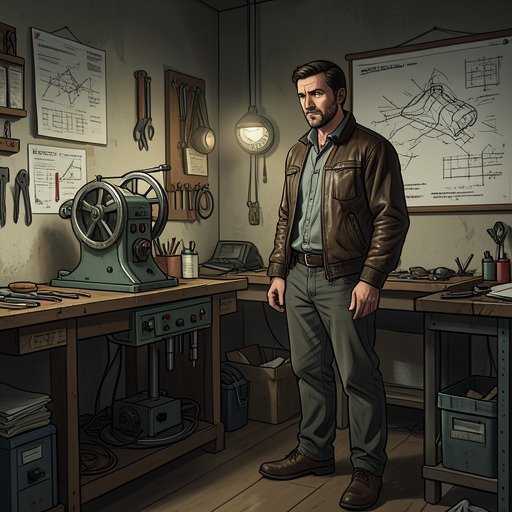
Plug-in component principle
The Door into SummerThe Plug-in component principle is Dan Davis’s design rule for making household machinery easier to keep working: replace a faulty component instead of repairing it in place. Adapted from military practice, it turns reliability into a question of modular construction, spare parts, and timely substitution—and places practical engineering, not novelty alone, at the center of invention.
Definition and Military Precedent
Davis introduces the principle against the ordinary vulnerability of domestic gadgets. Even well-designed machines can fail, and a house full of devices will inevitably contain some that are out of order. Military equipment offers a precedent for treating breakdown as a problem that must not interrupt a larger task: military designers use measures such as fail-safe systems and standby circuits, but the household-relevant solution Davis singles out is the plug-in component principle.
Its rule is deliberately simple: do not repair the failed part while the machine sits idle; replace it. The aim is not to make machinery immune to failure, but to keep a failure from becoming prolonged downtime. The distinction shifts attention from the isolated machine to the maintenance system around it, including the availability of interchangeable components.
Window Willie and Modular Maintenance
Davis applies the rule to Window Willie, intending to make every component liable to failure a plug-in unit and to include replacement components with each machine. A defective unit could be discarded or sent away for repair, while a replacement restored Willie to service. The design thus separates the user’s immediate need—a working machine—from the later handling of the faulty part.
This approach follows Davis’s wider preference for durable, practical devices over gadgets that cause their owners frustration. It also reflects his method of building from existing technologies rather than treating invention as the creation of every part from scratch. In developing Hired Girl, he combined an “Electric Turtles” prowl pattern, a memory circuit taken from a guided missile, and cleaning mechanisms and linkages drawn from multiple devices. He considered the arrangement of those pieces, and the production engineering that made them usable, more consequential than any single component.
The same emphasis on workable construction shaped the economics of Hired Girl. Its production relied largely on standard parts available through Sweet’s Catalogue; only two three-dimensional cams and one printed circuit fell outside that approach. The modular ideal therefore belongs to a larger engineering outlook in which machines should be buildable, maintainable, and capable of reaching users at a viable cost.
Engineering Judgment and Business Conflict
The principle also bears on the dispute over when Window Willie should move from a pilot model into production. Davis considered that timing an engineering decision; Miles Gentry considered it a business decision. For Davis, releasing Willie before its design was ready risked making it as unreliable as the “sickly, half-engineered” labor-saving gadgets he wanted to improve. Replaceability was not a substitute for sound design: it was one way to manage faults while keeping the machine useful.
Belle Darkin eased the disagreement. Davis acknowledged that her influence mattered to him and that, without her intervention, he might have yielded to Miles and let sales begin before he was satisfied with the engineering. The episode makes the principle part of a conflict over control as well as maintenance: the person deciding when a device is ready determines how much reliability the customer can expect.
A Continuing Engineering Method
Davis’s later work extends this practical approach from replaceable parts to programmable machines. In explaining Flexible Frank, he describes Thorsen memory tubes that can record an operation performed under manual control and repeat it without supervision. A second circuit hunts for specified conditions and can interrupt the stored routine when the situation differs from the expected cycle. The example of clearing a table makes the method concrete: the machine can learn a sequence once, or use a duplicated tube to handle dirty dishes the first time it encounters them.
When Davis returns to invention in 1970, he first builds Drafting Dan to avoid the slow compass-and-T-square design routine, then develops Protean Pete as an all-purpose automaton directed by Thorsen tubes. He expects later descendants to become specialized devices, but seeks broad patent claims and working models that can demonstrate both practicality and production economy. These developments are not the plug-in principle itself; they show the same concern with how components, instructions, and available technology combine into a useful system.
The principle’s significance lies in its modesty. It promises neither a machine that never fails nor a miraculous leap beyond contemporary engineering. Instead, it turns failure into a manageable interruption, while insisting that design, production, and maintenance be considered together. For Davis, a device succeeds not simply because it can perform a task, but because it can keep performing it in the real conditions of use.