Protean Pete
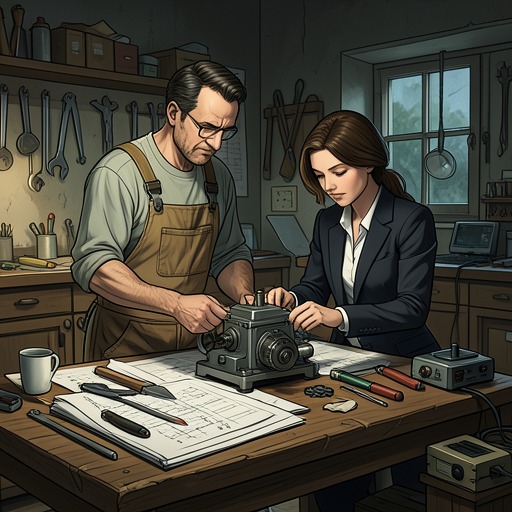
The Door into SummerProtean Pete is Dan Davis’s all-purpose automaton, designed to perform almost anything a man can do when its Thorsen tubes are properly instructed. Conceived first as a broad commercial invention and then brought into domestic use, it embodies a distinction at the heart of Dan’s design: the machine’s capacity is expansive, but each new task depends on deliberate teaching.
Design and Intended Scope
Dan built Drafting Dan before rebuilding Flexible Frank because designing by the old compass-and-T-square method consumed time he could not spare. The rebuilt machine became Protean Pete, linked to undertake a wide range of human tasks so long as its Thorsen tubes received the right instructions. Dan expected this all-purpose design not to remain a single, universal form indefinitely. He imagined its descendants evolving into a host of specialized gadgets, but wanted the initial patent claims to be as broad as possible.
The device was not merely a patent concept. Dan wanted working models that could be demonstrated reliably, both to show that they functioned and to make their commercial value visible. In his view, practical performance and economy of eventual production mattered alongside technical possibility: patent filings were full of inventions that worked but were commercially worthless. Protean Pete’s usefulness therefore had to be legible in the machine itself, not asserted in drawings alone.
Construction and Demonstration
Dan worked quickly because he already knew what he wanted to build, but slowly because he lacked a proper machine shop and assistance. He eventually used some of his limited cash to rent machine tools. He worked from breakfast until exhaustion, seven days a week, with only occasional weekends spent with John and Jenny. By the first of September, Protean Pete and Drafting Dan were both working properly.
The machines’ appearance and construction reflected Dan’s tight budget and commercial aims. He relied heavily on catalogue-available standard components, which made the designs feasible to build and helped keep them commercially practical. He paid to have speckle-lacquer cover plates made and the external moving parts chrome-plated, but those were the only jobs he sent out. Though reluctant to spend money on custom-made prettiness, he judged the finished models’ presentation worth the expense because they needed to sell themselves as workable, economical products.
When Dan demonstrated the machines to John and Jenny, the contrast between their interests revealed Protean Pete’s range. Jenny, who kept house with a Mark II Hired Girl, was not much impressed by Drafting Dan but was wide-eyed over Protean Pete and could see how much more it could do. John, by contrast, recognized Drafting Dan’s significance as an engineering tool. Together, their reactions placed Protean Pete’s appeal beside a second, more specialized vision of automation rather than making the two machines interchangeable.
Programming and Household Work
Protean Pete’s versatility did not mean that it could perform every task immediately. Dan explained that he had never programmed it to wash dishes. Teaching the task properly would take several hours, because dishwashing required alternate choices and judgment rather than a comparatively simple routine such as laying bricks or driving a truck. Once learned, however, the task would remain within the machine’s abilities. The example makes instruction, not just mechanical capacity, the hinge between a possible use and an accomplished one.
Jenny’s reaction to that explanation drew attention to the gendered labor the machine might take on: she was glad to find that a man understood housework, but told Dan not to stop and teach the machine at that moment, since she would do the dishes herself. She also remarked on how untidy Dan’s living quarters were. Her visit exposed a gap in his thinking: he had concentrated on training Protean Pete for other people’s commercial work without considering how it could work for him.
That recognition changed how Dan used the machine. He had been sweeping dirt into a corner or ignoring it while planning commercial applications; he now began teaching Protean Pete the household tasks that Flexible Frank had learned. The new machine had three times as many Thorsen tubes as Flexible Frank, giving it the capacity for this expanded instruction. Its domestic role thus grew not from an abstract claim of unlimited intelligence, but from Dan’s recognition that household work was another body of tasks the machine could learn.
Significance and Limits
Protean Pete joins a commercial ambition to a domestic possibility. Dan first imagines a general-purpose platform whose descendants will divide into specialized devices; the machine’s breadth is a starting point, not a promise that every future device will remain all-purpose. Its practical demonstration and reliance on standard components also connect versatility to manufacturability: a machine that can do many things still has to work dependably and make economic sense.
The episodes of instruction qualify the apparent expansiveness of its design. Protean Pete can be taught to wash dishes, but the task is not automatic simply because the machine is powerful or adaptable; Dan must invest hours in programming judgment, and household labor becomes visible only when Jenny’s visit turns his attention toward it. In this way, the automaton alters Dan’s conception of his invention as well as his routine. Built to work for other people, it becomes a means of changing the neglected conditions of his own life.