Thornton Memorial Laboratory
The Door into SummerThornton Memorial Laboratory is the university laboratory where Dr. Twitchell’s time-displacement experiment is tested and where Dan Davis is sent thirty-one years and three weeks into the past. Its importance lies not simply in housing an extraordinary machine: the scene makes the apparatus’s reality turn on a practical question of power, a pilot switch, and Davis’s deliberate challenge to the scientist who controls it.
Setting and Equipment
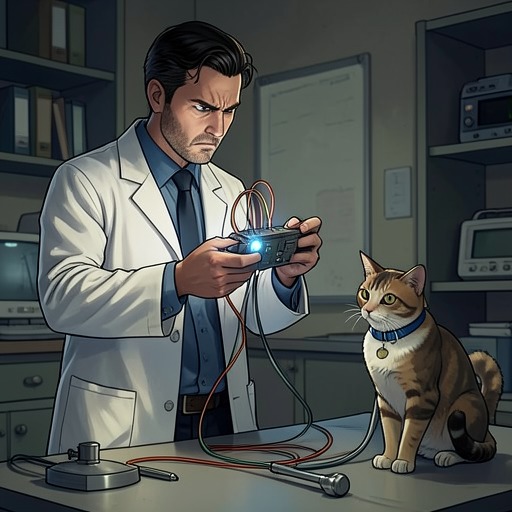
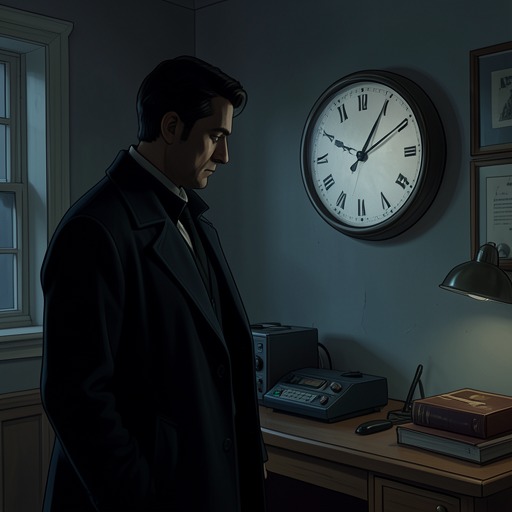
The laboratory is equipped for an experiment that requires substantial electrical power. When Twitchell is told that he lacks the power to proceed, he goes to a corner and uses a telephone that appears to have been installed when the laboratory was new. He calls the night superintendent of the university powerhouse, insists that his instructions be followed, and orders emergency full power across the laboratory bus bars in eight minutes. The exchange establishes both the experiment’s dependence on institutional infrastructure and Twitchell’s ability to claim access to it.
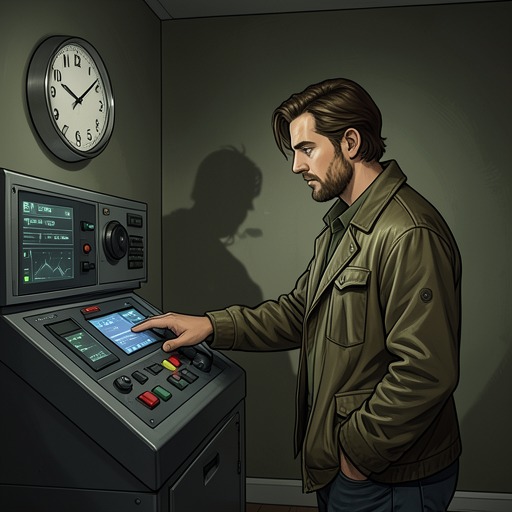
Once the power arrives, the equipment gives visible signs of readiness: Twitchell adjusts the control board, three sets of meter hands swing across their dials, and a red light comes on. Yet the room’s charged appearance does not itself produce the displacement. Twitchell explains that nothing will happen until he closes the pilot switch. The distinction between energized apparatus and activated apparatus makes the final action—not the spectacle of the meters—the decisive threshold.
The Experiment and Its Doubt
Davis has come to investigate a remarkable rumor, but the control board and its lights do not persuade him. He dismisses the apparatus as a theatrical-looking set and treats Twitchell’s demonstration with coins as a weak parlor trick, since Twitchell selected the coins and told him how to mark them. Davis also reports that the government department has not suppressed Twitchell’s report; it has filed it in what Davis calls the screwball file, where it is occasionally brought out for amusement. The laboratory therefore stages a conflict between an experiment’s claimed significance and the institutions and observers that refuse to take it seriously.
Twitchell warns Davis that closing the pilot switch would displace him precisely thirty-one years and three weeks. Davis answers that nothing will happen, and his contempt escalates into personal insults, including calling Twitchell a faker. His provocation is not a detached scientific test: he means to force the issue by striking at the scientist’s vanity. When Twitchell finally stabs at the button, Davis tries to stop him, but the activation is already under way.
Displacement and Consequences
The apparatus’s operation is abrupt. Davis feels himself falling and lands hard, describing a fall of only a few feet but one for which he is wholly unprepared. His last thought before the displacement is remorse: he has rejected the experiment, tormented an old man who had done him no harm, and cannot be sure either where he is going or whether he can reach it. The change from argument to bodily impact gives the laboratory scene its force: a disputed claim becomes an irreversible event before Davis can withdraw his challenge.
The displacement sends Davis back to 1970 and opens the next phase of his life. The laboratory is thus the point where a past he has not yet chosen becomes his actual destination. Its significance is also sharpened by the ordinary means through which the extraordinary event is presented: an old telephone, a call to a power superintendent, instructions repeated and confirmed, meters moving, and a switch. The apparatus does not become credible through explanation alone; the plot makes its reality evident through what happens to Davis when it is activated.
Narrative Significance
The laboratory scene is narrated retrospectively by Davis, whose account preserves both his confident skepticism before activation and his immediate recognition, too late, that the experiment may be real. That sequence keeps the reader close to his misjudgment without making the experiment’s success a foregone conclusion. The scene’s tension depends on a short delay: the laboratory receives its power, the meters respond, and still nothing happens until the pilot switch is closed.
The room also links technical possibility to the limits of what a given time can recognize. Twitchell’s work has been filed away as a joke by the department, yet its operation changes the course of Davis’s life. The laboratory is not merely the backdrop to time travel; it is the institutional and material setting where an ignored claim acquires consequences, and where Davis’s attempt to expose a fraud instead carries him into the past.