United States Army
The Door into SummerThe United States Army is central to the history of cold sleep and to Dan Davis’s formation as an engineer. Its wartime research makes large-scale human hibernation practical, and its culture of technical mobilization stands in sharp contrast to Davis’s determination to leave the service and become his own boss.
Wartime Service and Personal Independence
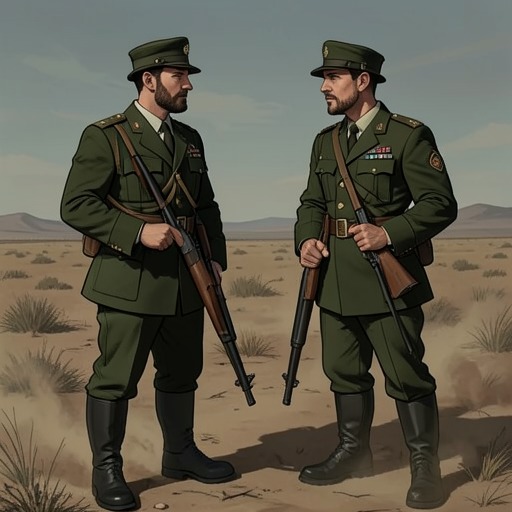
Davis has a mechanical-engineering degree when the Six Weeks War begins, but he does not use it to seek a commission. His father, Daniel Boone Davis, had stood for personal liberty and self-reliance; after his father’s death under brainwashing in North Korea, Davis carries forward an aversion to taking orders, giving them, or living by a schedule. He intends to serve his hitch and get out rather than build a military career.
When the Cold War boils over, Davis is a sergeant-technician at Sandia Weapons Center in New Mexico, working on atomic weapons and planning what he will do after his service. On the day Sandia disappears, he is in Dallas drawing a fresh supply of Schrecklichkeit; the fallout moves toward Oklahoma City, and he survives to draw his military benefits. The war thus takes him close to catastrophe without ending his life, leaving him with both technical experience and the freedom to choose a civilian course.
Military Research and Cold Sleep
The Army’s wartime logistics and medical research teams transform human cooling from a laboratory curiosity or last-resort therapy into a system for preserving personnel until needed. The military had divisions hidden at Thule and elsewhere, and cold sleep expands the possibility of storing people for later deployment. Davis credits the results to the scale of military research: with enough money, personnel, scientists, and engineers, even an inefficient process can eventually produce answers.
The procedure first drugs and hypnotizes a subject, then cools the body and holds it at precisely four degrees centigrade, the temperature at which water is densest and ice crystals do not form. Awakening can be accelerated by diathermy and posthypnotic command: the process took seven minutes at Nome, though such speed risks tissue aging and impaired intelligence. When time permits, two hours is preferable. The fast method is a calculated risk, a distinction that makes clear that military readiness comes with bodily costs.
The enemy has not anticipated this capability. After the war, Davis is paid off rather than liquidated or sent to a slave camp; he and his Army buddy Miles Gentry enter business around the time insurance companies begin selling cold sleep. The Army’s research therefore outlives its immediate military purpose, passing into the civilian economy and the next phase of Davis’s life.
From Military Engineering to Civilian Invention
Davis’s later inventions draw on technical knowledge and components associated with military systems. In developing Hired Girl, he adapts a basic search pattern from the Electric Turtles described in Scientific American, takes a memory circuit from a guided missile, and combines cleaning mechanisms from varied devices, including equipment used in Army hospitals and remote manipulators from atomic facilities. His account emphasizes assembly and production engineering rather than a wholly unprecedented component: the design becomes useful through the way existing technologies are put together.
The military connection recurs in his work on Flexible Frank. Thorsen memory tubes, used in intercontinental missiles and traffic-control systems, can record a manually demonstrated operation and direct a machine to repeat it. Additional circuits let the automaton search for specified conditions and interrupt its routine when circumstances do not match the recorded cycle. Davis uses this capability to make household tasks repeatable and adaptable, extending a technology associated with military guidance into domestic automation.
Military experience informs his practical sense of what engineering can accomplish, but it does not make him eager to remain in large institutions. When Miles pushes for expansion, Davis proposes licensing Hired Girl and Window Willie and reducing the company to a small research operation, so that he can concentrate on invention rather than production problems. He wants to escape the growth of a business that might resemble the organizations he rejected as a young engineer; military service supplies expertise, but his defining ambition is independence from institutional command.
Institutional Legacy
The Army’s role in the novel is both material and consequential: wartime investment produces a method that first serves military logistics, then becomes a commercial cold-sleep service with legal and financial structures of its own. A cold-sleep client remains alive but helpless and legally in chancery, so the institution’s technical achievement also creates a need for court oversight and custodial protection. The story’s later exposure of the collapse of Master Insurance shows how little bodily continuity alone can guarantee: Davis awakens to learn that his assets have vanished when the insurer is looted and goes bankrupt.
The Army does not control Davis’s civilian inventions, but its research world supplies part of their technical inheritance. Missile memory circuits and automated systems migrate into machines for cleaning, drawing, and household work. That movement from weapons research to domestic labor echoes Davis’s own passage out of military service: the same technical imagination that helped preserve soldiers becomes a means of building practical devices, while his insistence on self-direction resists the large organizations that made such advances possible.