Death of Yuriko Tajima
The Final CurtainYuriko Tajima’s death is both a personal loss and the belated opening of a family history that had remained largely unspoken. Found alone in her apartment, she is presumed to have died of heart failure, and no autopsy is performed. Yet the practical work that follows—telling those who knew her, arranging a funeral, and deciding what to do with her ashes—brings her estranged son, Kyoichiro Kaga, into contact with people who can help him understand the life she lived after leaving his family.
Discovery and determination of cause
After receiving no answer from inside Yuriko’s apartment, Yasuyo Miyamoto called the real estate company. About thirty minutes later, a representative let her in, and she found Yuriko on the kitchen floor. Yasuyo went to her friend and began to weep. The police took the body away, but the apartment showed no sign of disturbance; the detective considered both criminal involvement and suicide unlikely.
The police returned Yuriko’s body the following day without conducting an autopsy. They estimated that she had been dead for two days when she was found. Blood tests revealed nothing suspicious, and a hospital doctor considered heart failure the likeliest cause, possibly related to a preexisting condition. This remained a medical estimate rather than a conclusion established by an autopsy.
The funeral and the burden of practical care
The account of Yuriko’s death quickly becomes an account of the responsibilities left to the living. Yasuyo felt remorse that she had not insisted Yuriko see a doctor, then took it upon herself to arrange a funeral. Yuriko’s phone offered a small, stark measure of her isolation: its contacts included Yasuyo, the restaurant and Seven, Yuriko’s hairdresser, and about fifteen regular customers from the bar. Its call log showed no outgoing calls during the previous two weeks, and the only incoming calls had been from Yasuyo.
Yasuyo contacted Shunichi Watabe, Yuriko’s former partner, to tell him she had died and to ask for help with the arrangements. When he seemed ready to end the call, Yasuyo appealed to him not to hang up, explaining that she did not know what to do with Yuriko’s ashes. Watabe said he had an idea and promised to get in touch, but in the days that followed he did not answer her repeated calls. Yasuyo feared he had withdrawn from the responsibility.
The funeral was held the next day in the smallest room at the local funeral hall. A few of the regulars from Seven came, but the service was modest and sad. After the cremation, Yasuyo took Yuriko’s ashes home. As Yuriko’s guarantor, she was also responsible for clearing out the apartment, and she did not know whether she should discard Yuriko’s belongings. The urn and the unclaimed apartment left the practical question of what to do with the dead inseparable from the question of who would acknowledge her life.
Kaga’s arrival and the unfinished farewell
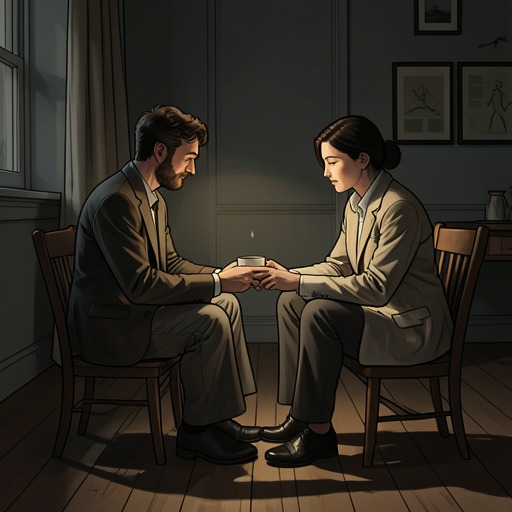
Yasuyo eventually reached Kaga. He identified himself as Yuriko Tajima’s son and thanked Yasuyo for what she had done for his mother. When he visited, he stood before the household altar, offered incense and a prayer, then bowed deeply to Yasuyo. The gesture gave him a place in the mourning that had initially been organized by his mother’s friend and bar customers, while making clear how much time had passed without a proper farewell.
The service remained an open question even after Kaga’s first visit. Later, he told Shuhei Matsumiya that no one had ever organized a proper memorial service for Yuriko. Kaga was not naturally drawn to memorials, and he would consider arranging one only after making progress on the case. His hesitation does not erase the need for remembrance; it shows that his pursuit of the circumstances surrounding his mother’s life and death is bound up with the possibility of honoring her.
The history disclosed through loss
Kaga’s questions turn Yuriko’s death into a search for the emotional conditions behind her long absence. His father had believed that, after Kaga’s grandmother died, Yuriko lost her strongest source of support and was left alone with a changed mental state. Kaga was still too young to offer meaningful help, and his father did not understand the change until much later. He remembered Yuriko breaking down at the dinner table, calling herself a failure as a person, wife, and mother, then recovering and asking the family to forget what she had said.
The family’s later understanding is shaped by guilt as well as grief. Kaga said his father believed he was to blame for not helping Yuriko through her mental health difficulties. He also believed that she might have wanted to see her son once, even briefly, before she died; that possibility caused him physical pain. Kaga’s own uncertainty remains visible when he hears the suggestion that he was in his mother’s thoughts at the end. He wants to know what emotional state she was in, but cannot claim certainty about what she thought as she died.
A letter from Watabe, delivered to Kaga through Hiromi Asai and passed on by Tokiko Kanamori, offers a fuller account of Yuriko’s life in Sendai. Watabe described himself as her long-term partner and explained that Yuriko had spoken of her family only after they had known one another for more than a year. In her telling, she had felt like a burden to her husband, blamed herself for conflict with her in-laws and for her mother’s death, and came to doubt her ability to raise a child. Watabe believed she had developed clinical depression, though at the time she understood her suffering as proof that she was a failure. He wrote that thoughts of suicide had become an unhealthy obsession, and that the sight of her sleeping son had once brought her back from the brink because she worried who would care for him.
The letter does not undo the years of separation or establish everything Yuriko felt at the end. Instead, it gives Kaga evidence of a life that had continued beyond the family’s reach, while showing how love, shame, and isolation could coexist in her account of herself. Her death first appears quiet and medically unexplained; its aftermath reveals the heavier question left to her son: how to mourn someone he loved but did not fully know.
Narrative significance
The discovery and funeral form a chain of small acts of belated recognition: Yasuyo enters the silent apartment, calls Watabe, gathers the bar’s regulars, keeps the ashes, and eventually welcomes Kaga to the altar. Each action addresses an immediate obligation, but together they restore relationships that Yuriko’s death might otherwise have left dispersed and unacknowledged. The ashes become not only a practical responsibility but also the focus of Yasuyo’s appeal to Watabe and the reason the unfinished funeral troubles Kaga.
The event also changes the meaning of Kaga’s investigation. His mother’s absence is no longer merely a blank in family history; it becomes a question about the distress she concealed, the support she lost, and the son she may have continued to care about. The story does not resolve that question by claiming access to Yuriko’s final thoughts. It lets the medical estimate, Yasuyo’s remorse, Kaga’s father’s guilt, and Watabe’s delayed letter stand as partial accounts—each arriving after her death, when understanding can no longer become a conversation.