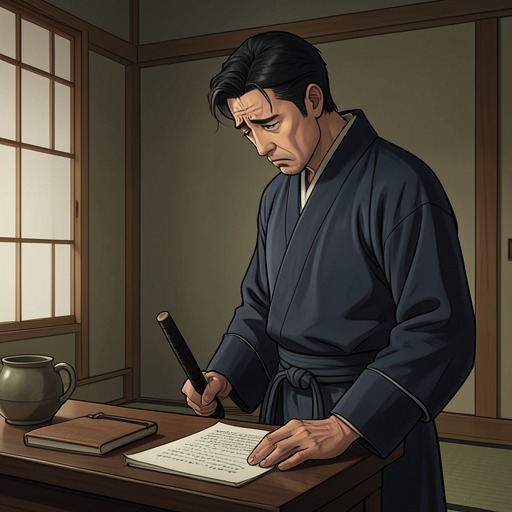
Depression
The Final CurtainDepression is presented as a hidden condition that shaped Yuriko Kaga’s view of herself and her family, yet went unnamed while she was suffering. Its delayed recognition becomes essential to Kyoichiro Kaga’s effort to understand why his mother left, and to the distinction between her apparent abandonment and the psychological distress that preceded it.
Recognition in retrospect
Kyoichiro recounts that his mother’s emotional support had come largely from his grandmother. After the grandmother died, Yuriko lost the person who had listened to her and encouraged her; Kyoichiro was still too young to provide meaningful support, and his father did not understand the change in her condition at the time. The loss of that support did not immediately show on the outside, but, as Kyoichiro later explains, something had changed within her.
One evening, during a family dinner, Yuriko abruptly began to cry and described herself as a failure—as a person, wife, and mother. She said she could not make her husband or son happy, then eventually composed herself and apologized, asking them to forget what she had said. Kyoichiro remembers the episode only dimly and allows that his recollection might be mistaken. That uncertainty gives the scene the character of a fragment recovered much later, rather than a diagnosis made at the time.
When Matsumiya asks whether the episode might have been depression, Kyoichiro agrees that it is possible. He points to low self-esteem and hopelessness as familiar symptoms, but emphasizes the historical gap in understanding: ordinary people knew little about depression then, and his father probably did not realize Yuriko was ill. Her distress remained largely invisible to the family until it was expressed in a crisis and, later, a note.
Self-blame and departure
The novel links Yuriko’s despair to a burden of guilt. In Shunichi Watabe’s letter, he explains that Yuriko saw herself as a burden to her husband from the beginning of their marriage. She blamed herself for conflict with her in-laws that led her husband to break with his family, and for making demands so she could care for her sick mother even though her mother died relatively soon. From these experiences, she came to believe she was of no use to anyone and doubted her ability to raise a child.
Watabe, like Kyoichiro in retrospect, considers clinical depression a likely explanation, while stressing that the word and the understanding were unavailable to Yuriko in the same way they are to later observers. Instead, she persuaded herself that she had failed. She endured this state for years, and Watabe describes her thoughts of suicide as becoming an unhealthy obsession. The account gives the diagnosis explanatory force without reducing Yuriko’s life to a label: it traces how guilt, bereavement, and a sense of incapacity gathered into a story she told about her own worth.
Yuriko eventually left her husband and son. Her note said that she no longer had confidence in herself as a wife or as Kyoichiro’s mother. Kyoichiro’s father understood the message only after she had gone, recognizing that she had been under great psychological pressure. He chose not to pursue her, believing that he had failed to help her through her mental-health difficulties and that his absence might be better for them both. His later conviction that Yuriko would have wanted to see her son, even briefly, before she died conveys the pain of a separation that neither explanation nor hindsight could undo.
The son as a sustaining attachment
Watabe’s letter adds a counterweight to Yuriko’s self-condemnation. For years, he writes, the sight of her sleeping son was the one thing that could bring her back from the brink. She worried about who would care for Kyoichiro if she were gone. Her attachment to him did not simply erase the illness or prevent her eventual departure; it appears instead as a powerful reason she continued living for a time, existing alongside the belief that she was an inadequate mother.
Much later, Kyoichiro says that he wants to learn what emotional state his mother was in, even if he is too old to be a devoted son. Tokiko answers that she believes Yuriko was thinking of him when she died because he was her only child. Kyoichiro cannot claim to know this for himself, but Tokiko insists that a patient of hers who knew she was dying had spoken of leaving the world without depression and with a measure of happiness. The exchange keeps the question personal rather than clinical: understanding depression also means asking what connection may have remained meaningful to Yuriko at the end.
Letters, death, and belated knowledge
The story delivers much of its understanding through messages that arrive after the people involved can no longer speak directly. Following Yuriko’s death, Yasuyo Miyamoto takes her ashes home after the cremation and faces responsibility for clearing her apartment. She repeatedly calls Watabe, who does not answer, and assumes he has withdrawn. He eventually helps connect the past to the present by locating Yuriko’s son, whose surname is Kaga, and suggesting that Yasuyo write to him because Watabe has no phone number for him.
Watabe’s letter to Kyoichiro makes explicit what Yuriko had once kept from him: more than a year into their relationship, she suddenly told him the story of her family and her feelings of failure. In the letter, written as Watabe approaches the end of his own life, he explains why he has decided to speak now: he no longer wants to remain silent about the woman who meant more to him than anyone else. His account does not replace Kyoichiro’s memories; it supplies another witness to a suffering that had been largely private and misunderstood.
Narrative significance
Depression matters to the novel as both a possible illness and a problem of belated recognition. Yuriko’s family first encounters the outward signs as an unexpected breakdown, while the explanation emerges years later through Kyoichiro’s reconstruction and Watabe’s letter. The same words of failure recur across these accounts, but their meaning shifts: what Yuriko took as proof of personal inadequacy becomes, to those who look back, evidence of unrecognized psychological distress.
The narrative also resists treating explanation as a simple repair. Kyoichiro’s father accepts blame for not understanding Yuriko, yet that recognition comes too late to restore the family; Kyoichiro can investigate his mother’s state of mind, but cannot know with certainty what she thought at the end. Depression thus links an individual’s hidden suffering to the failures of awareness around her, while the letters and memories preserve a relationship that separation and death left unresolved.