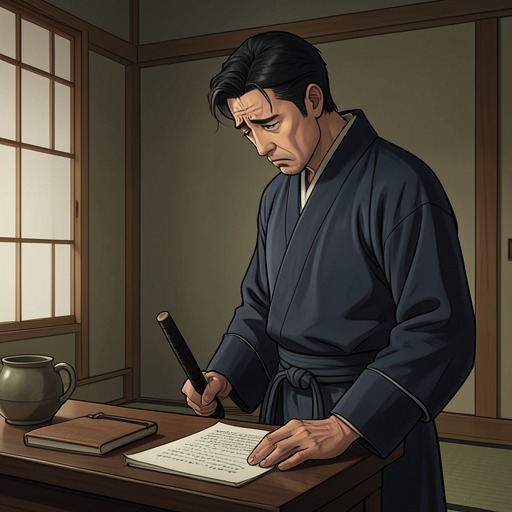
Mother's Love and Parting
The Final CurtainMother–son love and separation gives emotional weight to Kyoichiro Kaga’s effort to understand the mother he barely knew. Yuriko’s departure left a lasting silence between them, but the novel gradually reframes that absence: her separation from her son did not mean she had stopped loving him. Through memories, testimony, funeral arrangements, and a letter delivered after her death, the story makes their bond visible as something enduring but imperfectly expressed, burdened by guilt and understood too late for an ordinary reunion.
Separation and the life left behind
Yuriko’s absence reaches Kaga through places and objects as much as through direct recollection. When Kaga and Shuhei Matsumiya consider the decayed place where she lived and died, Matsumiya finds it difficult to believe that his aunt—Kaga’s mother—had spent her final years in surroundings that seemed to mean nothing to her. The neglected setting gives physical form to the distance between Yuriko’s life in Sendai and the family from whom she had separated. The separation is not resolved by simply discovering where she lived; the question that remains is what she felt, and why leaving had seemed necessary.
Yuriko’s story, as later conveyed to Kaga, is marked by a belief that she had been a burden from the beginning of her marriage. She felt guilty about conflict with her in-laws, about the demands she had made so she could care for her sick mother, and about her mother’s death not long afterward. Those accumulated failures, as she understood them, convinced her that she was of no use to anyone and made her doubt her ability to raise a child. Her departure is therefore set against a history of depression and self-reproach, rather than treated as a simple rejection of her son.
The separation also leaves Kaga with a question that cannot be answered by the fact of her leaving alone. He says that he wants to learn what emotional state his mother was in, even though he jokes that he may be too old to be such a devoted son. The wish is both belated and persistent: he cannot recover the years they lost, but he can try to understand the inner life that had remained hidden from him.
Love surviving estrangement
A memory of Kaga’s father, Takamasa, supplies one of the clearest expressions of the bond Yuriko left behind. Takamasa believed that Yuriko had done nothing wrong and that, before she died, she must have wanted to see her little boy, even for a brief moment. The thought caused him physical pain. His conviction does not erase the years of separation; instead, it reveals how the family’s love continued to act upon those who remained, as grief and regret rather than as a repaired relationship.
Tokiko Kanamori offers Kaga another way to imagine what his mother may have felt. She recalls a dying patient who was not depressed about leaving the world and looked forward to watching her children’s lives unfold from beyond it. Tokiko says she believes Yuriko was the same. This is not presented as something Kaga can verify through a final conversation with his mother. Its force lies in the possibility it gives him: Yuriko may have carried her son in her thoughts, and her attachment to him may have remained even when illness and guilt kept her away.
Katsuko Matsumiya likewise urges Kaga to forgive his mother. Though she says she and Yuriko were not close, she remembers Yuriko as kind and responsible and believes that leaving Kaga must have caused her agony. Katsuko’s appeal connects compassion with the difficulty of judging a choice from its consequences alone. Kaga responds with a grimace and a nod, acknowledging advice he has heard many times. The scene does not turn forgiveness into an easy resolution; it shows it as something repeatedly asked of him while the emotional facts remain hard to settle.
Death, ashes, and the work of mourning
Yuriko’s death makes the question of the mother–son bond practical as well as emotional. Yasuyo Miyamoto, who had been left with responsibility for arranging the aftermath, pleads with Shunichi Watabe not to end their call: she fears Yuriko will never rest in peace if she cannot do better, and she does not know what to do with the ashes. The urn is not an abstract symbol of loss. Someone must take it home, decide how long to keep it, and deal with Yuriko’s belongings and apartment.
The funeral held the next day is modest: it takes place in the smallest room at the local funeral hall, with only a few people summoned from Seven. Yasuyo experiences it as a sad and shabby ceremony. After the cremation, she carries the urn home, knowing she cannot keep it there forever. The scene places the burden of care on a person who is not Yuriko’s child, while Kaga remains absent from the funeral at this point in the account. That imbalance makes the later prospect of a memorial consequential: a public act of remembrance can acknowledge the family relationship that death and estrangement had left unattended.
When Katsuko raises the idea of a memorial service, Kaga says he will think about it after making progress on the case. She reminds him that no one has ever organized a proper one for Yuriko and insists that, whatever happened, Yuriko will always be his mother; the municipal record confirms that bond. The official record cannot supply the intimacy that separation denied them, but it gives their relationship an undeniable place in the world. Katsuko’s insistence turns the question of a service into more than ceremony: it is a request that Kaga recognize his mother publicly, not only pursue her privately through the case.
Belated testimony and the meaning of the bond
The most direct account of Yuriko’s emotional life arrives after her death through a letter from Watabe, passed on with a letter from Hiromi Asai. Watabe explains that he had been Yuriko’s long-term partner in Sendai and that she did not speak of her family during the first year after they met. When she finally told him the story, she described herself as a burden and as a failure, and he came to believe she had suffered clinical depression. His testimony gives Kaga information that could not have been obtained from Yuriko herself; the mother’s inner life reaches her son through another person’s recollection and a delayed act of disclosure.
Watabe’s letter describes the sleeping face of Yuriko’s only son as the one sight that could bring her back from the brink of suicide. She worried about who would care for her little boy if she were no longer there. This detail sharply complicates the apparent meaning of her departure: the child she left was also the person whose safety and future had restrained her despair. Love did not prevent separation, and it did not cure the illness and self-condemnation shaping her choices, but the letter reveals that Kaga remained central to Yuriko’s thoughts.
The novel thus treats mother–son love not as a guarantee of reunion but as an attachment that survives in fragments: a father’s painful conviction, a counselor’s compassionate inference, an aunt’s recollection, ashes held by someone else, and a letter that arrives too late for Kaga to ask his mother what she meant. Kaga’s search cannot restore their shared past. It can, however, replace the blunt fact of abandonment with a more difficult understanding of love entangled with illness, guilt, and fear. The prospect of a memorial matters because it gives that understanding a possible form: not a reconciliation between the living and the dead, but an acknowledgment of the mother whose place in Kaga’s life remained even through their long separation.