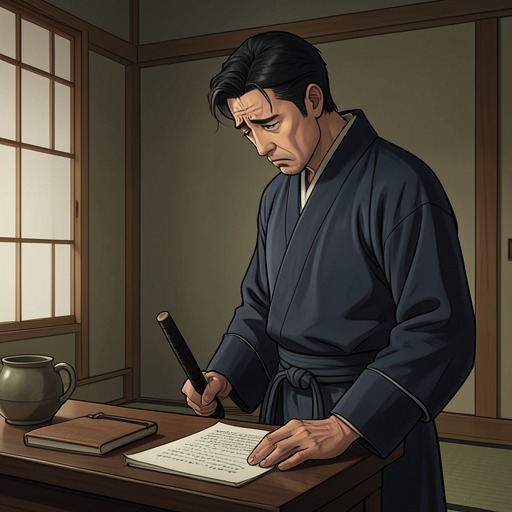
Mutsuo Koshikawa
The Final CurtainMutsuo Koshikawa is the name attached to a nearly empty apartment and a tenant who has disappeared. The investigation eventually identifies him as Shunichi Watabe, the former partner of Kaga’s mother, linking the murder of Michiko Oshitani to a history that reaches into Kaga’s family. Koshikawa’s identity is therefore both a forensic question and a personal one: the police must establish who he was, while Kaga’s recollections and a witness’s impressions supply clues that records alone cannot provide.
Identity and Disappearance
When investigators present the name Mutsuo Koshikawa to Michiko Oshitani’s brother, he does not recognize it. The name has little meaning to the family at first, even though Koshikawa is the tenant of the apartment where Michiko’s body is found. His identity begins as a blank where a connection should be.
Michiko’s body is discovered in the apartment after a resident reports liquid coming through the ceiling. The building manager enters with a duplicate key when no one answers. The autopsy establishes that she died more than two weeks earlier, and the circumstances lead police to treat the case as a homicide. Koshikawa, the tenant they most urgently need to question, is missing; other residents have not seen him for at least a week.
A search of the apartment finds no phone, photographs, identity cards, credit cards, or letters. The absence of ordinary personal effects makes it impossible to build a straightforward profile and suggests that someone deliberately cleared them away. Koshikawa had lived there for nine years, yet had not updated his residence-certificate details. His move-in paperwork gave Maebashi as his previous address, but investigators find no useful trace of him there and suspect the information is false. The loosely managed building had not properly vetted its tenants, leaving the police with a name that may itself be part of the concealment.
From Koshikawa to Watabe
A witness in Sendai recognizes a police sketch as resembling the Shunichi Watabe she knew. Yasuyo Miyamoto identifies not only facial features, including his downturned eyes and prominent nose, but also an impression of a man who kept his emotions contained. The detectives judge her response especially useful: an artist’s sketch can convey a witness’s felt impression as well as visible detail, whereas a highly detailed facial composite may not prompt the same kind of recognition. Her testimony gives the investigators the link they need: Mutsuo Koshikawa had previously used the name Shunichi Watabe.
A second, more objective link comes from an old train timetable. Investigators find prints matching those from Koshikawa’s apartment, and the number and placement of the prints indicate that Watabe, rather than Kaga’s mother, had handled it most. The finding establishes that the man associated with Watabe’s name and the apartment tenant called Koshikawa were one person. The timetable’s use also becomes a clue to his habits and movements, rather than merely an object that confirms identity.
Kaga follows that clue through what he remembers hearing from Miyamoto: his mother had said Watabe’s work was connected to electricity. Miyamoto can confirm the connection to electricity but cannot say whether the work involved nuclear power. Kaga reasons that, before the earthquake made travel more difficult, a worker based at Onagawa could travel to Sendai and back in roughly an hour and a half. He proposes that Watabe worked at the nuclear plant and spent much of his time at Onagawa, visiting Sendai on days off. The evidence offers this as an inference, not a confirmed account of Watabe’s employment.
A Second Trail: The Burned Shack
The investigation’s attention also turns to a homeless man who calls himself Tanaka and lives by collecting cans. A DNA test finds an almost perfect match between his DNA and material taken from a toothbrush, razor, and towel in Koshikawa’s apartment. That result gives the police a powerful physical link between the apartment and the man encountered elsewhere, even though Tanaka’s own identity remains uncertain.
Tanaka has no fixed address or registered legal domicile and is unsure of his age. He says that he once worked as a construction laborer, but lost his home when work dried up and began moving from place to place. He denies knowing how his shack burned: he had gone out to look for food, returned late, and found it on fire. Afraid of being blamed, he left the area for a while. He also says he did not know that his toothbrush, razor, and towel had been taken. The match identifies a connection between Tanaka’s belongings and Koshikawa’s apartment, but these circumstances do not, by themselves, resolve what Tanaka knew about the fire or the murder.
Connection to Kaga and the Murder Investigation
The identification of Koshikawa as Watabe changes the direction of the case without immediately solving it. Koshikawa’s burned body had been found on the riverbank at Shinkoiwa, and the detectives now know that the dead apartment tenant was the man who had maintained a long-term relationship with Kaga’s mother. Yet the murders of Koshikawa and Michiko still have no established connection. The police request assistance from the Miyagi Prefectural Police to learn more about the man who lived as Watabe, but the investigation initially produces no new leads.
The case thus moves forward through two kinds of evidence that answer different questions. Prints on the timetable and the DNA match help establish physical links; Miyamoto’s recognition and Kaga’s recollection give those links a human and biographical context. Together, they turn a vanished tenant with an emptied apartment into a man with a prior name, a past relationship, and possible routes between Onagawa and Sendai. But identifying him does not yet reveal why Michiko was killed or how her death relates to his.
Narrative Role and Significance
Koshikawa’s concealed identity structures the mystery: the name on the apartment records is not the name by which people from his past knew him, and the apparent absence of a life in his rooms becomes evidence of deliberate erasure. His case also draws the investigation into Kaga’s family history. A routine inquiry into a murder victim’s unknown connection to a tenant becomes entangled with the identity of the man who once loved Kaga’s mother.
The clues resist a single method of interpretation. An old timetable carries fingerprints and hints at travel; a sketch prompts recognition through qualities that are difficult to reduce to exact measurements; ordinary toiletries connect a displaced man to an apartment whose occupant left no official trace. Koshikawa remains elusive even after the detectives establish that he was Watabe. The investigation has recovered the identity behind the alias, but the motive and the relationship between the two deaths remain unresolved in the evidence presented here.