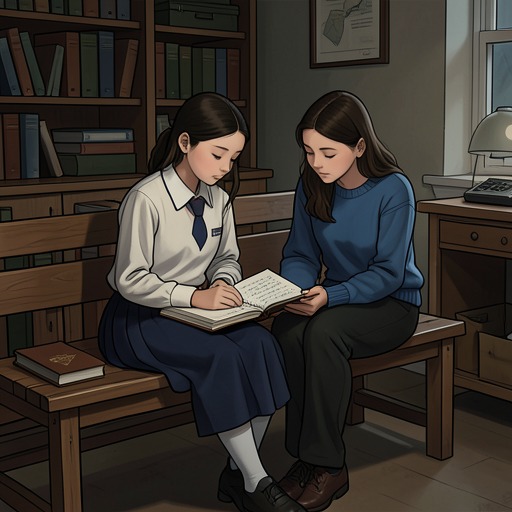
Oogami Michiko visits Tokyo to visit Shimé
The Final CurtainMichiko Oshitani’s journey to Tokyo brings an old friendship back into Hiromi Asai’s life at a moment when Hiromi has little room for anything beyond her work. Michiko has a reason to approach her: at Paradise Village, she believes she has recognized Hiromi’s estranged mother. But the reunion does not restore their former closeness. Instead, Michiko’s news exposes how completely Hiromi rejects the possibility of reconciliation, making the visit a point of collision between one woman’s wish to help and another’s determination to keep her family’s past at a distance.
Background and Reason for the Visit
Michiko encountered an elderly woman living at Paradise Village, where the local police had placed her after the hospital had completed her treatment and she had nowhere to return to. When Michiko passed the woman in a corridor, she suspected that she was the mother of a close junior-high-school friend. She told the retirement-home staff that she might know the woman, and, after speaking with her, became convinced that she had identified Hiromi’s mother. The woman would not acknowledge who she was, leaving Michiko with a suspicion rather than confirmation.
The discovery also gave Michiko a plausible reason to seek out a friend she had wanted to reconnect with for some time. She had seen Hiromi on television and knew that she worked in Tokyo theater; as a theater lover, she had hoped to see her again, but worried that an unprompted approach after so many years would not be welcome. The possible identification of Hiromi’s mother changed the nature of the visit: Michiko could present it as important news, not simply a bid to re-enter an old friend’s life.
Reunion at the Theater
Michiko went to see Hiromi on March 9, the day before the first public performance of Hiromi’s play at Meijiza Theater. It was Hiromi’s first play there, and she was under pressure to make it succeed. At the dress rehearsal, her voice was hoarse and she was perspiring, and she initially reacted to the message that a visitor was waiting by dismissing the request. When she learned that the visitor was Michiko Oshitani, she decided she could not simply send her away.
They met in a meeting room in the theater’s office. Michiko greeted Hiromi with exuberant praise, comparing the woman she had seen on television favorably with the real person before her, and joked about her own appearance. The years had changed both of them: Hiromi had first pictured Michiko as the junior-high-school student she remembered, then as the older woman she now met, and recognized that thirty years had passed. Michiko’s liveliness and talkativeness seemed unchanged, though Hiromi initially could not tell why she had come.
The News and Hiromi’s Refusal
Michiko eventually explained that she had found an elderly woman she was sure was Hiromi’s mother. When Michiko had addressed the woman as Mrs. Asai, the woman had stiffened, which Michiko took as confirmation. Hiromi kept her expression controlled and asked what Michiko expected her to do. When Michiko suggested that confirming the woman’s identity would help both the retirement-home staff and the police, Hiromi refused categorically.
Hiromi’s refusal was not a matter of indifference to an ordinary acquaintance. She said the woman had killed her father and that she did not care what happened to her. Her anger was directed at her mother, though in the conversation it fell on Michiko as well. Asked whether the two might ever repair their relationship, Hiromi answered that there was no chance. The visit therefore gives Michiko the opportunity she had sought, but not the reunion she may have hoped for: the fact that the woman could be Hiromi’s mother does not soften Hiromi’s judgment or make her willing to intervene.
Place in the Larger Family Story
The encounter sits within a wider history of separation and loss. Elsewhere, the narrative reveals that Hiromi’s mother had left her family, and that the consequences of this rupture continued to shape how Hiromi understood her parents. Michiko’s attempt to identify the woman makes that history immediate, but Hiromi’s response shows that recognition alone cannot repair it. The visit establishes the emotional obstacle that any later account of the family must confront: Hiromi sees her mother through the death of her father, while Michiko approaches her with the more practical hope of confirming an identity and helping the people responsible for the woman’s care.
The plot also places the visit beside Kyoichiro Kaga’s effort to understand his own mother’s state of mind. Kaga’s father had believed that his wife had done nothing wrong and that, before she died, she must have wanted to see her only child, if only briefly. Tokiko Kanamori likewise tells Kaga that he was probably in his mother’s thoughts at the end. Against those efforts to recover a mother’s feelings through memory and testimony, Hiromi’s meeting with Michiko presents a different outcome: the daughter is alive, the mother may be found, yet Hiromi refuses the possibility of renewed contact. The visit thus connects the investigation’s questions about family separation to the uneven, unresolved work of mourning and understanding.