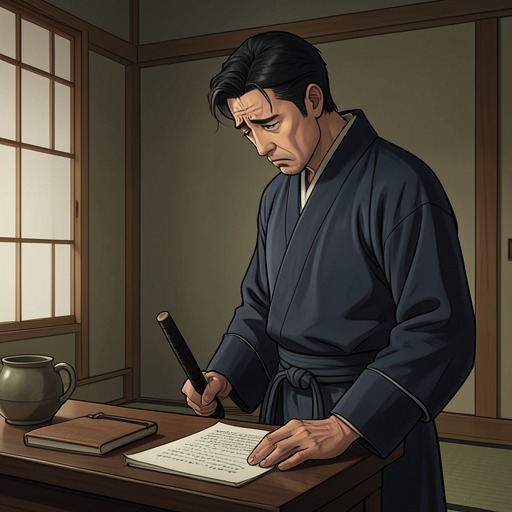
Takamasa Kaga
The Final CurtainTakamasa Kaga is Kyoichiro Kaga’s father and Yuriko’s former husband. His account of Yuriko’s distress is marked by delayed understanding: he eventually recognized that her mother’s death had removed the support on which she relied, but by then he had already failed to see how profoundly her mental state had changed. He chose not to pursue Yuriko after she left, accepting responsibility for his part in her suffering and leaving his son to reckon with the separation and its aftermath.
Family and delayed understanding
Takamasa’s later explanation, recalled by Kyoichiro, centers on Yuriko’s loss of her mother. He had once thought that his wife’s life might become easier after her mother died. In fact, the death took away Yuriko’s strongest source of emotional support: someone who listened to her troubles and encouraged her. Kyoichiro was still too young to offer meaningful support, and Takamasa himself did not understand the change in his wife at the time.
The change was not externally visible, but its first clear sign came one evening at the family dinner table. Yuriko suddenly wept and described herself as a failure—as a human being, a wife, and a mother—convinced she could never make her husband or son happy. Afterward, she returned to herself and apologized, asking them to forget what she had said. Kyoichiro retained only a dim memory of the episode and acknowledged that it might be imagined; Takamasa, by contrast, came to understand its significance only much later.
Separation and responsibility
When Matsumiya asks why Takamasa did not go looking for Yuriko, Kyoichiro explains that his father probably believed it would be better for both of them if he did not pursue her. Takamasa considered himself to blame because he had not helped Yuriko through her mental-health difficulties. His position was not that she had wronged the family: he was convinced that Yuriko had done nothing wrong.
That conviction gave his restraint a complicated meaning. Not pursuing Yuriko was, in his view, a way to avoid adding pressure to someone whose suffering he had failed to recognize in time. Yet the choice also meant that Kyoichiro grew up without resolving the distance between himself and his mother. Takamasa believed she must have wanted to see her only son, even briefly, before she died; he told Kyoichiro that imagining this caused him physical pain.
His own death and its echo
Takamasa’s understanding of Yuriko’s lonely death shaped the way he approached his own. He had made up his mind that he, too, should die alone. Tokiko, who cared for him in hospice, saw the resemblance between father and son when Kyoichiro agreed to respect that wish. Though she did not interfere, she privately felt that a father should not leave life without his only son beside him.
Matsumiya recalls that Kyoichiro and Takamasa had made an agreement that Kyoichiro would not visit even when his father was critically ill. When Takamasa died, Kyoichiro was not in the room. The arrangement repeats the family’s pattern of separation, but the evidence also shows it as a deliberate decision made between them, rather than an accidental absence.
What remains for Kyoichiro
Takamasa’s account survives through Kyoichiro’s recollections and the later investigation into Yuriko’s life. Kyoichiro continues to want to know what emotional state his mother was in, even while acknowledging that he may be too old to be asking such questions of himself. Tokiko tells him that, as Yuriko’s only child, he was likely in her thoughts when she died; Kyoichiro cannot claim certainty for himself.
A letter from Shunichi Watabe later supplies a fuller account of Yuriko’s feelings after she left her husband and son. Its arrival extends the inquiry beyond Takamasa’s belated understanding, but does not erase the cost of what he failed to perceive while Yuriko was alive. Takamasa’s significance lies in that unresolved gap: he loved and grieved for Yuriko, recognized his own failure to support her, and tried to honor her departure, while his choices left Kyoichiro with a mother whose inner life could only be recovered through other people’s memories.