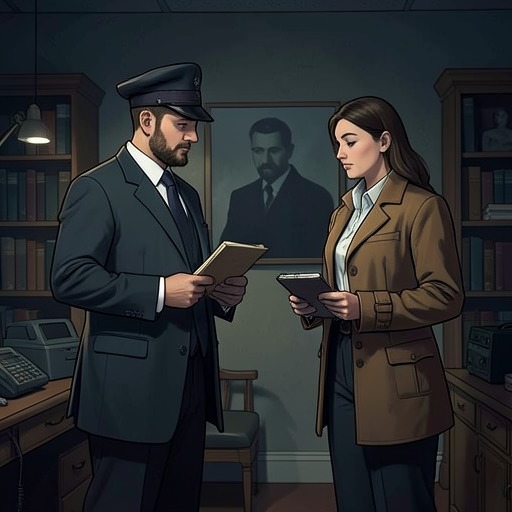
Takeo Suwa
The Final CurtainTakeo Suwa, Hiromi Asai’s ex-husband, offers a limited but consequential account of their marriage: they loved one another’s talents more clearly than they knew one another as people. When Shuhei Matsumiya visits him while investigating the murders of Michiko Oshitani and Mutsuo Koshikawa, Suwa’s recollections also reopen a line of inquiry into Hiromi’s past relationship with another man.
Identity and Introduction
Suwa enters the investigation as someone connected to Hiromi through a former marriage, not as a suspect or a person Matsumiya expects to provide a breakthrough. Matsumiya has no specific objective beyond checking that Suwa has nothing useful to add. He waits for about an hour before Suwa arrives, wearing a down vest over a polo shirt; the unremarkable encounter begins as a routine inquiry rather than a confrontation.
Marriage and Mutual Understanding
Suwa says that he and Hiromi spent a great deal of time together, but their conversations centered on acting and the theater. He knew little about her past, and says she showed similarly little curiosity about his life, never asking about it. The intimacy of time spent together therefore did not amount to broad knowledge of one another.
Asked whether love had been absent from the marriage, Suwa resists that absolute conclusion. He says he was crazy about Hiromi as a woman, while remaining unsure whether she felt the same way. His account is more specific about what bound them: “For normal couples, that’s true. We weren’t like that; we got married because we were in love with one another’s talents.” The distinction leaves room for his own desire while suggesting that their shared artistic admiration, rather than mutual understanding, was the marriage’s defining foundation.
Hiromi’s Earlier Relationship
Suwa cannot identify the man who had previously been in Hiromi’s life. He says he only learned of that relationship through one of Hiromi’s friends, an actress who used the stage name Rumi Tsukimura and whose real name was Emiko. By the time of his account, she had left the acting profession. Suwa’s knowledge is secondhand and sharply limited: he knows there had been another man, but not who the man was or what became of him.
The information he relays places the relationship trouble when Hiromi was about twenty-four or twenty-five. According to Emiko, Hiromi was then behaving unusually, often spacing out and failing to concentrate properly at rehearsals. Emiko confronted her and urged her to pull herself together; Hiromi explained that she was having relationship difficulties and that she and her boyfriend had split. Suwa can report what Emiko told him, but his account does not establish whether that explanation was true, and he has no further details to resolve the uncertainty.
Investigative Significance and Limits
The visit takes place after investigators have identified the burned riverbank corpse found at Shinkoiwa as Mutsuo Koshikawa, an occupant of the Kosuge apartment who had previously used the identity Shunichi Watabe. They know Watabe had a long-term relationship with Hiromi’s mother, and have requested information about him from Miyagi Prefectural Police, but that avenue has produced no leads. Against this stalled inquiry, Matsumiya’s conversation with Suwa offers a possible connection between Hiromi’s past and the identity investigators are trying to understand, but Suwa cannot supply the missing identification.
Suwa’s importance lies in the boundaries of his testimony as much as in what it reveals. His marriage gives him a personal connection to Hiromi, yet he describes a relationship with little exchange about their histories; his knowledge of her earlier boyfriend comes not from Hiromi directly but from Emiko. The account provides investigators with a reported circumstance and a witness to its transmission, not a confirmed link between that former boyfriend and the man known as Shunichi Watabe.