Tokiko Kanamori
The Final CurtainTokiko Kanamori is a caregiver who becomes an important witness to the private histories surrounding Kyoichiro Kaga. Her work in hospice and at a hospital brings her close to Kaga’s family, while her encounters with people affected by abandonment and bereavement give her a compassionate perspective on the pain behind his investigation. She helps him act on that investigation, then becomes the recipient of a letter carrying information Kaga has wanted all his life.
Identity and Background
Tokiko has cared for Kaga’s father, Takamasa Kaga, during his hospice stay and also looked after Kaga’s uncle. That history makes her more than a casual acquaintance: she has seen the family in circumstances of illness and impending death, and she understands the stubborn pride that shaped Takamasa’s choices. When Tokiko later meets Kaga with Yusuke, she tells him that Kaga is almost never late, a small observation that conveys her familiarity with his habits and her ease in speaking about him to others.
Her hospital work also informs how she thinks about people facing loss. Recalling a patient who had children, Tokiko explains that the woman had looked forward to watching their lives unfold from the other world and therefore did not fear losing her physical body. Tokiko becomes emotional as she remembers her, then tells Kaga that his mother must have felt the same. Her comparison gives Kaga a possible way to imagine his mother’s attachment to her son, rather than viewing her only through the pain of her departure.
Connection to Kaga’s Family
Tokiko’s recollection of Takamasa exposes a painful resemblance between father and son. Knowing that Takamasa’s former wife had died lonely, Takamasa nevertheless resolved to die alone himself. Kaga agreed to honor that wish. Tokiko thought of the choice as a family likeness, but did not interfere; inwardly, she wanted to say that a father should not leave the world without his only son beside him. Her judgment is grounded in care, but her restraint also matters: she recognizes that her own wish cannot simply overrule the decision Kaga and his father made.
Tokiko’s connection to Kaga’s mother, Yuriko, is less direct but emotionally consequential. When Kaga asks about his mother, Tokiko recalls the patient who wanted to continue witnessing her children’s lives after death and suggests that Yuriko may have shared that feeling. Kaga responds earnestly and thanks her. The exchange does not establish what Yuriko thought, but it gives the investigation a human point of comparison and shows Tokiko trying to help Kaga approach his mother’s history with empathy.
The account of Kaga’s own mother’s distress underscores why the subject is so charged. After Kaga’s grandmother died, his mother lost the person his father understood to have been her strongest emotional support. Kaga was still too young to offer meaningful support, and his father did not recognize the depth of the change at the time. At dinner one evening, his mother suddenly declared herself a failure and said she could never make her husband or son happy, then returned to herself and apologized. Kaga remembers the episode only dimly and allows that the memory might be imagined. Elsewhere, Yasuyo reports that Yuriko had spoken of having failed as a wife and mother. Tokiko’s compassionate suggestion therefore enters a story already marked by self-blame and by the difficulty of knowing another person’s inner life.
Assistance in the Investigation
Tokiko’s involvement becomes practical when Kaga asks her to accompany him to Hiromi Kadokura’s apartment in Aoyama. Before they enter, he gives her a small plastic pouch and a signal: when he makes it, she is to ask to use the restroom and transfer hairs from Kadokura’s hairbrush into the pouch. For the rest of the visit, she is to remain quiet. The instructions place Tokiko inside an investigative operation whose tense exchange between Kaga and Kadokura she would otherwise have observed only from outside.
Tokiko is anxious throughout the encounter and finds the tension between the two difficult to watch. At the same time, seeing Kaga at work firsthand leaves her with respect for the demands of his profession. She considers the experience challenging but worthwhile. Her role is limited and carefully assigned, yet it makes her a participant in the investigation rather than merely a source of personal memories.
Tokiko also appears during a confrontation in which Kaga presses someone about whether an event could have been kept secret. She leaves the room and later returns; when Kaga asks whether she is all right, she says she is fine, apologizes for the fuss, and sits beside him again. The episode offers little explanation of what prompted her departure, but it shows Kaga attending to her and Tokiko resuming her place alongside him.
The Letter and Its Aftermath
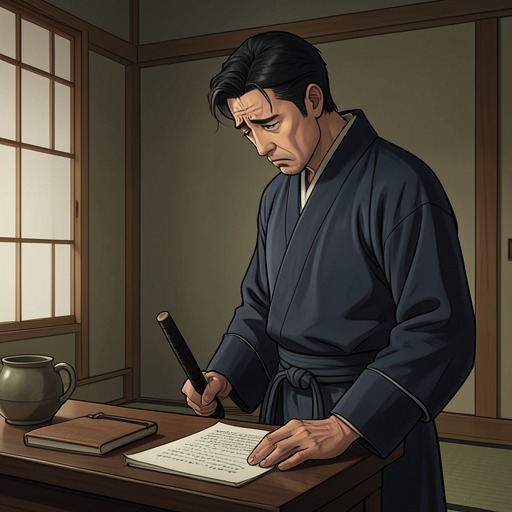
Later, Tokiko meets Shuhei Matsumiya, Kaga’s cousin, at a café. Matsumiya tells her that Kaga wanted her to have the opportunity to read a letter, but asks her to wait until he has left. The envelope is not sealed. After Matsumiya goes out to the street, Tokiko opens it and finds five photocopied pages. The first is a covering letter from Hiromi Asai, who apologizes for the trouble caused by her crimes and explains that her father wanted his own letter delivered to Kaga.
The enclosed letter is from Shunichi Watabe. He identifies himself as Yuriko Tajima’s long-term partner in Sendai and as the person who gave Yasuyo Miyamoto Kaga’s contact details. He says he is writing to explain Yuriko’s emotional state after she left Kaga and his father, and acknowledges that he cannot fully explain why he is writing only at this late stage. Tokiko’s discovery places her at the threshold of a family history long concealed from Kaga: the letter is intended to supply information about Yuriko that he has sought all his life.
Tokiko is startled by the pages and their dense handwriting, but the scene ends with her reading rather than with the letter’s contents fully disclosed. Her narrative function is therefore both active and transitional. She has already helped Kaga obtain evidence, offered a humane interpretation of his mother’s possible feelings, and now holds a document that may alter his understanding of the past. Through Tokiko, the book links acts of care in the present with testimony arriving belatedly from people who knew the absent and the dead.