Yasuyo Miyamoto
The Final CurtainYasuyo Miyamoto is a Sendai restaurant and bar owner whose practical generosity gives Yuriko Tajima a new start and whose recollections later become a crucial, carefully tested part of a police investigation. Her role is defined by two forms of attention: she recognizes what Yuriko can bring to Seven, and, when detectives seek to identify Shunichi Watabe, she distinguishes a remembered person from a plausible but incorrect face.## Identity and Background Yasuyo runs a small restaurant as well as Seven, her bar in Sendai. When a bartender marries and leaves, Yasuyo has to reconsider the bar’s staffing. She is willing to meet Yuriko because she trusts the friend who recommends her and sees no reason not to consider a potential employee. The decision is practical, but it opens the way to a consequential relationship.
Yuriko is thirty-six, ten years younger than Yasuyo, and has come to Sendai after separating from her husband. She has no other family there and some experience in the nightclub business. Yasuyo meets her at Seven before it opens. The staffing need gives the conversation an immediate purpose, while the prospect of a job offers Yuriko a chance to establish herself in a new city.
Yasuyo’s approach to the prospective hire extends beyond filling a vacancy. She tells Yuriko that, if the work becomes full-time, they will need to find her a place of her own, and offers the help of a friend who is a real-estate agent. Yuriko tears up, promises not to let her down, and repeatedly bows her head. The exchange establishes the practical, direct form Yasuyo’s care takes: she offers an opportunity, then considers what will make it possible for Yuriko to remain in Sendai.
Seven and Yuriko’s New Life
Yuriko joins Seven, and Yasuyo’s instinct that she will be popular proves correct. Customers take to her, while the gray-haired bartender tells Yasuyo that Yuriko has changed the atmosphere of the bar. He does not describe her as a brilliant conversationalist; her value, in his view, lies in the glamour and mystery she brings, and in her ability to balance formality with openness. His assessment complements Yasuyo’s original judgment: Yuriko’s presence matters as much as her technical experience.
Seven consequently becomes more than a workplace in the account of Yuriko’s life. It gives her employment and, through its customers and staff, a social place in the city where she has chosen to live. Yasuyo is both her employer and an important practical support. The bar’s welcome does not erase the fact that Yuriko has arrived after a separation and without family in Sendai, but it gives her a community in which she is appreciated.
After Yuriko’s health declines, she dies at home. Yasuyo, as Yuriko’s employer and apartment guarantor, organizes the funeral and takes charge of her ashes and personal effects. With no immediate family to assume responsibility, Yasuyo becomes the person who must decide what will happen to them. Her relationship with Yuriko thus continues beyond the bar and into the difficult work of arranging her funeral and seeking a family member who can take custody of her remains.
Contacting Kyoichiro Kaga
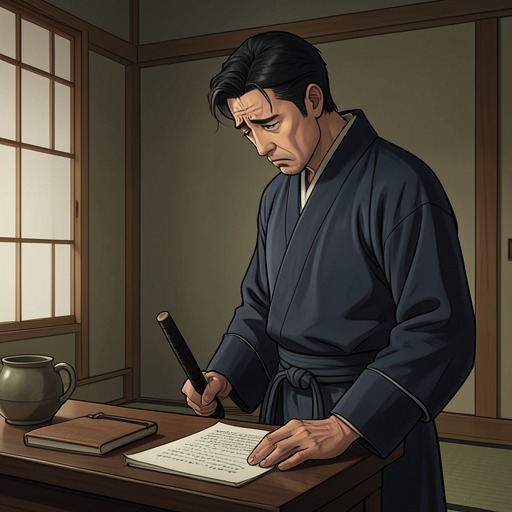
Yasuyo writes to Kyoichiro Kaga to inform him of his mother’s death and ask him to collect Yuriko’s ashes and possessions. The letter is an unexpected one: Yasuyo identifies herself as a hospitality worker in Sendai, explains that Yuriko had worked at her bar, and reports that a doctor attributed the death to heart failure. She also explains why she has taken responsibility for the funeral and ashes, and asks Kaga to come north if he is willing to receive them.
The letter takes several false starts before Yasuyo settles on what to say. Kaga responds by telephone three days later. Yasuyo is somewhat surprised that he is ready to come; she had assumed that he might take time to act on news concerning his mother. Nevertheless, she welcomes his visit. When he later calls from Sendai Station, she gives him directions using nearby landmarks and begins preparing green tea before he reaches her home.
In the household altar, an urn containing Yuriko’s ashes sits beside a framed photograph taken in the bar. Yuriko is smiling broadly in the picture, an unusual expression for her according to Yasuyo’s recollection; a regular customer gave the photograph to Yasuyo before the funeral. Looking at the photograph, Yasuyo thinks with relief that Yuriko’s son is coming to collect her. The scene makes the chain of responsibility visible: the employer who once offered Yuriko a job and help with housing has kept her ashes and photograph until family can take them.
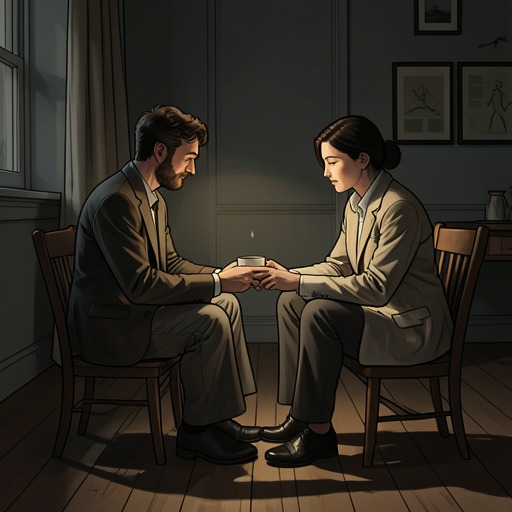
During their conversation, Yasuyo tells Kaga that Yuriko had said she was at fault and had failed as a wife and mother, but had not explained further. Kaga focuses on the word “Failed.” Yasuyo cannot provide a fuller account of what Yuriko meant, and her testimony remains bounded by what Yuriko chose to tell her. That limit matters: Yasuyo can supply a significant fragment of Yuriko’s private history, but not a complete explanation of it.
A Witness in the Watabe Investigation
Years later, Yasuyo’s memories become relevant to the investigation into Shunichi Watabe and the identities concealed behind that name. Investigators consider Seizo Naemura as a possible man connected to Hiromi Asai and Michiko Oshitani. Yasuyo’s recollection helps rule him out: when shown two pictures, she says she has never seen the man. Asked to imagine him older, she remains perplexed; when Matsumiya specifically asks whether the man is Watabe, she firmly says that he is someone else. Her refusal is not an absence of evidence but a useful distinction in a case where people and names have been confused.
The detectives test her memory against multiple images rather than relying on a single impression. In another identification exercise, Matsumiya shuffles five sketches face down so that he will not know the order. Yasuyo’s attention returns to the fourth picture, and she selects it without hesitation as resembling Watabe. The procedure makes the recognition more informative: Matsumiya has tried to prevent his own expectations from shaping the sequence, while Yasuyo’s choice rests on her own memory.
That recognition helps the investigators separate Watabe from Naemura, but the larger identity question remains unsettled. Kyoichiro Kaga explains that his mother had a long relationship with a man called Shunichi Watabe and that he knows little about him. Yasuyo supplies a further clue: Yuriko had told her that Watabe’s work was connected to electricity, though she could not say whether it involved nuclear power. Kaga checks the detail with her and uses it to consider whether Watabe may have worked at Onagawa Nuclear Power Station, travelling between Onagawa and Sendai during time off. Yasuyo’s report is a remembered conversation, not proof of an occupation; its importance lies in giving the investigators a direction to test.
Recognition, Error, and Evidentiary Limits
The case turns on distinguishing a face remembered from years earlier from another man who could fit the investigators’ theory. Yasuyo is shown an image of Kazutoshi Yokoyama and is unequivocal: it is not Watabe. When the Miyagi Prefectural Police later show her Yokoyama’s photographs, she again insists that he does not look like Watabe. These judgments carry particular force because she has already identified a sketch as resembling Watabe and rejected a different candidate as someone else.
The distinction matters because the evidence surrounding Watabe is layered. Investigators find that fingerprints connect Mutsuo Koshikawa, who had vanished from his apartment, with the man living in Sendai under the name Shunichi Watabe; the prints on a timetable also suggest Watabe had made greater use of it than Kaga’s mother. Separately, Kaga’s hypothesis is that Watabe was in fact Tadao Asai, Hiromi’s father, who had faked his death and lived under an assumed identity. Yasuyo’s memory can help identify the man she knew as Watabe, but it cannot by itself establish every link among the names, records and forensic evidence.
The police also have reason to treat personal and administrative records cautiously. Mutsuo Koshikawa had lived in his apartment for nine years without updating his residence certificate, and the previous address he gave when moving to Tokyo was likely false. Investigators find no ordinary personal documents in the apartment and use objects including a toothbrush, safety razor and old towel to seek DNA evidence. Against this background of erased or misleading identities, Yasuyo’s testimony offers a different kind of evidence: a witness’s remembered recognition, valuable precisely because it can be compared with sketches, photographs and physical records rather than mistaken for certainty about the whole case.
Narrative Role and Significance
Yasuyo links the private history of Yuriko Tajima to the police investigation through ordinary acts of care: offering work, considering housing, arranging a funeral, preserving ashes and responding to a letter she had no obligation to send. Those acts bring Kyoichiro Kaga into contact with the story of his mother and allow fragments of what Yuriko knew about Watabe to reach the detectives. Her importance therefore grows out of the same quality that first shaped her relationship with Yuriko: she takes responsibility for what is directly in front of her, without claiming knowledge she does not have.
As a witness, Yasuyo is most useful not as an all-knowing source but as a careful one. She recognizes one representation of Watabe, rejects another, and remembers a limited clue about his work. The investigation must still test each piece against other evidence, including fingerprints and DNA. This balance gives her role its significance: in a case built around borrowed names and concealed histories, a confident identification matters, but so does the equally confident refusal to call the wrong man by a familiar name.