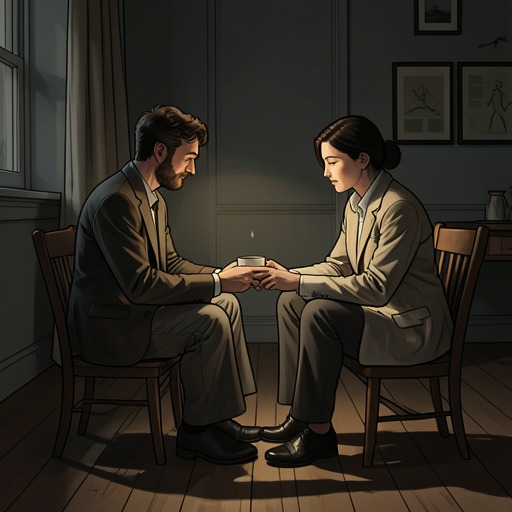
Yuriko Kaga–Shunichi Watabe relationship
The Final CurtainThe relationship between Yuriko Kaga and Shunichi Watabe was a long-term partnership formed after Yuriko left her husband and son, and it became the route through which her son eventually learned more about her life and emotional state. Watabe’s later disappearance from view, his assumed identity, and the letter he left behind turned that private history into a belated account of Yuriko’s suffering and enduring attachment to her child.
The relationship and its hidden history
Watabe told Kyoichiro Kaga that he had been in a long-term relationship with Yuriko Tajima while she lived in Sendai. He identified himself as the man who had supplied Yasuyo Miyamoto with Kaga’s contact details. The relationship thus connected Yuriko’s life after leaving her family to the eventual effort to bring her son into contact with her memory.
The truth surfaced through a letter written under Watabe’s other identity, Shunichi Watabe: the burned corpse found on the riverbank at Shinkoiwa was Mutsuo Koshikawa, the occupant of the Kosuge apartment, and Koshikawa had formerly lived as Watabe. Kaga and the investigators established that this was the man who had shared Yuriko’s life in Sendai. The discovery clarified the identity of her partner, though it did not immediately resolve the case connected to his death.
Yuriko’s account of her family life
In his letter, Watabe explained that Yuriko did not speak about her family when they first met. More than a year into their relationship, she suddenly told him the story. As she understood it, she had been a burden to her husband from the beginning of their marriage; conflict with her in-laws had led her husband to break with his family. She also felt guilty that, despite asking for more time to care for her ill mother, her mother had died relatively soon.
Watabe described the weight these experiences carried for Yuriko. Convinced that she was of no use to anyone, she became deeply depressed and doubted her ability to raise a child. He believed she had likely experienced clinical depression, though at the time she came to regard herself as a failure rather than having an explanation for her condition. He wrote that she struggled for years with thoughts of suicide.
Separation, grief, and the funeral
After Yuriko’s death, Miyamoto contacted Watabe about the funeral and the disposition of Yuriko’s ashes. He initially said he had problems of his own and asked Miyamoto to arrange a service. When she pleaded that Yuriko could not rest in peace if she did no better, and asked what she should do with the ashes, Watabe promised to be in touch and took her phone number. He did not answer her repeated calls in the following days, leaving Miyamoto to fear that he had abandoned the responsibility.
A modest funeral was held the next day in the smallest room at the local funeral hall. Miyamoto had contacted regulars from Seven, so a few people attended, but the ceremony remained sad and shabby. After the cremation, Miyamoto took the urn home. As Yuriko’s guarantor, she also had to clear out the apartment and decide what to do with its contents. The handling of the ashes and belongings made the practical burden of Yuriko’s death fall, at least initially, on her friend rather than on Watabe or her family.
Kyoichiro eventually came to the altar, offered incense and a prayer, and thanked Miyamoto for what she had done. Later, he admitted that no one had ever organized a proper memorial service for his mother. He said he would think about arranging one after making progress on the case. The relationship’s aftermath therefore reached beyond Watabe’s account: Yuriko’s son was still deciding how to acknowledge a mother he had lost long before he could understand her.
The son Yuriko remembered
Watabe’s letter made clear that Kyoichiro had been central to Yuriko’s inner life despite their separation. He wrote that the sight of her only son sleeping was the one thing that could bring her back from the brink when thoughts of suicide took hold. Her worry about who would care for the boy if she were gone repeatedly interrupted her despair. The relationship with Watabe is therefore also the channel through which the novel reveals the persistence of Yuriko’s attachment to her child.
Kyoichiro’s father, Takamasa Kaga, believed Yuriko would have wanted to see her little boy, even briefly, before she died. He did not pursue her, partly because he felt responsible for not helping her through her mental-health difficulties and believed it might be better for both of them not to set off after her. Kyoichiro later said that this thought caused his father physical pain. Watabe’s account and Takamasa’s belief converge on the same point: separation did not erase Yuriko’s place in her son’s life, but it left that bond to be reconstructed through other people’s memories.
Watabe’s delayed testimony
Watabe’s letter, delivered to Kaga through Hiromi Asai and Tokiko Kanamori, explained why he was speaking only near the end of his life. He described himself as someone who had spent his life trying not to be noticed or interfere in other people’s affairs, but questioned whether that restraint was fair when it kept Yuriko’s son from knowing what she had endured. He wanted Kaga to understand Yuriko’s emotional state and the life she had lived after leaving her family.
The testimony arrives too late to restore the relationship or permit a conversation between mother and son. Instead, it gives Kaga a fuller account of Yuriko than he had possessed and reframes her departure: the woman who had seemed to have left her family was also a depressed mother whose sleeping child had repeatedly held her to life. Watabe’s relationship with her survives in the story chiefly through this act of disclosure, which turns a concealed past into a belated form of care.