Jim Uses a Week of Gift-Giving to Save His Marriage to Janice
The Five Love LanguagesJim Uses a Week of Gift-Giving to Save His Marriage to Janice shows how a series of modest gifts becomes a turning point in a marriage close to collapse. After a seminar, Jim recognizes that Janice experiences gifts as expressions of love, acknowledges how long he has neglected that need, and deliberately gives her something each day for a week. The immediate change is in Janice’s response; the lasting change is Jim’s decision to keep expressing love in a way she can receive.
Identity and Background
Jim and Janice had both grown up on farms in central Illinois, less than a hundred miles apart, and moved to Chicago soon after marrying. When their story was recounted, they had been married for fifteen years and had three children. Their rural beginnings and later life in Chicago form the background to a relationship whose difficulties had become entrenched over time.
Janice described Jim as methodical and governed by routine. She had spent years cooking, washing, and ironing, and believed she was doing what a good wife should do. She also understood that sex mattered to Jim, but did not feel loved in return. In her account, he had stopped dating her after marriage, taken her efforts for granted, and left her feeling used and unappreciated.
Their differing readings of the marriage were central to the crisis. Jim pointed to paid bills, a comfortable house, a new car, and Janice’s freedom to work outside the home or not as reasons she should be satisfied. Janice wanted him to understand her feelings; his practical inventory did not answer that need. She said he laughed when she raised her unhappiness, and that she felt rejected rather than heard.
Crisis and the Seminar
Three years before Janice told the story, she was seriously considering leaving Jim and had told him so. She said the marriage had felt empty for a long time, that she had given up, and that she had come to hate him. She loved their children and knew they loved her, but felt no affection coming from Jim. Her account establishes the high stakes of the later gestures: they entered a relationship that she already believed might be beyond repair.
The couple attended a marriage seminar in Chicago for the first time. Janice expected little and did not believe anyone could change Jim. During and after the seminar, he said little about its ideas, though he seemed to enjoy it and called the speaker funny. Janice neither asked him to discuss what he had heard nor expected him to act on it. The narrative therefore sets up the first gift as an unexpected break with the routine she had described.
The Week of Gifts
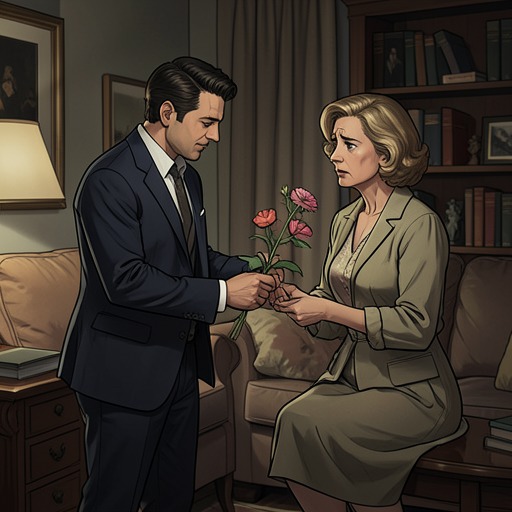
On Monday, after the seminar ended Saturday, Jim came home from work with a rose. He said he had bought it from a street vendor because he thought Janice deserved it. She began to cry and told him it was sweet. She knew the vendor was a young man she had seen selling roses that afternoon, but the flower’s importance lay in Jim’s bringing it to her.
On Tuesday, Jim called from his office at about one-thirty to suggest buying a pizza and bringing it home for dinner so Janice could take a break from cooking. She welcomed the idea. The children enjoyed the pizza and thanked their father, and Janice hugged Jim and told him how much she had enjoyed it. The gesture addressed not only her wish to feel cherished but also the daily work she had been carrying.
On Wednesday, Jim brought each child a box of Cracker Jack and gave Janice a small potted plant. He explained that the rose would die and that the plant might last longer. By then Janice could hardly believe the change in his behavior. On Thursday, he gave her a card saying that he could not always express his love but hoped the card would communicate how much he cared. She cried, hugged and kissed him, and accepted his suggestion that they get a babysitter and go to dinner together on Saturday.
On Friday, Jim stopped at a cookie shop and bought each family member a favorite cookie, keeping the purchase a surprise by saying only that he had a dessert treat. By Saturday night, Janice said she was “in orbit”: she was enjoying the attention but did not know what had come over him or whether it would last. After their dinner at a restaurant, she asked what was happening. Her question brings the week’s sequence to its turning point: the gifts had changed her experience, but she still needed to understand why Jim had begun giving them.
Recognition and Repair
Jim explained that the seminar had helped him recognize Janice’s primary love language as gifts. He recalled that while they were dating he had brought her flowers and other small presents, but after marriage he had assumed they could not afford such things. He admitted that he might not have given her a gift in years, perhaps not since they married. He had chosen to give one each day for a week to see whether it made a difference, and could already see a substantial change in her attitude.
His explanation joined recognition with apology. Jim said he now understood that learning the right love language was key to helping another person feel loved. He apologized for having been so dense and for failing for years to meet Janice’s need for love. He told her that he loved her and appreciated what she did for him and the children, and said that, with God’s help, he intended to be a gift giver for the rest of his life. The account presents the gifts not as expensive tokens but as evidence that he had begun to see what Janice had been asking him to see.
Janice warned that he could not afford to buy gifts every day indefinitely. Jim agreed that daily gifts might not be practical, but proposed giving at least one each week—fifty-two more in a year than she had received in the previous five years. He also widened the idea beyond purchases: he might make gifts himself or pick a free flower from the front yard in spring. His answer reframed the practice as sustained attention rather than spending.
Lasting Change and Significance
When Janice recounted the story three years later, she said Jim had not missed a single week of giving her a gift. She called him a new man and said they had been very happy; their children now called them “lovebirds.” Her account gives the week an aftermath rather than leaving it as a temporary romantic gesture: the daily experiment became a continuing practice, and the response Janice described was renewed happiness in the marriage.
Jim’s own experience was different. Asked whether he felt loved by Janice, he said he had always felt loved because she was an excellent housekeeper and cook, kept his clothes washed and ironed, and did wonderful things for the children. He then asked the speaker whether he knew Jim’s love language. The exchange reveals a mismatch rather than an absence of care: Janice had been expressing love through practical service, while Jim recognized that service as love and Janice needed gifts to feel loved. The story’s central change comes from making that difference visible and acting on it.
The episode also illustrates a wider distinction between loving intention and received affection. Janice had worked hard for the household, and Jim had provided material stability, but neither fact alone had answered her stated need. The rose, pizza, plant, card, dinner, and cookies made the shift legible through concrete acts, while Jim’s weekly commitment carried it beyond the initial burst. The account’s emphasis is not on an extravagant rescue but on learning to express care in a form the other person can recognize.