
The sea and the working community
The Florios of SicilyThis flow follows the traditional tuna fishery as a seasonal community and its transformation under Florio investment and industrial preservation.
increasing Bearing strength in each event
 decreasing
Bearing strength in each eventdecreasingA seasonal ritual
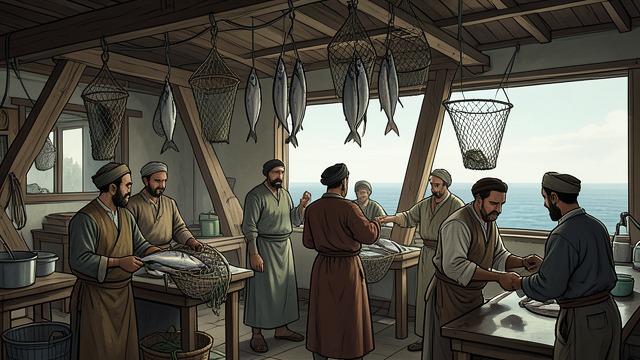
A seasonal ritual
The tuna migration
Tuna enter the Mediterranean in spring, and the tonnara’s nets and boats organize the seasonal catch. Fishing families work together at sea and in the processing plant.
Nothing discarded
The fish provide meat, oil, fertilizer, and roe. The work follows inherited knowledge and uses nearly every part of the catch.
The tonnara is not merely a business site; it is a living community whose rhythms depend on the sea and on cooperation among families.
A neglected inheritance

A neglected inheritance
A failing operation
Vincenzo Florio sees the Arenella fishery struggling and takes over its management despite years of poor returns. Ignazio Florio had valued the place for its sea and its potential.
Investment and repair
Vincenzo improves facilities and develops tuna preservation in oil. Later, he leases the Favignana fishery and finds buildings and work practices in poor condition.
His investment treats local fisheries as both inherited knowledge and infrastructure that can be reshaped for larger markets.
Families enter the factory
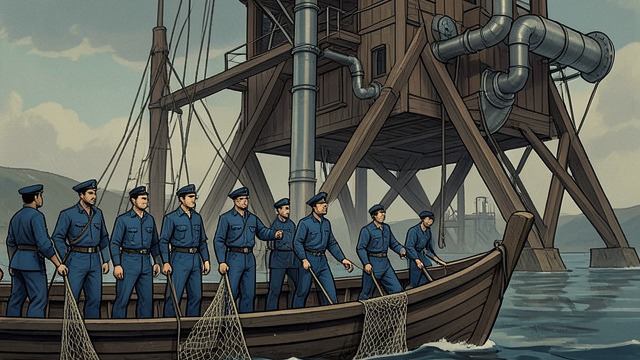
Families enter the factory
Work reorganized
At Favignana, Vincenzo Florio proposes cooking tuna and sealing it in oil. He promises to employ families, not only fishermen, and to use the products left over from processing.
A community transformed
Vito Cordova responds to the promise of work, while the existing bookkeeper resists the new system. Industrial change brings employment but alters a community’s established practices.
The tonnara becomes a meeting point between inherited ritual and modern production, with the people who work there central to whether the change succeeds.
Spring and summer
1830s to 1850s
1850s
