1837 Palermo cholera epidemic
The Florios of SicilyThe 1837 Palermo cholera epidemic is a citywide disaster that exposes the limits of medicine and commerce while forcing Vincenzo Florio to choose between family safety and the obligations of his business. Arriving from the mainland in June, the disease spreads through a population living in appalling hygienic conditions and is not eradicated until early October. The narrative gives the catastrophe both a public scale—contemporary testimony puts the dead in Palermo alone at 23,000—and an intimate one, in which supplies disappear, relatives flee, and the ordinary work of caring for the sick becomes precarious.
Causes and Background
The epidemic reaches Sicily as cholera moves across Europe. Poor living conditions help the disease spread, while the story places its consequences within a city already vulnerable to scarcity and disruption. As the contagion advances, ships cease arriving and goods cannot be restocked; disease therefore becomes not only a medical emergency but a crisis in the systems that ordinarily bring food and medicines into Palermo.
The Florios’ trade gives this shortage a concrete shape. Their business depends on goods passing through distant routes and customs arrangements: spices travel through many hands before reaching European ports, and the firm stores imported merchandise in a warehouse within the Palazzo Steri property. During the epidemic, those commercial networks no longer guarantee access. The interruption turns the Florios’ stores, ordinarily places of exchange and livelihood, into sites where desperate people seek remedies that are no longer available.
The City Under Epidemic
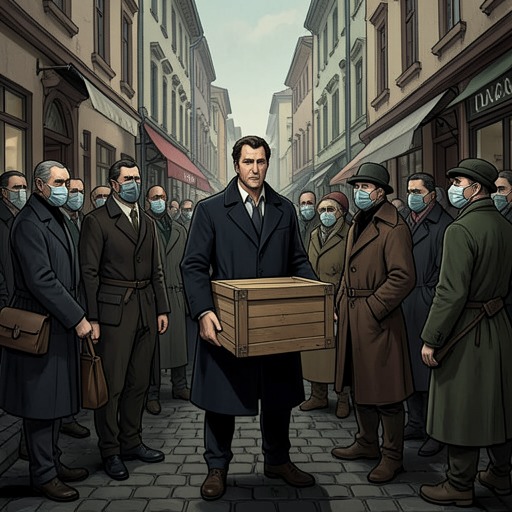
Palermo’s decline is rendered through the daily handling of death and the failure of public order. Carts pass along the Cassaro to collect the dead, while people call out for bodies to be buried. Food is scarce, the aristocracy has abandoned its houses, and looting and fires spread through shops and homes. Chlorine fumigation does not stop the epidemic; it adds another burden to the city’s already dire conditions. Few physicians remain, and monks go from house to house to administer last rites or bless the dead.
Fear also takes political form. People accuse the king of deliberately contaminating food and water to reduce the population. The narrative presents these charges as accusations voiced amid panic, not as established fact. In the countryside, priests are attacked under the belief that they are spreading infection; in the city, a pharmacy is reportedly ransacked and the Florio shop faces a crowd demanding medicines. The epidemic thus compounds physical danger with mistrust, hunger, and the collapse of confidence in authority.
Medicine, Commerce, and the Crowd
As the crisis deepens, Vincenzo’s trade representative Francesco Di Giorgio reports that the supplies of valerian tincture, pepper, cardamom, and mint essential oil are gone, with what remained requisitioned. At the aromateria on Via dei Materassai, manager Carmelo Caratozzolo tells the crowd that there is nothing left and no incoming ship to replenish the stock. People plead for laudanum for a wife in pain and valerian for a daughter. Their need is immediate, but the merchant’s counter cannot provide what the disrupted supply chain has removed.
The confrontation tests the boundary between a business and a public resource. One man accuses the Florios of hoarding spices for their friends and throws a stone at the window. Vincenzo pushes through the crowd to protect the shop, which is inseparable from his sense of identity: he first entered its rooms as a boy of eleven with his uncle Ignazio, and the injured-lion sign became an enduring emblem of the firm. Yet the encounter is not resolved by force or a promise of stock. When Bettina doubts that Palermo’s largest trader has nothing to sell, Vincenzo invites her to inspect the store. The crowd falls silent, opens a path, and gradually disperses. Only one young man remains on the ground; Vincenzo tells him to go home and pray, recognizing that the shop has no remedy for the city’s extremity.
Flight and Family Risk
Vincenzo’s actions at the shop unfold alongside his attempts to protect his family. He sends his mother and the servant women to the estate at Marsala, and later sees Giulia and their daughter Angelina leave by carriage. He turns away because he fears the disease could kill them within a day and that this may be their last meeting. Even as he escorts relatives to safety, he cannot leave Palermo: he must secure the warehouses and supplies and tell French suppliers not to send goods that cannot pass through customs while the Customs House is unattended. The epidemic makes the conflict between familial care and commercial responsibility immediate rather than abstract.
The family’s survival remains uncertain until the crisis passes. In October, the narrative identifies Vincenzo as a trader and industrialist whose holdings include schooners, sulfur mines, wine cellars, and tuna fisheries, and as a member of the Chamber of Commerce and a financial intermediary. That inventory stands in contrast to the household’s narrow relief: he, Giulia, and their daughters are alive, while entire families have been lost. The distinction between public prominence and private vulnerability is central to the episode; wealth and standing do not make the family immune to disease.
Aftermath and Narrative Significance
After the epidemic, life begins to resume. Vincenzo dines with Giulia and their daughters in their apartment on Via della Zecca Regia; the girls are asleep, and Giulia, who learned French as a child in Milan, speaks to them in that language and reads them stories. Tomorrow, Vincenzo plans to visit his mother on Via dei Materassai. The household’s ordinary routines return, but the narrative places their recovery against the large number of deaths and the fragile luck of having survived.
A can of tuna links this domestic scene to an earlier memory. Giulia struggles to open the can, which comes from the Arenella fishery Vincenzo owns in partnership with Augusto Merle. As Vincenzo opens it, the object leads his thoughts back to the kitchen at Piano San Giacomo and a figure taking fish from a wax-sealed earthenware pot. The epidemic’s aftermath therefore does not end with the city’s return to routine: it frames a movement from present survival to remembered family life, with food and household labor carrying the transition.
The epidemic also belongs to a longer history of medicine and commerce. Cinchona bark, whose fever-reducing properties were first recognized by Indigenous peoples in Peru and Bolivia before Jesuits carried it to Spain, reaches Europe as an expensive drug transported and sold through major ports. The Florios’ trade in medicines and imported goods is part of this wider history, but the epidemic reveals its limits: merchandise can connect distant markets, and a prosperous trader can stock a shop, yet neither commerce nor reputation can guarantee the remedy a frightened city needs. The episode’s decisive contrast is between goods that ordinarily move through the world and a disease that leaves families, businesses, and the city unable to command what comes next.