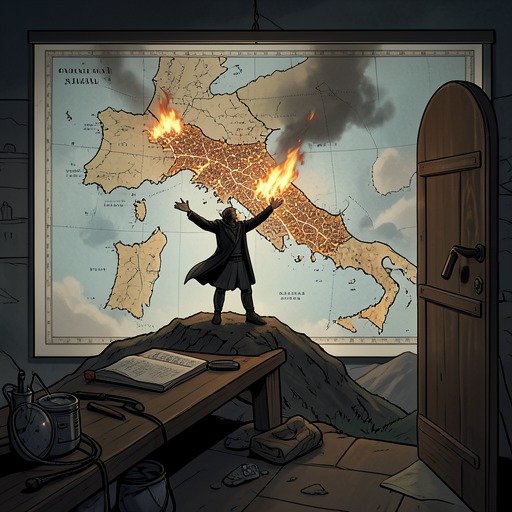
Abolition of the Kingdom of Sicily and Constitution in 1816
The Florios of SicilyThe abolition of the Kingdom of Sicily and its constitution in 1816 was a decisive transfer of power from the island to the Bourbon state. Its consequences reach beyond constitutional politics: Neapolitan officials take control of Sicilian offices and customs, trade is constrained, and the loss of autonomy becomes a grievance that later fuels revolt.
Background and political settlement
The novel places the abolition within a sequence of upheavals. In 1799, the Jacobins of the Kingdom of Naples established the Neapolitan Republic, forcing Ferdinand IV and Maria Carolina to take refuge in Palermo; the republic ended in repression, and the Bourbons returned to Naples in 1802. Later, Napoleon’s expansion again drove Ferdinand from Naples to Palermo under British protection, though he continued to rule Sicily.
After the Bourbons returned, Sicily’s cities were divided, despite their shared hostility to rule from beyond the Strait of Messina. The novel presents this disunity as a weakness that helped leave the island unable to defend its political institutions. In 1816, the king abolished the Kingdom of Sicily and repealed the constitution established in 1812, consolidating the kingdoms under Bourbon rule.
Administration and economic consequences
The new arrangement had immediate administrative effects. From December 1816, Neapolitans administered state offices and customs, and Neapolitans also held military command. Palermo lost its power and independence; heavier taxes, restrictions, and new constraints on trade compounded an economy already struggling until commercial activity ground to a halt.
Those changes mattered directly to the Florio business. The family had developed a wholesale trade in spices, using a warehouse within the Palazzo Steri property to store goods moving between ports or awaiting sale. Its customs arrangements allowed import tariffs to be paid only when goods entered Palermo. The post-1816 restrictions therefore touched the practical conditions of commerce: customs authority, taxation, and access to trade were instruments of political control as well as burdens on merchants.
The abolition as a cause of revolt
The loss of the kingdom and constitution became a lasting insult in the novel’s account of the 1820 revolt. Aristocrats and secret societies cultivated opposition to Bourbon rule, which was blamed for extinguishing Sicilian ambitions by uniting the kingdoms and revoking the 1812 constitution. On June 15, 1820, revolt forced Prince Francesco to take refuge in Naples and brought the Sicilian Parliament back into being, with the constitution restored. A revolt on the mainland followed in July.
The Sicilian movement sought to restore the Kingdom of Sicily, but the same divisions among Palermo, Messina, and Catania weakened it. The Bourbons suppressed the revolt, restored the monarchy in November, and returned Sicily to Neapolitan government. In March 1821, Austrian forces entered Naples at Ferdinand I’s request and restored him to the throne, remaining there until 1827. The sequence shows how the constitutional restoration proved temporary: the 1816 settlement continued to shape political conflict even when rebels briefly reversed it.
From remembered grievance to material stakes
When another revolution begins in 1848, the abolition remains an active political memory. Vincenzo explains to Giulia that the revolutionary committee has bought rifles from England and is proclaiming a Kingdom of Sicily, but has found no willing king. He connects the crisis to the earlier constitutional experiment and the lack of a stable political point of reference. The revolt also disrupts commerce: trading has fallen by half, and the revolutionary regime has taken the Palermo, a vessel of the Sicilian Steamship Company, to transport troops.
The episode makes the costs of sovereignty concrete for a merchant whose ships, credit, and capital are caught between governments. The Florios’ experience links constitutional change to customs stoppages, requisition, and the movement of money. During the later crisis, Vincenzo orders cash and bank drafts secured in the Royal Bank’s safe while anticipating that Garibaldi’s men will requisition the treasury’s substantial gold supply.
After Italian unification, Vincenzo voices a related fear: that Sicily has exchanged one external domination for another. He argues that the Piedmontese are turning the island into a colony and points to the seizure of the Bourbon Crown treasury to pay for annexation. His complaint does not erase the earlier Bourbon settlement; it echoes its central issue, the distance between formal political arrangements and Sicilian control over its own institutions and resources.