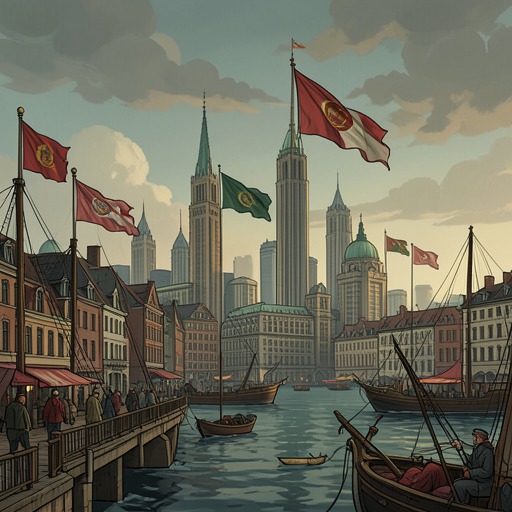
Annexation of Sicily to the Kingdom of Sardinia
The Florios of SicilyThe Annexation of Sicily to the Kingdom of Sardinia is presented as a change of sovereignty that fails to deliver meaningful self-government: officials from the north extend their laws, taxes, and trading system across the island without adapting them to Sicilian conditions. Its consequences reach from public discontent to the private arguments and commercial anxieties of Vincenzo Florio, making annexation a political turning point whose promised unity is shadowed by renewed subordination.
Background: Trade and Political Control
Earlier changes of regime had already shown how directly political authority could govern commerce. After the Bourbons returned, Neapolitans took control of state offices, customs, and military command from December 1816. Palermo lost its power and independence, while heavier taxes and new trade restrictions brought an already faltering economy to a halt. The book thus frames later disputes over sovereignty against a history in which control of administration and customs could determine whether Sicilian merchants could operate at all.
The island’s economy was also embedded in routes extending well beyond Sicily. Spices passed through many hands and across long overland and sea journeys before reaching European ports; the costs accumulated at each stage, leaving medicinal and culinary goods accessible chiefly to the wealthy. By the early nineteenth century, British and French merchants sold colonial goods such as medicinal herbs, sugar, tea, coffee, and chocolate. Lower prices and a wider market increased the number of people able to sell spices, including Palermo’s aromatari. The Florios’ own trade drew on this international network: their warehouse within the Palazzo Steri property held spices from India obtained through the British, goods from French colonies bought through Italian sailors, and products from across the Mediterranean. That commercial reach made customs rules and political control more than abstract questions of government.
From Revolution to Unification
The annexation follows the revolutionary struggle against Bourbon rule. In 1848, Vincenzo Florio tells Giulia that he has bought a large consignment of rifles for the revolutionary committee. The revolutionaries proclaim a Kingdom of Sicily and seek to revive the 1812 constitution, but they cannot find a king willing to take the crown; Vincenzo also notes British opposition to Sicily’s separation from the Bourbons. The episode places his financial and commercial resources inside the political conflict, while exposing the uncertainty of the revolutionary project and the competing pressures bearing on it.
The later movement toward unification is described as a coalition of forces rather than a simple popular triumph. Sicilian unrest continues underground, while nobles and members of the intellectual middle class look to Victor Emmanuel II, king of Sardinia, as a means of freeing the island from Bourbon subjection. Francesco Crispi persuades Giuseppe Garibaldi to support an external insurrection, presenting the effort as a way to assist Sicilian rebels and ultimately unite Italy. Garibaldi’s volunteer force sails from Quarto, lands at Marsala, and advances through Sicily before reaching Naples. His meeting with Victor Emmanuel II at Teano marks the beginning of the Kingdom of Italy.
The Terms and Consequences of Annexation
The decisive criticism is that the new authorities do not accommodate the island they have incorporated. After unification, officials from the Kingdom of Sardinia extend their legislative, economic, fiscal, and trading systems to southern Italy and Sicily without adapting them. They refuse compromise. The resulting discontent is not confined to the aristocracy: nobles lose privileges and cultural identity, while ordinary people remain trapped in difficult economic conditions with little prospect of improvement. The narrative concludes that Sicily is once again a conquered land, turning the language of national union against the experience of imposed rule.
That judgment resurfaces in Giulia and Vincenzo’s later conflict. Vincenzo is angry that the new authorities behave not as sovereigns but as masters: they impose laws and officials and refuse to listen to people with experience of Sicilian affairs. Giulia’s response sets his grievance against the sacrifices made for a united nation, but Vincenzo insists that Piedmont is reducing Sicily to a colony. He also alleges that the Bourbon Crown’s treasury has been seized and taken to Piedmont to pay for the annexation campaign. The disagreement makes the political dispute intimate: Giulia asks what the ideal of unity means, while Vincenzo fears that the new state will take control of the world he has built.
Commerce and the Limits of Sovereignty
The novel repeatedly measures political power through its effects on goods, ships, and money. During the 1848 upheaval, customs disorder brings trade to a standstill: outgoing ships are blocked, and Vincenzo’s shipment is caught amid requisitions and the formation of a provisional government. Later, after unification, he goes to the Royal Bank and orders all cash and bank drafts transferred into the safe until the crisis passes and the money can be returned to circulation or converted into the kingdom’s new currency. He expects Garibaldi’s men to requisition the substantial gold supply in the treasury within hours. These episodes show a merchant adapting to political transitions by protecting liquidity, while public authorities claim access to shipping and reserves for their own purposes.
The annexation’s meaning therefore exceeds the formal transfer of sovereignty. It joins the larger pattern of Sicily’s dependence on outside commercial and political powers: foreign networks shape the spice trade, state administrations control customs, and new authorities impose fiscal and trading systems without local compromise. For Vincenzo, national unity does not resolve that imbalance. It risks replacing Bourbon command with a new center of power that can still dictate terms to the island and intrude upon the commercial independence he has spent a lifetime creating.