Arenella tonnara
The Florios of SicilyArenella tonnara is the Florio family’s tuna-fishing plant and, more than any of its other holdings, the place through which the novel gives form to Ignazio Florio’s enduring bond with the sea. Its changing fortunes mirror the company’s growth: it is kept through years of poor fishing and scarce money, revived when conditions improve, and eventually reshaped into a productive industrial site and a house Vincenzo imagines as a family legacy.
Setting and work
The plant’s life follows the seasonal movement of tuna and the labor organized around catching and processing them. In May 1828, after the Feast of the Holy Crucifixion, Ignazio watches the fish unloaded following the mattanza, the traditional slaughter. The account locates the scene in spring, but its emphasis is on the work and its consequences: the fish arrive in succession, and the catch becomes the basis for the tonnara’s commercial activity.
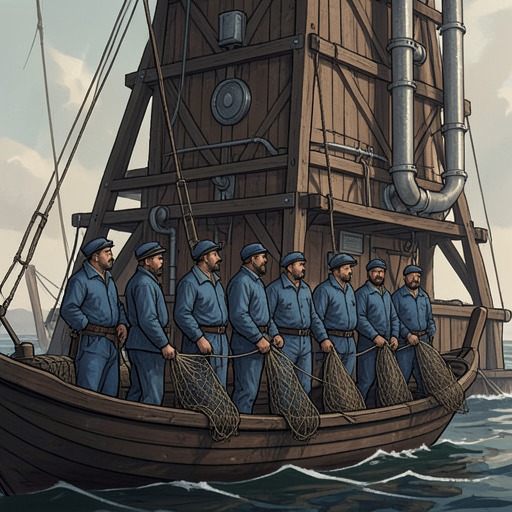
The fishing is collective, not simply a matter of an owner’s investment. Men repair the nets that will catch tuna as they enter the Mediterranean to mate, while the rais directs work at the tonnara. After a successful second netting, the company secretary reports that the crew can collect its money from the office. The fishery therefore connects the sea’s seasonal yield to coordinated labor and payment.
The site is also a processing plant, not merely a place to land fish. Sounds of voices, impacts, and chains come from inside as the catch is handled; the secretary notes that the tuna can be cured and sold on the mainland, beyond the lighthouse. Later, a can of tuna in brine from Arenella appears in a domestic setting, making the plant’s output tangible beyond the fishing season and its immediate workforce.
Ignazio and the recovery of the fishery
Ignazio’s attachment to Arenella is personal as well as commercial. He explains that he took over its management when it was not productive: fishing was scarce, the British had left, and money was no longer circulating. Within a few years, he says, circumstances changed. The secretary likewise observes that the timing had previously been wrong but that the current year’s sea has been generous. The recovery thus depends on a favorable catch and a changed economic setting, rather than on the plant alone.
That commitment has a cost. The larger Ignazio and Vincenzo Florio Company becomes wealthy through spices, colonial goods, insurance, and shares in steamers and cargo ships; it also manages several tuna fisheries, including those at San Nicolò l’Arena and Vergine Maria, and later takes over the fishery at Isola delle Femmine. But for Vincenzo, the tonnara means Arenella in particular. It is the one Ignazio continued to rent even when tuna fishing was in severe crisis. The contrast between the wider portfolio’s profitable investments and this persistently maintained site marks Arenella as an attachment that cannot be reduced to short-term returns.
Ownership, enterprise, and transformation
Arenella’s operation involves shareholders and partners as well as the Florios. Mercurio Nasca di Montemaggiore is identified as one of the tonnara’s shareholders, alongside the Monastery of San Martino delle Scale. In a later domestic scene, Vincenzo’s share in the plant is described as a partnership with Augusto Merle, a half-Frenchman who had relocated to Palermo. The evidence presents the fishery as an enterprise built through shared interests, even as the Florios’ influence over it grows.
The family’s commercial position rests on handling goods through multiple stages, and the tonnara extends that pattern from capture to processing and sale. The company’s other activities include trade in spices and colonial goods, insurance, and shipping; tuna adds a product drawn from local waters and prepared for a mainland market. The appearance of Arenella tuna in brine further connects the plant to the family’s preservation efforts and to the movement of food from the fishing site into ordinary household use.
The physical setting changes with the enterprise. In one visit, Vincenzo walks past the marfaraggio, the working plant, whose exterior is painted the same black as the fishing boats. Later, the courtyard has become a front garden, with a trellis, trees, and potted plants breaking up the cobblestones. The low building has been raised and turned into a house, with large windows and a terrace overlooking the boat ramp; a square turret stands nearer the sea. The change does not erase the site’s industrial history: the house remains organized around the courtyard, ramp, and shoreline of the fishery.
A family inheritance and imagined home
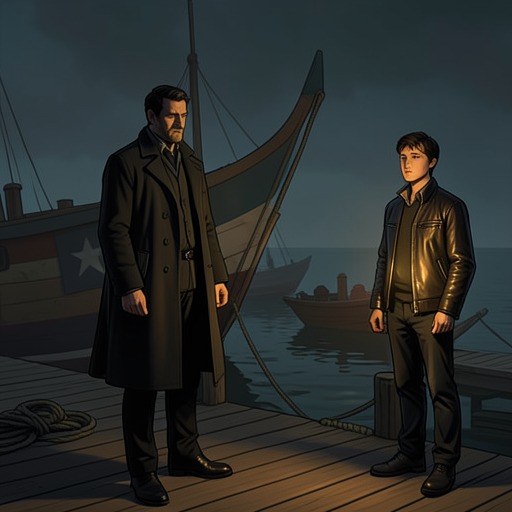
Vincenzo’s own language makes clear that Arenella is both a business asset and an object of longing. He embraces its buildings with his gaze and asks why he has brought his companion there; he then says that what he wants is a villa, pointing to the walls. His plan locates a domestic future inside the place associated with Ignazio’s labor and his own commercial life.
That wish belongs to a wider concern with what the family will leave behind. Vincenzo thinks that what Ignazio and he have built cannot be left exposed to chance; it is an heirloom to be passed on and safeguarded, for which he believes good blood is necessary. The phrase places the fishery within the Florios’ effort to turn acquired wealth into durable family standing. Yet the novel repeatedly shows the limit of that effort: aristocratic families distinguish business dealings from marriage and kinship, and Gabriele Chiaramonte Bordonaro refuses to marry his relatives to Vincenzo’s daughters because of the circumstances of their birth, even while acknowledging the value of Vincenzo’s money. The transformed tonnara can make the Florios’ achievement visible, but cannot by itself dissolve inherited social barriers.
Narrative significance
Arenella gathers several strands of the Florio story into one changing place. It is a site of seasonal fishing and organized labor, a commercial operation whose returns depend on timing and markets, and a material record of Ignazio’s willingness to maintain an unprofitable investment. Its later conversion into a house gives that record an intimate dimension: Vincenzo wants to inhabit and pass on the place that first embodied his uncle’s commitment.
The fishery also helps distinguish commercial success from social acceptance. The Florios can invest in multiple fisheries, process tuna, and make the Arenella property into a substantial residence, yet their wealth does not automatically become aristocratic legitimacy. The plant’s transformation therefore carries a double meaning: it displays how far the family has risen through work and enterprise, while its proposed future as an heirloom exposes the continuing importance the family assigns to blood and inheritance.