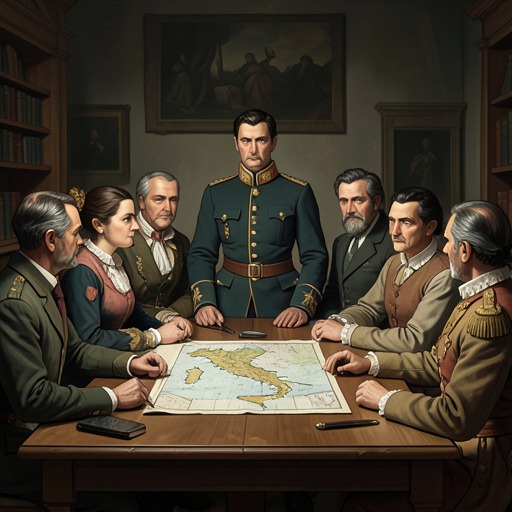
Capture of Palermo (1860)
The Florios of SicilyThe Capture of Palermo (1860) is the military turning point through which Garibaldi’s forces take the city from the Bourbons, but the novel presents conquest as both street fighting and a contest over sovereignty. As the city braces for the approaching Red Shirts, fear divides households; after the Bourbon position collapses, the new authorities and local merchants begin negotiating in the same political landscape left by the failed revolution of 1848.
Causes and Background
The city’s vulnerability has a longer political and economic history. Since 1816, Neapolitans have administered state offices and customs and held military command; Palermo has lost its political independence, while heavier taxes, restrictions, and limits on trade have brought its already faltering economy to a halt. This history gives the invasion stakes beyond a change of rulers: control of customs, commerce, and public resources is part of the struggle over who governs Sicily.
The narrative has already shown how each regime’s claims reach into trade. During an earlier customs shutdown, outgoing ships were blocked amid confusion over a provisional government, and merchants and sailors crowded the Customs House. Under Ferdinand II, meanwhile, the government promoted infrastructure and technology, including railways and metal-hulled military ships, while sulfur exploitation provoked conflict with British and French buyers seeking below-market prices. The 1860 conquest therefore arrives in a world where political authority is experienced through the movement of ships, commodities, and money as well as through armed force.
The City Awaits an Army
As Garibaldi draws to within seven miles, Palermo hesitates between welcoming his Red Shirts and the peasant volunteers known as picciotti, or preparing for a defense that appears unlikely to succeed. The city is not united in its response. Some families bolt doors and windows; women pray the rosary while men hide behind shutters, whereas many young men take up rifles and ready themselves for the assault. Political uncertainty becomes a domestic division, with residents facing the same approaching force from opposing positions.
On May 23, Garibaldi’s men reach the gates through the mountains rather than by sea. From inside the city, residents see dust raised by the clashes and hear cannon fire and gunshots. The approach through the mountains makes the assault a landward arrival, not a naval landing, and turns the surrounding heights into the route by which the city’s fate closes in.
The Assault and Conquest
Four days after reaching the gates, the attackers break through Porta Termini, Palermo’s most vulnerable entrance. The Bourbons then attempt to shell the city from the sea, but the bombardment comes too late to prevent the advance. After a clash in Via Maqueda, Palermo is conquered. The sequence moves from the breached gate to fighting within the city, marking the decisive collapse of Bourbon control there.
The men in red shirts pass through Porta Termini and spread into the streets. Young people and others join them, while the arriving force’s Italian speech carries a mixture of nuances, sounds, and accents. The city’s response is not simple celebration: people embrace and wave flags, but also watch one another suspiciously and hide family jewels. Furniture piled in the streets as barricades is cleared away, exposing building façades as the immediate fighting gives way to occupation and uneasy contact.
Political Aftermath and Meaning
Garibaldi declares that the expedition must continue and redeem the Bourbon kingdom, so the capture is a stage in a larger campaign rather than its conclusion. Meanwhile, contracts are made and agreements sealed inside Palermo. The provisional government occupies Palazzo Pretorio, the same civic building where rebels had gathered in 1848. Twelve years later, some of those rebels have returned, older and more cynical but still determined; others have unfinished business or new pacts to pursue, and seek quieter places away from the crowds and watching eyes.
The transfer of power remains inseparable from control of finance. As trade governor, Vincenzo Florio orders all cash and bank drafts transferred into the safe, intending to keep the money secure until the crisis ends and it can be returned to circulation or converted into the kingdom’s new currency. The gold ingots in the treasury are harder to protect: Garibaldi’s men are expected to requisition them within hours. The city’s conquest thus places commercial assets and public wealth at immediate risk even as new political agreements take shape.
The victory also fails to settle the question of Sicilian autonomy. Vincenzo later argues that the Piedmontese are turning Sicily into a colony and condemns the removal of the Bourbon Crown treasury to Piedmont to pay for annexation. His objection places the conquest within a second transfer of power: Bourbon rule has been displaced, but the island’s resources and political direction remain contested. Palermo’s capture is therefore both a military defeat of the old regime and the beginning of conflict over the terms of the new one.