Catholic norm against abortion
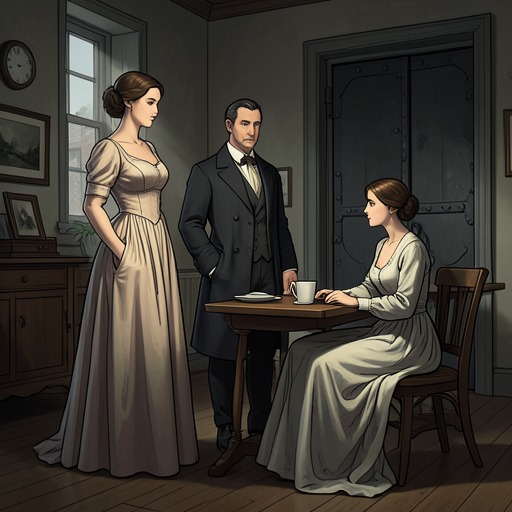
The Florios of SicilyCatholic norm against abortion is portrayed as an inwardly enforced religious prohibition, not merely an abstract rule. It shapes Giuseppina’s thoughts about an unwanted pregnancy: she believes refusing the child would be a mortal sin, yet cannot make herself feel that the child is hers. The enduring conflict between doctrine, expectation, and distress gives the norm its narrative force, while nearby scenes of sexual coercion expose the unequal conditions in which women are expected to bear its consequences.
Religious Prohibition and the Unwanted Pregnancy
Giuseppina’s hesitation is rooted in teaching she has absorbed since childhood. Her grandmother warned that the Blessed Virgin turns away from a woman who casts off her child, and Giuseppina understands the thought of refusing a pregnancy as sinful. When she considers seeking the Bagnara midwife, Mariuccia Colosimo, she pauses over the moral meaning of what she might do: the prohibition is already active before she has made any decision.
The pregnancy makes the conflict intimate rather than theoretical. Giuseppina believes children are sent by God and that refusing them is a mortal sin. She also believes that the Lord gives and takes away, and fears punishment if she harms the child. Yet she does not experience this pregnancy as she did the one with Vincenzo: he had seemed connected to her even before birth, while the child she now carries feels alien. The rule offers no resolution to that estrangement; it sharpens the gap between what she thinks she must believe and what she feels.
The Discipline of Motherhood
Giuseppina tries to imagine that attachment may come with time. Perhaps she can grow accustomed to the pregnancy and let nature teach her again how to be a mother. That effort to reassure herself is immediately shadowed by another fear: perhaps wishing not to be a mother is itself sinful. The passage therefore distinguishes between the act she might take and the thought she cannot stop having. Even desire for an end to motherhood becomes a source of guilt.
The narrative gives this thought a long afterlife. Giuseppina will carry it for years, and remembering it will feel like a nail digging into her. The lasting consequence is not a stated outcome of the pregnancy but the persistence of moral pain: she is left with a memory in which religious prohibition, fear of harming the child, and alienation from it remain bound together. When a cramp makes her stop at the breakfast table, she tells Vittoria only that she is having women’s pains; the private spiritual conflict remains unspoken.
Intimacy, Force, and the Limits of Bodily Response
Other intimate scenes in the evidence complicate any easy equation between female bodily response and consent. Paolo presses Giuseppina after she says she is tired and tells him to leave her alone. He grips her, lifts her skirt, and then takes her by the wrist to the bedroom, where he undresses her. She keeps her eyes shut as he searches for love and she feels she has to give it. Her body’s involuntary quiver does not undo her refusal or the coercion described in his actions.
The same distinction matters in the encounters involving Vincenzo and Giulia. At the exit, Giulia wants to leave, but Vincenzo stops her with his hands on her bare shoulders and drags her into darkness. Later, after declaring that their relationship must end, he drops her basket, removes her hat, and kisses her physically while she tries to push him away. When he kisses her again and tears the lace of her dress, the narration says she cannot fight back because her flesh betrays her, and that she wants him. That language records desire and conflict, but it does not erase the concrete force, restraint, and spoken resistance in the scene.
Narrative Significance
The religious norm is most sharply rendered through the distance between doctrine and lived experience. Giuseppina believes the child is God-sent and fears divine punishment, but her alienation from the pregnancy does not disappear under that belief. The remembered warning of the Virgin gives the prohibition a personal and inherited voice; the lasting image of the nail shows how guilt continues long after the moment of hesitation.
Set beside the scenes of sexual pressure, this conflict also reveals how bodily autonomy is constrained from more than one direction. Giuseppina’s religious convictions intensify the burden of an unwanted pregnancy, while the intimate scenes show men exercising physical power in the face of women’s refusals. The narrative does not present bodily desire as proof of consent, nor does it resolve the tension by claiming that belief settles what Giuseppina should feel. Instead, it leaves the reader with the cost of an obligation experienced as both sacred and painful.