Favignana Tonnara
The Florios of SicilyFavignana Tonnara is the tuna-processing complex that Vincenzo Florio calls his masterpiece after ten years of management. Its high rent and the risks of introducing a new preservation method mark it as more than a source of wealth: the fishery embodies his ability to reorganize production and bring people into a shared enterprise. When Vincenzo takes his fourteen-year-old son, Ignazio, there for the first time, the workplace also becomes a setting for passing on the knowledge and responsibilities behind the family business.
Setting and Industrial Transformation
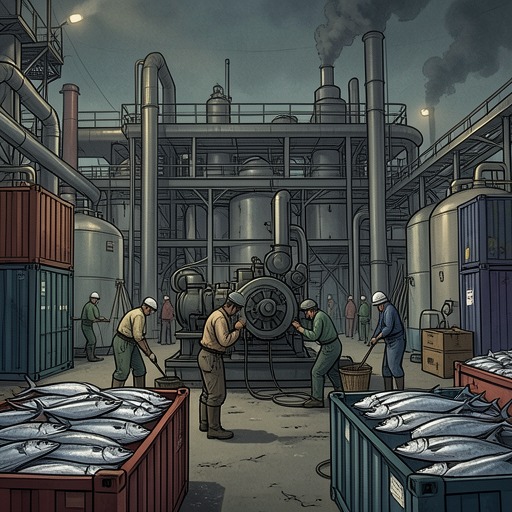
The fishery stands beyond the village on Favignana. Its working grounds include warehouses, a courtyard shaded by trees, a stone corridor, a boat shelter, and an open area by the sea where workers mend nets and rigging. The island’s beauty does not conceal the conditions of processing: the plant is accompanied by the odor of tuna remains decomposing in the sun. Vincenzo points out the area where the carcasses are left to dry, known as the bosco, or tuna cemetery.
That waste is part of a production system that carries the catch beyond the island. Vincenzo has managed the tonnara for ten years, despite its high rent, and built a network of entrepreneurs while taking on the risks of a new preservation method. Tuna preserved in oil has spread across the Mediterranean. A can of tuna in brine from the Arenella tonnara, which Vincenzo owns in partnership with Augusto Merle, also connects his broader tuna business to domestic life: when Giulia asks for help opening it, the familiar product brings Vincenzo’s memories of his childhood kitchen into the present.
Work, Labor, and Organization
Vincenzo recalls that when he first came to Favignana with Carlo Giachery, the site was in disrepair and lacked suitable accommodation. He sent a message to Palermo for ship carpenters and builders to renovate it, while he began teaching local people how to produce tuna in oil. The account links commercial innovation to construction, instruction, and the organization of labor rather than to an invention operating on its own.
To explain his approach to managing people, Vincenzo reenacts the gestures of that first effort: he removes his jacket and rolls up his sleeves. He had gathered the heads of families and their wives to show that he was willing to get his hands dirty. His stated principle is that workers should feel part of something when they work for an employer. The scene presents the fishery’s development as dependent on relationships with the people who do the work, even as Vincenzo remains its owner and manager.
The wider commercial context helps clarify what is at stake in such an enterprise. The book describes commodities reaching markets through extended chains of transport, handling, and sale, with costs accumulating along the way. The Florios’ warehouse within the Palazzo Steri property serves as a transit point for spices from India obtained through British traders and goods from French colonies sold through Livorno and across the Tyrrhenian Sea. Elsewhere, sulfur extracted by workers in Sicily is shipped to France, Britain, and northern Italy. Against this background, the Favignana fishery represents another effort to organize production and extend a Sicilian commodity’s reach through a commercial network.
A Father’s Lesson and an Heir’s Introduction
The visit to Favignana changes the usual pattern of Vincenzo’s relationship with Ignazio. The boy often accompanies his father to the office and to the Marsala cellars, but this is the first time Vincenzo has brought him to the island. As they walk through the complex, Vincenzo takes his son by the arm. Ignazio accepts the gesture with surprise and wariness because he cannot remember his father holding him so closely before.
Vincenzo introduces the fishery by telling Ignazio how he rebuilt the neglected site and taught its workers the new method. The lesson shifts from the mechanics of the business to the knowledge that makes it possible: understanding people. Vincenzo remembers that his uncle, after whom the boy was named, made him stay behind the counter of the aromateria, a job he once hated but later understood as preparation for dealing with people. Ignazio answers that this was for understanding them. The exchange makes the island visit an account not only of commercial achievement but of how practical knowledge passes between generations.
Inheritance and Social Status
The fishery belongs to a larger family project that Vincenzo regards as an inheritance requiring protection. After Ignazio’s death, Giuseppina worries that what Ignazio and Vincenzo built must not be left exposed to chance; she believes Casa Florio needs a suitable heir and a woman raised as a lady to secure its future. Her outlook makes visible the pressure of lineage around a commercial enterprise: money and accumulated work alone, in her view, do not settle the question of who will carry the family forward.
That tension recurs in the Florios’ encounters with the aristocracy. At a gathering in the Quattro Pizzi hall, Vincenzo watches titled guests assess the furnishings with envy and irritation, while remaining unwilling to regard him as their social equal. He measures their inherited privilege against his own attention to work, the sea, ships, tuna, sumac, sulfur, silk, spices, and Casa Florio. The Favignana fishery gives concrete form to that contrast: it is a costly, labor-intensive achievement that can expand the family’s wealth, but commercial success does not by itself dissolve the status boundary between new money and noble birth.