Giuseppe Garibaldi
The Florios of SicilyGiuseppe Garibaldi enters the story as the leader around whom a divided Sicilian revolt can become an armed campaign for Italian unification. His 1860 expedition brings the red-shirted volunteers into Sicily, where they are welcomed as liberators by some and feared as conquerors by others; the capture of Palermo makes that tension visible in the city’s streets. The victory opens a new political order, but the novel’s account of what follows refuses to treat unification as a simple resolution: Sicily again finds itself governed from outside.
Political Context and the Invitation
By 1860, revolutionary unrest in Sicily is simmering beneath the surface, sustained by clandestine publicity and failed attempts at popular uprising. Francesco Crispi proposes that Garibaldi support Sicilian rebels through an external insurrection, one intended ultimately to unite Italy. To persuade him, Crispi tells him that an uprising has already begun in Palermo—the Gancia revolt, which Crispi himself steered from April 4 to 18. The account presents Garibaldi’s intervention as the convergence of two political aims: aiding the island’s rebels and advancing national unification.
Garibaldi and his volunteers depart from Quarto on May 5 without the king’s explicit support. The expedition is made up of volunteer fighters recognizable by their red shirts. They land at Marsala on May 11 and reach Salemi on May 14, where Garibaldi proclaims himself dictator of Sicily in the name of Victor Emmanuel II. The sequence gives the campaign a deliberate political framing: Garibaldi leads an armed expedition, but its declared authority is attached to the Sardinian king and its stated horizon is a united Italy.
The Advance Through Sicily
After the proclamation at Salemi, Garibaldi’s men march on Palermo. They reach the city on May 23, approaching not from the sea but through the mountains. Palermo is already caught between expectation and dread. Some residents consider going out to meet the Red Shirts and the picciotti, the peasants who joined Garibaldi and helped at the Battle of Calatafimi; others prepare for a defense they believe may be futile.
The city’s division is domestic as well as political. Some families barricade themselves indoors, bolting doors and windows; women recite their rosaries while men wait behind closed shutters. Other young men take up rifles and ready themselves for the assault. Garibaldi’s approach therefore does not find a city united in welcome. It exposes competing calculations about danger, resistance, and the uncertain outcome of the Bourbon regime.
Four days after the men reach the gates, Palermo yields. A group of fighters storms Porta Termini, its most vulnerable entrance. The Bourbons then decide to bombard the city from the sea, but the decision comes too late. Following a clash on Via Maqueda, the city is conquered. The red-shirted troops enter through Porta Termini and spread through the streets; residents join their procession, while others watch with suspicion or hide family jewels. Hugs and waving flags coexist with distrust and precautions against the upheaval.
Palermo After the Conquest
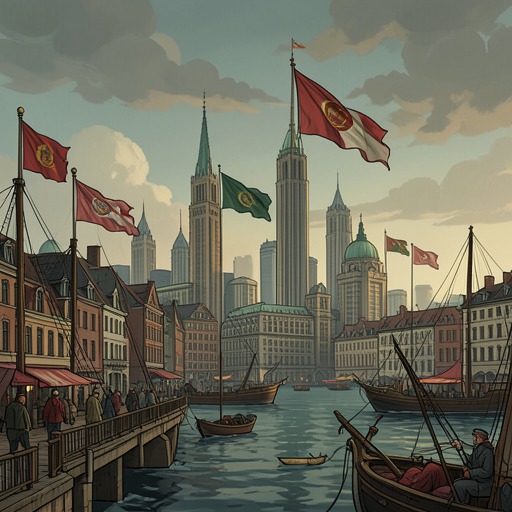
The arrival of Garibaldi’s forces changes the visible life of the city. Streets cluttered with furniture used for barricades are cleared, and a varied crowd moves through them, speaking Italian in different nuances, sounds, and accents. People from Piedmont, Venetia, Rome, and Emilia encounter a Palermo they had previously known only through companions in exile. Their attention falls on the city’s contrasts: its cathedral and Moorish pinnacles, the Norman mosaics of the Royal Palace, sumptuous Baroque houses, sailors’ and fishermen’s cottages, and aristocratic palaces. Palermo appears at once poor, dirty, and regal, its sewers and orange blossom sharing the same urban landscape.
The narrative also registers how quickly the campaign moves beyond the island’s capital. Garibaldi’s forces reach Naples on September 7. His meeting with Victor Emmanuel II at Teano on October 26 marks the beginning of the Kingdom of Italy. The campaign thus links the Sicilian fighting to a national political settlement, though the book distinguishes the military promise of liberation from the terms of the state that follows.
Vincenzo Florio and the New Power
Garibaldi’s advance intersects with the Florio business through Vincenzo’s decisions about when and how to commit. As Garibaldi approaches, the city is unsettled by the memory of the Gancia revolt and by news that Rosolino Pilo has died fighting at San Martino delle Scale. Vincenzo cannot know what will happen, but he goes to the Royal Bank carrying a bag and a decision; he has left Ignazio in Via dei Materassai because he does not want him involved.
Vincenzo later offers information demonstrating his knowledge of the Royal Bank, acknowledging that disclosing it exposes him. His interlocutor says the offer will be reported to Garibaldi and notes Vincenzo’s contribution to producing cannons for the Red Shirts at the Oretea foundry. Vincenzo describes the work as his duty as a Sicilian and says that once the workers understood the cannons were intended for use against the Bourbons, they did not mind how long they had to work. The exchange makes his support concrete: it consists not only of political alignment but of industrial production and information, resources that can materially assist the expedition.
Yet the episode also preserves the ambiguity of his timing. His interlocutor remarks that Vincenzo had the foresight to wait and see which way the wind was blowing. The observation casts commercial prudence and patriotic commitment together rather than resolving them into a single motive. For Vincenzo, the political change is also a question of protecting a business whose ships and services have repeatedly been claimed by the state.
Unification and Its Limits
The conquest and the meeting at Teano lead toward the Kingdom of Italy, but the narrative’s account of unification emphasizes what Sicily does not gain. Sardinian officials extend their legislative, economic, fiscal, and trading systems to southern Italy and Sicily without adapting them to local conditions or accepting compromise. Nobles resent the loss of privileges and cultural identity, while ordinary people remain caught in an economy with difficult conditions and little apparent prospect of improvement. Sicily is described, in consequence, as once again a conquered land.
That aftermath gives Garibaldi’s role its central tension in the novel. His expedition helps defeat Bourbon power in Palermo and carries the campaign to Naples, while his proclamation in Victor Emmanuel II’s name anticipates the national state. But the transfer of sovereignty does not amount to local autonomy. Garibaldi’s military success belongs to a story of liberation whose political settlement leaves Sicily subject to an externally imposed system; the city’s welcome and fear, and Vincenzo’s mixture of allegiance and calculation, register the difference between conquering a regime and securing a just outcome for the island.