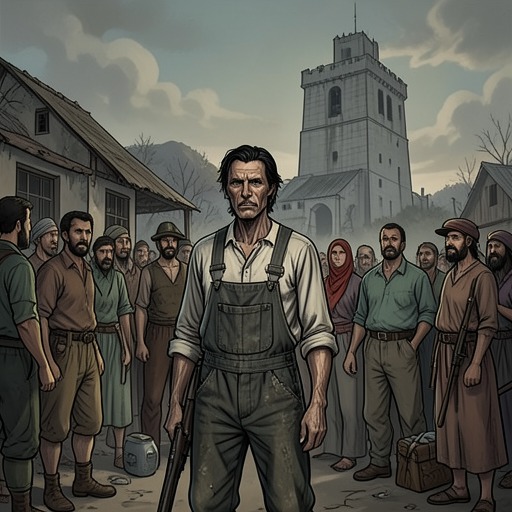
Giuseppe La Masa
The Florios of SicilyGiuseppe La Masa is a prominent Sicilian patriot whose appearance in the 1848 revolt forces the prosperous merchant Vincenzo Florio to face the political and moral stakes of independence. A leader of the Palermo insurrection, he is at once a wanted enemy of Bourbon rule, a persuasive advocate for a new Sicily, and one of the revolutionary figures sent into exile after the movement’s defeat. His confrontation with Vincenzo joins the island’s struggle for self-government to the merchant’s private calculations of risk, wealth, and responsibility.
Identity and political background
La Masa is identified as one of the leaders of the insurrection that begins in Palermo on January 12, 1848, alongside Rosolino Pilo. Their revolt makes Palermo the first large Italian city to declare independence from central power. In the wider upheaval, Admiral Ruggero Settimo heads the revolutionary government, which tries—with the aid of aristocrats and the bourgeoisie—to draw the people into decision-making. The revolt therefore begins with a coalition, but not a settled agreement about what a new political order should deliver.
The independence cause has force beyond the city. After years of relative quiet, protests spread through Sicily from 1847 amid poverty, demands for independence, and social conflict. Ferdinand II’s repressive posture intensifies these tensions. The book later makes clear that the revolutionary coalition contains competing material interests: aristocrats and bourgeoisie hope to acquire Church property and grow wealthy, while ordinary people look to land redistribution. La Masa’s call for a new Sicily speaks into this divide, even as the movement’s different constituencies make a unified settlement difficult.
The encounter with Vincenzo Florio
La Masa enters Vincenzo’s story during a dangerous passage outside Palermo. Vincenzo is confronted by an armed young man who accuses the wealthy of believing money gives them the right to go anywhere and command everyone. The youth points a pistol at Vincenzo and orders him to turn back, claiming that he is trying to flee the city. La Masa arrives with other armed men, intervenes, and rebukes the youth for treating people like bandits. The scene places the uprising’s suspicion of wealth beside the immediate threat of armed force.
La Masa recognizes Vincenzo as the owner of Casa Florio and offers him his hand. He introduces himself as a patriot and greets Vincenzo’s companion, Giulia Portalupi. Vincenzo already knows his name from newspapers that portray him as a rebel and agitator, and understands that he is among the most famous and wanted enemies of the Bourbon government. For Vincenzo, La Masa is not simply an insurgent encountered on the road: he represents a political movement that has entered the space of his family and business.
Giulia answers La Masa before Vincenzo does. She says she has heard of him and read his work, describing it as closer to a manifesto than a book, but useful to her. Vincenzo is astonished and angered that she has read an insurgent’s writing; Giulia meets his reaction with a fierce look, leaving their argument for later. Her response reveals that La Masa’s ideas have travelled into the Florio household and that she has engaged with them independently of Vincenzo’s approval.
Argument for an independent Sicily
La Masa explains his cause in terms that connect political subordination to everyday material grievance. Looking toward Palermo, where cannon fire and smoke mark the assault on the city walls, he says the city is on the insurgents’ side. He condemns the Neapolitan authorities who command in Sicily, take its wealth, and impose heavy taxes. He also invokes the abuse of Sicilian women by Ferdinand’s soldiers, arguing that the island is treated as a conquered and exploited land rather than as a community of subjects to be governed.
His appeal enlarges the conflict beyond Palermo: he insists that the whole island is rising, and that Sicilians deserve a better life. This is not an invitation framed only in constitutional language. La Masa makes independence a claim about who controls Sicilian resources, who bears the burden of taxation, and whose people are exposed to military violence. His speech gives Vincenzo’s commercial position an uncomfortable double meaning: the merchant possesses resources that could assist the cause, but wealth alone does not settle whether he will stand with those challenging the order that enables his prosperity.
La Masa presses that point directly. He presents Vincenzo as an enlightened entrepreneur, one of the island’s few, and asks him to collaborate in building a new world with his resources and intelligence. The request turns a political argument into a test of participation. Vincenzo is alarmed by La Masa’s intensity and sees that the armed men have not lowered their weapons; they have also surrounded his children’s carriage. The offer of alliance thus arrives under coercive pressure and amid an immediate threat to his family, complicating any easy distinction between persuasion and danger.
Vincenzo, Giulia, and the revolution’s stakes
Afterward, Giulia challenges Vincenzo’s habit of dismissing her political understanding as outside a woman’s concern. She explains that reading La Masa’s work helped her understand why he, Rosolino Pilo, and Ruggero Settimo are seeking to establish an independent Sicilian state. She distinguishes belief in their passion from certainty about their success, and asks Vincenzo to speak to her as a partner rather than treating her as his mother or daughter. Her account makes La Masa’s writing consequential beyond the public encounter: it has furnished Giulia with a framework for interpreting the revolution and for questioning her place within Vincenzo’s private world.
Vincenzo admits that he has bought a large consignment of rifles from England on behalf of the revolutionary committee. Yet his support is already mixed with apprehension. The revolutionaries proclaim a Kingdom of Sicily but cannot find a willing king; the British oppose separation from the Bourbons; and the renewed constitutional project lacks a point of reference. Vincenzo also resents the requisitioning of ships and the pressure to provide what amounts to a loan. His decision to supply arms therefore does not make him a confident revolutionary. It exposes the strain between commitment to the cause and the commercial and personal costs of acting for it.
Defeat, exile, and continuing influence
The revolution eventually founders on both military defeat and internal fragmentation. In May 1849, weakened and pursued by Bourbon troops, the revolutionary administration surrenders. Ferdinand II sends the leaders of the revolt into exile rather than sentencing them to death. When Vincenzo asks who will be exiled, the answer includes Ruggero Settimo, Rosolino Pilo, Giuseppe La Masa, the Prince of Butera, and roughly forty others. La Masa’s removal marks the end of his active presence in the immediate Sicilian struggle, but not the disappearance of the independence project.
The political settlement remains compromised. The constitution promulgated by the Sicilian Parliament in March 1848 is suspended, and Ferdinand imposes a heavy national debt as he attempts to restore unity in the Kingdom of the Two Sicilies. Local administrations and people, worn down by instability, accept the taxes, while aristocrats distance themselves from further rebellion. Against that reactionary restoration, the patriotic energy of the exiles continues through their writings and interventions. La Masa is named alongside Settimo and the younger Francesco Crispi as part of this continuing current. His narrative significance lies in that persistence: although forced from the island after defeat, he remains a voice through which the 1848 demand for Sicilian independence outlasts the revolution that first gave it political form.