Ignazio and Giuseppina's affair
The Florios of SicilyIgnazio and Giuseppina's affair is a secret bond shaped by bereavement, resentment, and constrained choice. Its decisive encounter moves from a mirror-side confrontation to a boundary Giuseppina crosses, but the scene keeps desire alongside fear and force rather than treating attraction as uncomplicated consent. The affair is buried as a shame neither can speak of; years later, Ignazio remains with Giuseppina and Vincenzo, describing what he feels not as passion but as the tenderness of a love past its summer.
Background and Household
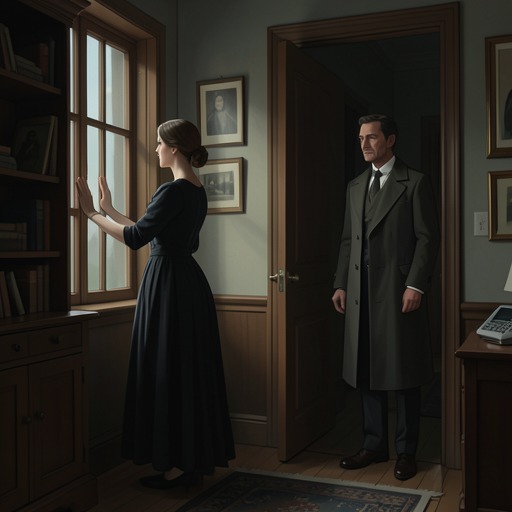
Giuseppina is Ignazio’s sister-in-law and Paolo’s widow. Their intimacy takes place inside a household marked by Paolo’s death and by Giuseppina’s sense that she has been made to live a life she did not choose. In a confrontation in her bedroom, she stands before a mirror in a plain nightdress left over from her trousseau, removing the clips from her hair. The ordinary domestic details frame a private reckoning: Ignazio asks why she keeps recalling the past, while Giuseppina answers that being there is a penance for her.
That history is not a distant obstacle that the affair simply overcomes. Giuseppina accuses the brothers of taking what they want: first Paolo, then Ignazio, she says, have taken her life, leaving her feeling reduced to nothing and condemning Vincenzo in her eyes as well. Her anger identifies the family structure around their relationship as part of its cost. Ignazio is not approaching a free-standing romance; he is entering a bond with his dead brother’s widow, who understands her place in the household through loss and constraint.
The Encounter and Its Unequal Terms
The central encounter begins in verbal conflict. Ignazio tells Giuseppina that she is important to him and asks why she must always remember the past. When she answers that her situation was not her choice, he leaves. Her resentment remains. She calls after him, then he suddenly catches her in a painful embrace from behind. Her nightdress opens, and they see one another in the mirror.
The narrative makes the shift in Ignazio’s conduct unmistakable: Giuseppina sees a stranger rather than the mild, patient man she knows. He is trembling, holding her tightly, and his desperate declaration that he would have taken what he wanted years earlier is accompanied by his hands. She is afraid; the scene does not erase that fear when it also records that she recognizes her own desire. The two responses coexist, and the text marks the approach to intimacy as precarious rather than as a simple reconciliation.
Giuseppina is the one who turns toward him and crosses the boundary. The narration immediately keeps the choice entangled with its anticipated aftermath: she may regret it in the morning, and the two may be unable to look one another in the eye for days. Their intimacy is described as a route their hands have already traveled in imagination, but that does not make the encounter free of the fear and pressure that have just been shown. Desire and apprehension remain part of the same scene.
Secrecy, Guilt, and the Wider Pattern of Coercion
The encounter becomes a secret they intend to bury. The narration says that remorse and awareness of betraying someone no longer present will be too powerful, so that neither will speak of the night, even as if it were a dream. Its secrecy is therefore bound not only to social exposure but also to Paolo’s absence and the lovers’ sense of betrayal. The affair is remembered as shame, not announced as a new public life together.
Elsewhere, the book places this relationship beside other intimate scenes in which physical desire is inseparable from coercion. When Paolo presses Giuseppina after she says she is tired and tells him to leave her alone, he squeezes her hips, lifts her skirt, and takes her by the wrist to the bedroom. The narration states that she has to give him the love he searches for. In a later encounter between Vincenzo and Giulia, Vincenzo stops Giulia from leaving by placing his hands on her bare shoulders; he kisses her forcefully, and tears the lace on her dress. These scenes do not establish that all the relationships are identical, but they make it important to read bodily desire alongside spoken refusal, force, and unequal power. In Ignazio and Giuseppina’s encounter, the narration likewise records both her fear and her desire, refusing to let one cancel the other.
The Long Afterlife of the Affair
Years later, Ignazio considers that he could find another woman, receive love, and start a family of his own. Yet he remains with Giuseppina and Vincenzo. He understands this not as mere duty or pretense but as the life he has chosen, and he can acknowledge that choice with the calm of someone who has settled accounts with his past. The passage does not describe a conventional romantic resolution; it presents continued attachment as a decision made within the history they share.
What Ignazio feels for Giuseppina has changed. It no longer has the taste of passion, the narration says, but resembles the gentleness of autumn evenings, with summer behind and winter approaching. The seasonal image gives their lasting closeness both warmth and limit: it is tenderness, but tenderness conscious of time and decline. The affair’s arc is thus not a public union or a clean escape from the past. It is a secret born in resentment and fear, preserved through remorse, and carried forward as a subdued companionship inside the family life Ignazio chooses.