Napoleonic Wars
The Florios of SicilyThe Napoleonic Wars are a changing political and commercial force in the novel, not merely a distant military chronology. French expansion first unsettles Italy and draws the Bourbon court to Palermo; later, wartime disruption turns Palermo into a Mediterranean free port, while the end of the conflict removes the British presence that had sustained its wartime importance. These reversals shape the market in which the Florios build their business and expose how quickly prosperity founded on strategic geography can contract.
Revolution and the Bourbon Court
The conflicts begin to press upon Italy from 1796, as troops led by Napoleon Bonaparte bring the winds of revolution. In 1799, the Jacobins of the Kingdom of Naples rebel against the Bourbon monarchy and establish the Neapolitan Republic. Ferdinand IV of Naples and Maria Carolina of Austria take refuge in Palermo, returning to Naples only in 1802, after the republican experiment has been crushed by fierce repression.
The broader war is marked by alliances that shift with military fortunes. In 1798, Great Britain, Austria, Russia, and the Kingdom of Naples join an anti-French coalition. After the French victory at Marengo on June 14, 1800, Austria signs the Treaty of Lunéville on February 9, 1801; Great Britain makes peace through the Treaty of Amiens on March 25, 1802. The account emphasizes the practical calculation behind the British settlement: it safeguards British colonial possessions and helps the Royal Navy strengthen its Mediterranean presence, especially around Sicily.
Wartime Trade and Palermo’s Opportunity
The wars reorder commerce as well as sovereignty. The spice trade, once associated with Venice’s wealth and customs duties, is increasingly supplied by British and French merchants drawing goods from overseas colonies. Their ships carry medicinal herbs alongside sugar, tea, coffee, and chocolate. As prices fall, markets diversify, and ports open, the number of people able to sell spices grows; in Palermo, the aromatari form a guild and maintain their own church, Sant’Andrea degli Amalfitani.
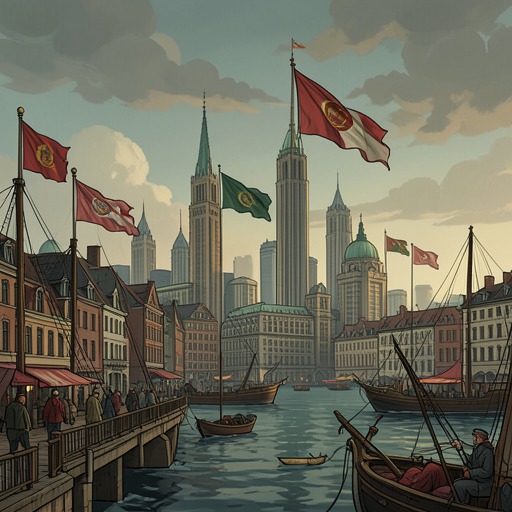
When hostilities resume, merchant shipping becomes dangerous. Napoleon attacks vessels crossing the Mediterranean, and the British, formerly masters of the sea, are pushed into a corner. Palermo and Sicily become a free port beyond French influence and occupy a valuable position at the center of the Mediterranean. Merchants and sailors arrive from across Europe; French spices come through northern Italian ports, British goods through Malta, and other supplies from Turkey, Egypt, Tunisia, and Spain. The Florios’ commercial world is thus made by disrupted routes and competing powers as much as by local enterprise.
The Florios in a Changing Market
The Florios turn the volatile trade into an expanding business. Their warehouse within the Palazzo Steri property, behind the customs offices, stores spices in transit or awaiting sale to merchants bound for other ports. The arrangement lets wholesalers defer import tariffs until goods actually enter Palermo, making rented storage preferable to paying taxes earlier. Their stock includes Indian spices obtained through British channels and products from French colonies, bought through Livorno and the Tyrrhenian trade, alongside goods from across the Mediterranean. Their store on Via dei Materassai eventually becomes too small, a concrete sign of how far the business has advanced, even if the Canzoneris remain wealthier.
That growth depends on a particular wartime geography. After Napoleon’s defeat, the Mediterranean is no longer closed to British trade: British merchants can trade wherever and however they please, and Sicily loses its strategic importance. The change is visible in Palermo’s empty harbor and shuttered British warehouses. A merchant city that had filled with international traffic now seems nearly dead, and the credit crisis compounds the contraction: half the city is in debt, while many creditors cannot collect what they are owed. The Florios’ commercial ascent and the market’s sudden retreat are presented as linked consequences of the same political shifts.
Political Afterlife and Long-Term Consequences
The wars’ aftermath does not restore a stable political order. Bourbon rule reunites the Kingdom of Naples with Sicily and revokes the 1812 constitution, a loss of Sicilian ambition that helps fuel hatred of the monarchy. In June 1820, revolt forces Prince Francesco to take refuge in Naples and brings about the creation of the Sicilian Parliament, which restores the constitution. The mainland uprising led by General Guglielmo Pepe follows in July, but conflict among Sicilian cities weakens the independence-seeking government. The monarchy returns in November, and Austrian forces enter Naples in March 1821 at Ferdinand I’s request, remaining until 1827.
Across these episodes, political time and commercial time move together but not at the same speed. Battles, treaties, and revolts rapidly change who controls the sea or the state; trade routes, customs arrangements, credit, and local labor determine how those changes enter ordinary life. Later images of sulfur extraction and the tuna fishery extend this material history beyond the Napoleonic conflict itself, showing an island whose fortunes continue to depend on commodities, transport, and the powers that govern access to markets. The wars therefore matter both as a sequence of regime changes and as the force that repeatedly remakes Sicily’s position within Mediterranean commerce.