Palermo
The Florios of SicilyPalermo is the destination that turns the Florios’ coastal warehouse into an ambitious commercial enterprise, and the city whose changing fortunes give that ascent its setting and its limits. A major Mediterranean port and, during wartime, a free port at the center of competing sea routes, it offers opportunity to merchants from across Europe and beyond. Yet Palermo is also a city repeatedly subjected to political violence: its walls are battered in rebellion, its citizens surrender to a Bourbon commander, and its eventual arrival of new rulers leaves the city wary rather than assured of freedom.
Port, opportunity, and migration
The decision to leave Bagnara grows from both danger and ambition. After an earthquake, Paolo worries that Vincenzo could grow up in a place where a house might collapse on him; he also admits that the village and its life no longer satisfy him and says he wants to go to Palermo. The destination is not an abstract promise. Ignazio recalls how a small fondaco, first used to store goods collected along the coast for sale elsewhere on the island, became an emporium when Paolo saw that their sales could be expanded in Palermo. The city already had a substantial community from Bagnara, and the arrival of Bourbons fleeing revolution had added to its appeal as a lively, wealthy place full of possibilities.
The journey itself registers the force of that attraction. Whenever the skiff comes within sight of the harbor, Ignazio feels a pang in his stomach like a man in love; he smiles and squeezes Paolo’s arm, and Paolo returns the gesture. The family’s move thus begins as more than a business calculation. Palermo draws them as a desired place of arrival, even while the earthquake that prompts their decision keeps the risks of home sharply present.
The port’s commercial importance rests on long, international chains of movement. Before cinnamon or ginger reaches a counter, it may pass through dozens of hands, travel by mule or camel in caravans, cross an ocean, and arrive at European ports. At the beginning of the nineteenth century, the older wealth of Venice’s spice trade and customs duties has given way to British and French sellers, whose ships bring medicinal herbs as well as sugar, tea, coffee, and chocolate from overseas colonies. The city’s prosperity is therefore tied to goods that originate far beyond Sicily and reach it through networks of shipping, transport, and trade.
War changes the port’s position without closing it. As French and British hostilities resume and Napoleon attacks ships in the Mediterranean, merchant shipping becomes unsafe and British maritime power is pressed back. Palermo and Sicily become a free port outside French influence and, crucially, a center of Mediterranean exchange. Merchants and sailors arrive from across Europe; French spices come through northern Italian ports, British goods through Malta, and other cargoes from Turkey, Egypt, Tunisia, and Spain. The upheaval that makes the sea dangerous also enlarges the city’s commercial reach.
The Florios in the city’s commercial fabric
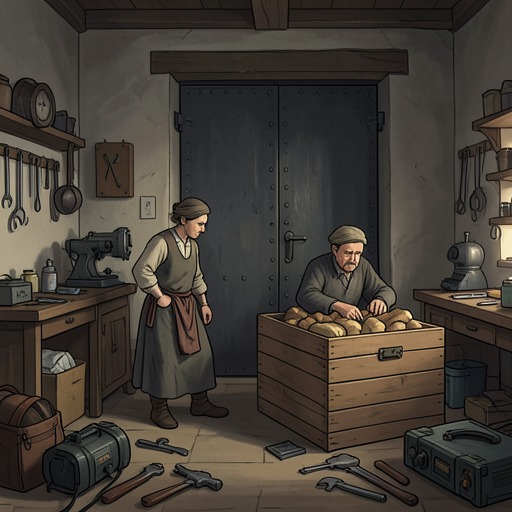
The Florios’ rise is visible not only in the goods they handle but in their changing place within Palermo. Their rented warehouse lies behind the customs offices in the extensive Palazzo Steri property: cool, guarded rooms at the end of a corridor, opening onto a service courtyard behind the accounts office. There they store spices in transit or awaiting sale. Because import tariffs are due only when goods actually enter Palermo, wholesalers can reduce their tax burden by paying rent for storage rather than bringing every consignment into the city at once. The Florios use this arrangement to manage stock drawn from more than one route: spices from India acquired through British traders, and goods from French colonies sold in Livorno and elsewhere along the Tyrrhenian Sea before Italian sailors bring them to Palermo. They are not as rich as the Canzoneris, but their progress has been rapid.
Their position becomes social as well as commercial. In Via dei Materassai, in the alleys of the Castellammare district, they are known as middlemen, merchants, and wholesalers of colonial produce. People of standing consult them about consignments and letters of guarantee. The Florios have become people to approach for judgment and commercial confidence, rather than merely newcomers trying to establish a shop.
That standing does not erase hostility. Ignazio considers why others resent the family: at first, he thinks, they were accused of undercutting established traders; later, their success itself became unforgivable. The Florios have tried to operate on their own terms, without asking for help, and Ignazio believes some people would gladly burn their store if they could. Palermo’s market offers mobility, but not equal welcome. Commercial ascent brings the family into view and makes it a target as well as a presence.
The city’s trade also extends beyond spices into processing and industry. By October 1837, Vincenzo is a Palermo trader and industrialist who owns schooners, sulfur mines, wine cellars, and tuna fisheries, and serves as a member of the Chamber of Commerce, an underwriter, and a financial intermediary. In a modest kitchen on the mezzanine of a building in Via della Zecca Regia, a can of tuna in brine from the Arenella fishery—owned by Vincenzo in partnership with Augusto Merle—makes one of those commercial ventures part of ordinary domestic life. The contrast is telling: the network of ownership reaches into the household in the form of a can opened for a meal.
Streets, labor, and the lived city
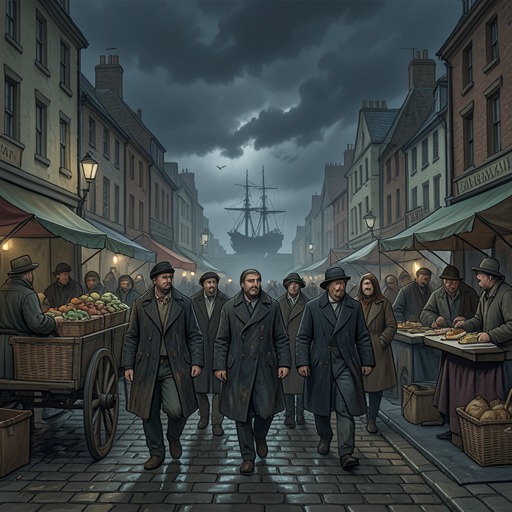
Palermo appears through specific working and public spaces as well as through its harbor. At dawn, Piano San Giacomo, the square overlooked by the Florio and Barbaro shop, is almost deserted. Elsewhere, La Cala is cold and half-empty, occupied by a few porters and sailors moving around the ships. Wind lashes the city walls, bangs the shutters, and twists laundry on the lines. Such scenes place trade in an exposed urban environment: the port is a workplace subject to weather, and the streets surrounding it are both commercial routes and lived neighborhoods.
The city’s public life gathers around markets and institutions. The church of the aromatari, Sant’Andrea degli Amalfitani, is crowded with men in dark suits and a small number of women in black veils, while the nearby Vucciria market makes itself present through its voices and smells. As the Florios move through the city, business, religious affiliation, and market activity occupy adjacent spaces. By evening, after a day of work, the streets are quieting: the sky darkens from gray to blue, and a few passersby trudge across the basalt.
Palermo’s prosperity is not the whole story of its landscape. Underground corridors are being dug, where men and children line up and emerge with baskets of yellow stone that bend their backs. The image of extraction and bodily strain stands beside the city’s mercantile networks, reminding the reader that urban wealth is made in environments of labor as well as exchange. Elsewhere, winds and saltwater shape the view from the coast: from the road opposite the Marsala shore, the Aegadian Islands appear like iron against the sky, while spray soils the windows of a carriage. Palermo belongs to a wider island world in which sea routes, weather, and land-based work meet.
Revolution, defeat, and the city's uneasy threshold
Palermo’s political upheaval becomes tangible on January 12, 1848, when a cannon shot interrupts what had seemed an ordinary morning. Vincenzo follows the crowd, listens to its voices, and tries to make sense of the news as he moves through Via Pantelleria toward Via della Tavola Tonda, only a short distance from home. The uprising is not simply a date in the city’s history: it breaks into daily movement, drawing a merchant into the crowd and turning familiar streets into places where events unfold.
The rebellion leaves damage written across the urban landscape. The walls above the sea have been shelled and broken, and the alleys are obstructed by remnants of barricades built to stop the Bourbon soldiers. Barracks, including the one in the Noviziato, have been devastated. At Porta Felice, an enormous canvas blocks the view of the sea from the Cassaro, preventing signals from passing between the Royal Palace and Bourbon ships offshore. The city’s relation to the sea, ordinarily a source of commerce and connection, has become a military vulnerability to be screened from sight.
The revolution’s failure becomes formal when a delegation of prominent Palermo citizens meets the Bourbon army commander, Carlo Filangeri, Prince of Satriano, at Caltanissetta and hands him the city’s surrender. Defeat is thus both military and civic: representatives of Palermo deliver the city to the commander of the army that has been advancing against it. Later, Vincenzo waits in the Via dei Materassai office after returning only a few hours earlier, his arrival unknown to others. The ordinary commercial address remains in place after political violence, but the city around it has been altered.
Revolutionary hopes return in 1860 amid underground agitation and failed attempts at popular revolt. Francesco Crispi proposes to Giuseppe Garibaldi an external insurrection in support of Sicilian rebels, with the larger aim of Italian unity. To persuade him, Crispi claims that an uprising has already begun in Palermo: the Gancia revolt, which he directed from April 4 to 18. Garibaldi and the volunteer force known as the Expedition of the Thousand then sail from Quarto on May 5, without the king’s explicit support. Palermo again occupies the hinge between local revolt and a larger national project, though the account’s emphasis on Crispi’s claim makes clear that the city’s name can itself be used to mobilize action before events on the ground settle into certainty.
Conquered city and uncertain future
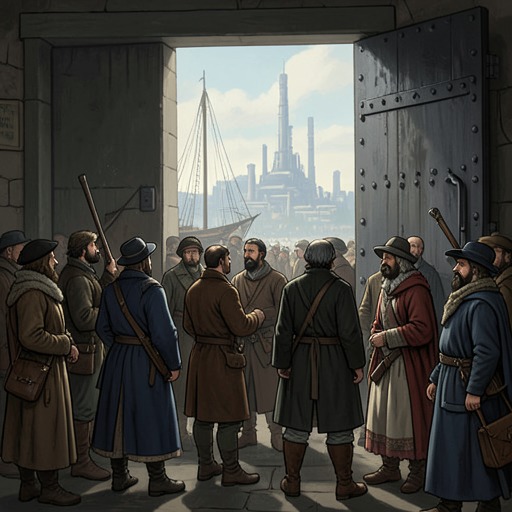
The final image of Palermo refuses a simple equation between conquest and liberation. Around the walls and streets overlooking the Cassaro, beyond bastions breached by cannon fire, time seems suspended. The sea brings the scent of dried algae, while orange blossoms come from the mountains. The city’s beauty remains perceptible, but it does not erase the physical evidence of bombardment or the unresolved political meaning of what has happened.
Palermo appears motionless on the threshold of an uncertain future, waiting to learn what its new rulers—arriving as liberators—will want from it. Its distrust has been earned through repeated conquests. Across the narrative, the port draws the Florios into prosperity, the city’s institutions and markets make their business legible, and its walls register the violence of political change. Palermo is therefore not merely the backdrop to the family’s advancement: it is a contested place where commercial opportunity and civic vulnerability, welcome and exclusion, and liberation and renewed subjection remain in tension.