Palermo uprising of 12 January 1848
The Florios of SicilyThe Palermo uprising of 12 January 1848 is presented as a sudden armed insurrection that breaks into family life and commercial routine, then confronts Vincenzo Florio with a choice between protecting his property and supporting a political cause. Its opening juxtaposes children reacting to the first reports of danger with Vincenzo trying to safeguard his enterprise; the encounter with Giuseppe La Masa makes the uprising’s larger stakes explicit, asking whether the island’s wealthy and influential will help create a new Sicily.
The uprising breaks into the city
At eight a.m. on January 12, a cannon shot interrupts what had seemed an ordinary day. In the Florio home, twelve-year-old Angelina embraces her sister Giuseppina as Giuseppina begins to scream; young Ignazio sits in bed, still sleepy and bewildered. Their sisters report seeing armed people running through the streets. When the first noise subsides, more abrupt sounds follow: gunshots. The sequence gives the rebellion an immediate domestic scale. Political violence first reaches the children not as an explanation but as sound, alarm, and fragmentary news.
At his office overlooking Piano San Giacomo, Vincenzo has been working since dawn in the financial headquarters he recently established in a building he acquired. He looks up from his papers at the first shot and asks his secretary Giovanni Caruso what it was. An explosion and a volley of shots soon make the disturbance harder to dismiss. Vincenzo goes to the window and sees a crowd moving toward Porta Carbone and the harbor, with some men armed. A further cannon blast changes the apparent scale of events: the batteries at Castello a Mare are firing on the city from the sea. The uprising is no longer a disturbance in the streets but an attack reaching Palermo from more than one direction.
A city divided by danger and rumor
Vincenzo leaves the office and reaches the aromateria, where employees and clerks have taken shelter beneath the counters. He borrows a cloak to avoid being recognized and goes out through the alleys, intending to reach the Oretea foundry. His immediate purpose is practical: he wants the workers to bar the gates and put away the most important tools, fearing that either rebels or soldiers might target the works. This effort to protect the business is interrupted when he encounters a barricade on Via Bambinai, where men are firing at Bourbon troops. A partly legible bill remains visible beside it, a small trace of public notice amid a rapidly changing street conflict.
The voices around Vincenzo convey the city’s competing fears and reports. A rebel calls on anyone with a weapon to help defend the land, but is interrupted when he is shot in the arm. Elsewhere, people say the Royal Palace is being stormed; others report that the fighting began in Piazza della Fieravecchia, that there are already casualties, and that aristocrats’ houses may be burned. They also say the insurgents want a republic. These reports establish the uprising as both an armed contest and a struggle over political order, while their circulation through the streets leaves residents responding to urgent claims whose full meaning is still unfolding.
The Florios seek safety
As the danger spreads, Vincenzo decides that his family should leave the city. He orders that money, silver, and other valuable possessions be taken, and proposes retreating to Villa dei Quattro Pizzi, outside the walls and therefore easier to defend. The plan shows how quickly a crisis in the city becomes a question of household security and property. Leaving is not straightforward: the coachman argues and asks again for the two carriages to be allowed through, and a scuffle follows. When Vincenzo opens the door, he finds himself facing a pistol barrel.
The armed men’s resistance to the departure is framed not simply as a threat but as a claim about who belongs in the city and what the wealthy owe it. One of them argues that the city needs aristocrats and rich people. That appeal turns the attempted escape into a political confrontation: the Florios’ resources are treated as potentially necessary to Palermo, not merely as possessions to be carried to safety. Vincenzo’s standing as owner of Casa Florio is invoked directly, making the family’s commercial position part of the uprising’s public stakes.
La Masa’s appeal and the unresolved choice
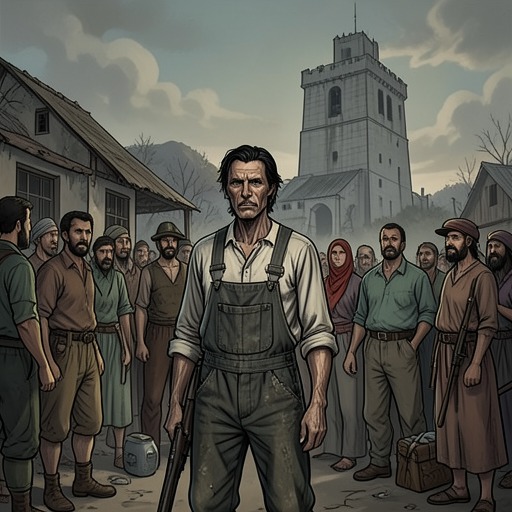
More armed men arrive, their faces described as tired and dusty. One rider separates from the group, challenges the treatment of the people at the carriages, and asks whether they are being treated like bandits. He is Giuseppe La Masa, who introduces himself to Vincenzo and offers his hand. His arrival changes the encounter from a threatened departure into a direct political appeal by a named patriot to a prominent entrepreneur.
La Masa presses Vincenzo to collaborate with the cause. He calls him enlightened and one of the island’s few entrepreneurs, and argues that Casa Florio’s resources and Vincenzo’s intelligence could help build a new Sicily. The appeal makes the conflict’s central tension explicit: Vincenzo has just been trying to protect his family, money, and industrial property, while La Masa asks him to put economic power at the service of political reconstruction. The evidence establishes the invitation and the pressure of the decision, but not Vincenzo’s answer in this encounter.
The episode’s movement from cannon fire to the household, office, foundry, barricade, and carriage makes the uprising legible through the places and obligations it disrupts. Children encounter danger as an interruption they cannot yet interpret; employees shelter in the shop; Vincenzo thinks first of securing machinery and moving his family, then faces La Masa’s demand that wealth become a contribution to collective change. The revolt thus tests the boundary between private safety and public responsibility without resolving it in the scene.