Paolo Florio
The Florios of SicilyPaolo Florio’s decisive legacy is a double inheritance: he sets the family on its path from Bagnara to Palermo, then leaves his son Vincenzo in the care of his brother Ignazio. A practical, industrious merchant, Paolo wants a wider future for himself and his son; but his growing business does not undo the family injuries he leaves behind. His death, preceded by illness and regret, becomes both a turning point in the Florio enterprise and an enduring presence in the family that survives him.
Identity and the move from Bagnara
Paolo is Vincenzo’s father and Ignazio’s brother. His ambition is made explicit in his desire to leave Bagnara: he cannot keep supervising roof repairs while also earning enough to feed the household, and the journeys he makes between Naples and Palermo have convinced him that he no longer wants to remain a Bagnara man. He wants more for himself and his son. The decision brings opportunity, but also separation: those around him fear how he will manage alone, since he has never lived alone before.
The move is bound up with the limits of the life Paolo is leaving. He describes himself as unable to divide his time between practical responsibilities and the work that sustains the family. His choice to seek a different future is therefore not simply a declaration of ambition; it is a response to an economic pressure that makes staying seem untenable. The family’s later rise in Palermo begins in this personal calculation of work, food, and a son’s prospects.
Work and commercial beginnings
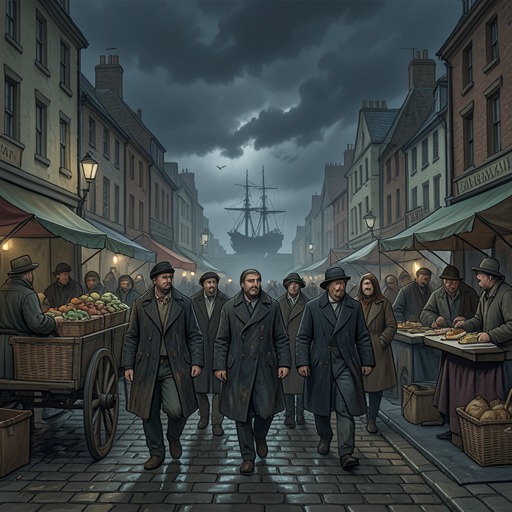
Paolo enters a trade shaped by long and complicated supply chains. Before spices reach a counter, they pass through many hands, travel by caravan and sea, and arrive at European ports. At the beginning of the nineteenth century, British and French merchants dominate the sale of spices and other goods brought from overseas colonies, including medicinal herbs, sugar, tea, coffee, and chocolate. Paolo’s business thus operates within a market whose goods and routes extend well beyond Sicily.
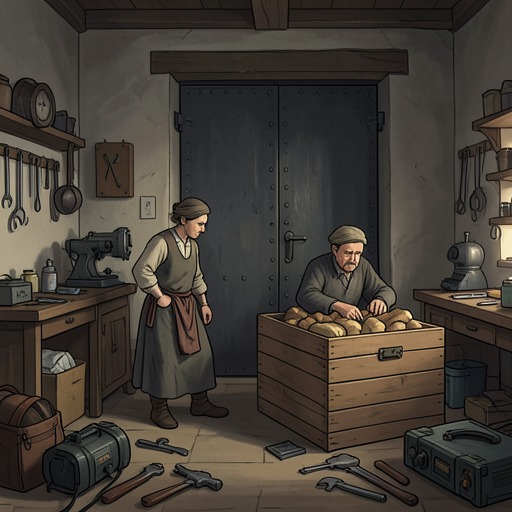
The family’s commercial position develops through both partnership and adaptation. By the time the company formed by Paolo Florio and Paolo Barbaro has been dissolved, it has already become an important part of the Florio family’s early business history. The Florios also rent a warehouse within the Palazzo Steri property, behind the customs offices. Its cool, guarded rooms hold spices in transit or awaiting sale. By paying rent on storage rather than import duties before goods enter Palermo, wholesalers avoid paying those tariffs too early. The stock includes spices from India obtained through British suppliers and goods from French colonies purchased through Italian sailors and traded around the Tyrrhenian Sea. The Florios are not yet as wealthy as the Canzoneris, but they have advanced considerably.
A later glimpse of the Palermo shop connects Paolo’s commercial ambitions to the work left for the next generation. When he returns, he finds the putìa in a state that provokes controlled anger; rather than comment, he takes a broom and begins sweeping. The gesture shows the practical attention he gives to the business, as well as the standards he expects of it. His work is not an abstract family legacy: it is a shop whose condition, stock, and daily labor require care.
Family obligations and estrangement
Paolo’s household is marked by unequal power and unresolved hurt. Giuseppina recalls that she was fourteen when her father arranged her marriage to Paolo, and argues that a woman had little choice in marriage or in being brought to Palermo. Her account places Paolo within a patriarchal family order that shapes the lives of women as well as the decisions of men. The evidence does not reduce their marriage to a single judgment: Giuseppina later says that she accepted Paolo as the husband given to her by her family and God, and that he was reliable, hardworking, and devoted to work. She also remembers that they argued because they were alike.
Ignazio challenges Giuseppina’s later tendency to take the blame for the marriage’s unhappiness. He remembers that they wanted different things, that Paolo forced her into things she did not want, and that their conflict was real. He loved his brother deeply, but refuses to make Paolo faultless at Giuseppina’s expense. Their exchange preserves two truths at once: Paolo could be dependable and industrious, and his conduct could also cause lasting hurt.
The family rupture extends to Paolo’s sister Mattia. When Mattia comes to Palermo after a breach with her husband, Paolo rejects her rather than offer the help she sought. She feels sent away as if she were an outcast, despite having left her marriage to come to her brother. Later, as Paolo lies ill, this refusal becomes a source of acute remorse. He tells Ignazio that he could have helped Mattia when she was ill and could have received her when she came, but did neither. He asks Ignazio to tell her that he forgives her and to ask her to forgive him. The request does not erase the rejection; it makes clear that Paolo understands, near the end of his life, the cost of having withheld help.
Illness, succession, and death
By the end of 1806, Paolo’s cough has become persistent and deep. Ignazio repeatedly urges him to see a physician, but Paolo refuses. He is often tired and can spend only a short time in the shop, an unmistakable limit on the work that had defined him. As his strength diminishes, he turns to Ignazio not only to acknowledge his regrets but to transfer responsibility: he tells his brother that Ignazio must become what Paolo can no longer be.
The handover is both intimate and practical. Paolo presses Ignazio’s arm, and Ignazio feels how little strength remains in him. Paolo’s words make his brother the person charged with carrying forward the family’s work and care for Vincenzo. When Ignazio arrives on the final occasion, Paolo is already dead. His succession is therefore not a gradual retirement from the business but a responsibility assumed at the moment of loss.
Memory and narrative significance
Paolo’s death does not end his influence on the family. Seven years later, Giuseppina still prays for his soul and wears mourning clothes, though the narration distinguishes this from simple grief: she is trying to atone for harms that she believes she and Paolo caused each other. She describes the marriage in terms of acceptance and duty, while Ignazio resists allowing her to absorb all responsibility. The dead Paolo remains the point around which their memories and disagreements turn.
Vincenzo grows up within the emotional structure left by his father’s absence. Ignazio and Giuseppina come to seem to him not merely separate guardians but a couple who have made a family around him, perhaps sacrificing themselves in the process. Their bond, in the narration, is powerful despite having nothing to do with marriage; between them stands Paolo’s ghost. Years later, Giuseppina wonders what would have happened if Paolo had lived and if their other child had been born. Vincenzo can barely remember his father and cannot answer.
The novel finally gives that absence a concrete place. Two years before the late scene, Vincenzo brings his son to a house surrounded by a large park. Passing along the main road, partly screened by olive trees, Vincenzo thinks he sees Ignazio offering his hand to a little boy. He then identifies the site as the place where his father died. Paolo is thus remembered not through an extended account of his final moments, but through the family’s inheritance of work, regret, kinship, and a precise place that the next generation is shown. His early ambition begins the Florio ascent; his failures and death leave obligations that the business alone cannot settle.