Raffaele Barbaro
The Florios of SicilyRaffaele Barbaro is Paolo Barbaro and Mattia Florio’s son, a cousin of Vincenzo Florio who moves from a marginal place in the family business toward ownership in a new commercial venture. His story follows the opportunities and limits of kinship in Casa Florio: Vincenzo brings him into the firm, grants him a substantial share in the Marsala cellar partnership, and later questions whether he has the initiative the work demands.
Identity and Entry into the Business
Raffaele is identified as the son of Paolo Barbaro and Mattia Florio. When Vincenzo meets him, he recognizes in Raffaele’s determined tone the quality he has been seeking. He invites him to Via dei Materassai the next day to meet Ignazio Messina, an elderly and experienced man from whom Raffaele is to learn the business at close quarters. Vincenzo also plans to bring him to the family home, telling him that Giuseppina will be pleased to see Mattia’s son. Raffaele’s place in the firm is thus framed through both commercial usefulness and family connection.
His position is not initially that of an independent principal. He is described as Don Florio’s cousin and one of Vincenzo’s factotums in Palermo. That subordinate status helps explain the importance of Vincenzo’s later offer: it would make Raffaele a consequential figure in Marsala rather than merely a relative serving the established Florio enterprise.
A Commercial World of Brokers and Goods
Raffaele works within a business that trades rather than manufactures. Vincenzo describes Casa Florio as a firm that brings manufacturers and buyers together, acting either in its own name or for other parties. When the Milan trader Tommaso Portalupi asks what Sicilian goods the firm can supply, Vincenzo answers that he can obtain everything produced in Sicily. Raffaele is beside him during this exchange, already included in the commercial scene in which the firm’s reach is being asserted.
The goods under discussion connect local production to wider markets: wine, oil, tuna in brine, sumac, and sulfur are among Portalupi’s requirements. The firm’s broader trade draws on goods moving through a complicated network of producers, brokers, ports, and foreign suppliers. Its spice stock, for example, includes products from India obtained through British channels and from French colonies, with some goods purchased by Italian sailors and sold in Palermo. Raffaele’s work in this setting belongs to an economy of intermediation, where access to goods and the ability to connect suppliers with buyers are central to the firm’s ambitions.
Building the Marsala Cellar
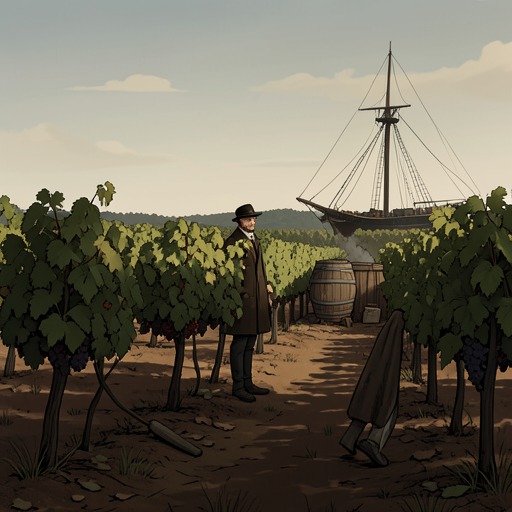
Raffaele takes part in developing the Florios’ wine venture. When Vincenzo is occupied with other matters, Raffaele brings a map of the Marsala coast and lays it over a map of the sulfur quarry. They consider a site for the cellar in Contrada Inferno, where direct access to the sea can avoid the cost and difficulty of moving barrels by poor roads. Vincenzo favors a location between the Ingham and Woodhouse plants, so that wine can travel from the works to ships without depending on large wagons. Raffaele’s work includes gathering the information needed to evaluate the land, including its size, price, and the tax owed to Baron Spanò.
The venture grows from the choice of a site into a planned production and shipping operation. Casks of sherry for refinement are due to arrive, and Vincenzo has prepared a memorandum listing Palermo coopers, one of whom is willing to move his workshop to Marsala. As construction proceeds, Vincenzo acknowledges Raffaele’s commitment and says they can formalize their arrangement by September. He presents the cellar as more than a facility: its wine is to be distinguished by quality and sold into different markets, including France and Piedmont. He also instructs Raffaele to speak with the workers directly and make clear that working at the cellar should be regarded as an honor.
Partnership and Its Unequal Terms
Vincenzo’s proposal turns Raffaele’s involvement into a formal investment relationship. He offers a partnership among Raffaele Barbaro, Ignazio Florio, and Vincenzo Florio. The terms are explicit: Raffaele is to receive one third, while Casa Florio retains two thirds. Vincenzo says he wants a partner invested in the business’s money, not someone who merely looks after operations without caring about the larger enterprise. He points out that Raffaele has already set money aside to buy the land, making the proposed share a continuation of his financial commitment.
Raffaele hesitates because he has come to know Vincenzo as a difficult man, and accepting the offer makes him anxious. Yet the partnership is rare and valuable: it promises him importance in Marsala beyond the narrower standing he has as Vincenzo’s cousin and factotum in Palermo. He accepts. Vincenzo’s confidence that he would say yes confirms both the attraction of the opportunity and the power imbalance within it: the offer grants Raffaele a stake, but Vincenzo sets the terms and continues to direct the venture.
Performance, Kinship, and the Limits of the Alliance
The partnership does not erase Vincenzo’s doubts about Raffaele’s business judgment. Later, while discussing the firm’s operations in a carriage, Vincenzo says the Marsala cellars could be more profitable but that Raffaele lacks initiative. On another occasion, after hearing a vineyard owner’s favorable account of Vincenzo’s own ideas, Vincenzo reflects that the cellar is worrying him: in his view, things are not going as they should, and Raffaele lacks both initiative and courage. He resolves that he will have to address the matter with him.
The criticism gives the alliance a divided character. Raffaele is trusted with a substantial share, contributes to choosing and developing the cellar site, and remains its manager; at the same time, Vincenzo measures him against an ambitious commercial vision and judges his management insufficiently forceful. Their relationship brings together kinship, investment, and authority without making those interests identical. Raffaele’s ascent depends on Vincenzo’s invitation, while the firm’s expectations leave him accountable to the same man who created the opportunity.
Raffaele’s significance lies in that tension. His move from family subordinate to one-third partner shows how Casa Florio can convert kinship into commercial participation, but the later doubts show that inclusion does not guarantee equal control or approval. The Marsala cellar gives him a place in the firm’s expansion; Vincenzo’s criticism leaves open whether he can meet the initiative that expansion requires.