Ritual and community in Sicilian tuna fishing
The Florios of SicilyRitual and community in Sicilian tuna fishing centers on the tonnara as both a method of harvesting tuna and an inherited social world. Its seasonal cycle organizes work and family life around the migrating shoals, while the processing of the catch connects the sea to local labor and distant markets. Through Vincenzo Florio’s transformation of the Favignana fishery, the novel places this long-established communal system in contact with commercial innovation: the tonnara remains a place of collective work even as new methods change what it can produce and sell.
The seasonal system
The account begins with the arrival of tuna in the Mediterranean. In spring, as the water warms, the fish travel from the Atlantic in shoals to reproduce. The tonnara is lowered at this point in their passage, making the fishing season part of a recurring natural cycle rather than an isolated commercial operation. An image attributed to Herodotus, of nets cast and stretched to receive tuna on a full-moon night, gives this practice a deep historical dimension; the narrative immediately contrasts that centuries-old continuity with the changes now under way.
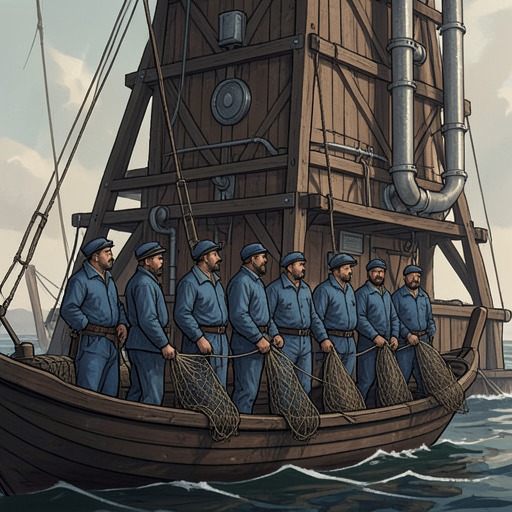
The tonnara is not simply a building or marfaraggio. It is also a construction of nets arranged into successive chambers, a method described as originating with the Arabs, passing to the Spaniards, and reaching a distinctive culmination in Sicily. By distinguishing the installation from the broader system, the account presents tuna fishing as both physical infrastructure and accumulated practical knowledge. Its operation depends on an arrangement designed to guide fish through the nets, and on the people who maintain and work that arrangement.
Work and community through the year
The fishery shapes the lives of entire families. Men work at sea, while women work in the plants; winter is devoted to maintaining ships and mending nets, and spring and summer bring the catch, slaughter, and processing. This division of labor makes the tonnara a year-round community, not merely a workplace occupied during the season. The calendar of repairs and preparation is as much a part of its operation as the moment when the tuna are caught.
That collective life is also visible in the labor surrounding the Favignana tonnara. When Vincenzo first found the site in poor condition, he summoned ship carpenters and builders from Palermo and began teaching local people to produce tuna in oil. He gathered the heads of the families and their wives to show that he was willing to work alongside them. His explanation to his son, Ignazio, is that workers should feel part of what they are building. The episode connects the social character of the fishery to the way Vincenzo tries to manage it: he regards knowledge of the people and their needs as essential to work and trade.
Making use of the catch
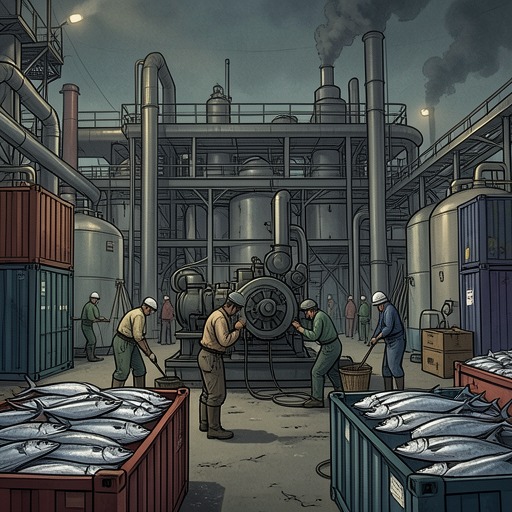
The tuna is called the sea pig because almost nothing is wasted. Its red flesh is processed, salted, and sold in large barrels; its skin and bones are dried, powdered, and used as fertilizer; its fat serves for lamps; and its eggs become expensive roe. The description makes resourcefulness part of the tonnara’s identity. The fishery does not end with the catch: it continues through the labor of turning different parts of the animal into products with distinct uses and values.
The relationship between tuna and salt is presented as enduring, grounded in the practical need to preserve a fish that cannot leave the sea. The fishery thus links ecological conditions to processing and commerce. It is at once dependent on the tuna’s migration, on organized labor at the shore, and on methods that make the catch usable and saleable beyond the moment of harvest.
Favignana and commercial change
Vincenzo has managed the Favignana tonnara for ten years by the time he brings his fourteen-year-old son there. He regards the undertaking as his masterpiece, but its development has required high rent, a network of entrepreneurs, and the risks of adopting a new preservation method. Tuna preserved in oil has since spread across the Mediterranean. The expansion represents a change in the market reach of the product, while the island fishery remains dependent on the work and organization that make production possible.
The visit lets Ignazio see the setting behind that success. In May, the season of the mattanza, the boats are at sea. Workers are mending damaged nets in a courtyard, while the processing leftovers are left to decompose in the sun at the area workers call the bosco, or tuna cemetery. The scene connects the celebrated product to the less visible stages and by-products of its manufacture. Ignazio also sees changes to the village: oil-soaked tuff has stopped crumbling, the square outside the main church has flagstones, and Vincenzo has arranged for a schoolteacher to teach reading and writing to those who wish to learn.
The novel therefore presents the tonnara neither as an untouched relic nor as a business detached from its community. Its inherited seasonal practices, family labor, and comprehensive use of the catch persist alongside investment, new preservation, and wider markets. Vincenzo’s enterprise depends on these communal foundations even as it alters the fishery’s prospects; the resulting transformation is measured not only in Mediterranean sales, but also in the working island and village through which the trade takes shape.