Rosa Bellantoni’s wedding ring
The Florios of SicilyRosa Bellantoni’s wedding ring is the surviving link between Ignazio Florio and the mother he lost as a child. First retrieved from an iron casket during a moment of danger, the ring becomes both a practical object he guards and a private source of comfort: he wears it so he will not lose it, and touches it when he longs for his mother’s nearness. Its journey from the family home to Ignazio’s hand gives material form to memory, kinship, and loss.
Identity and Preservation
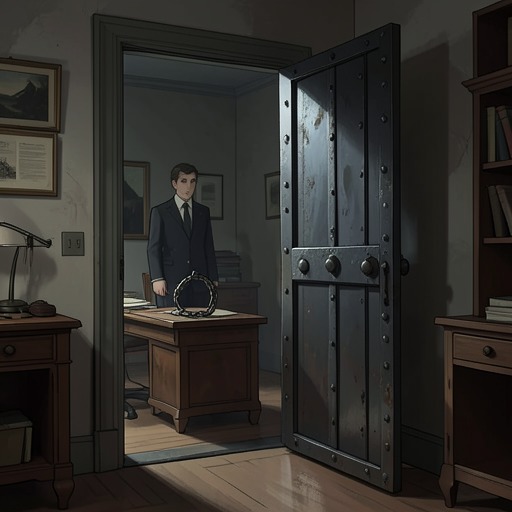
The ring is kept in an iron casket in Ignazio’s room. When he gathers belongings in the wake of danger, he finds the casket, places it in his knapsack, and carries it with his work tools. The urgency of the moment makes the choice revealing: among what he saves is not merely a useful possession, but a keepsake connected to his mother.
Later, Ignazio opens the box and takes out the wrought-gold ring. He clasps it in his hand over his heart and whispers, “Mamma.” The brief gesture brings the heirloom into the present as a means of seeking solace. Rosa died when Ignazio was seven, in 1783, the year an earthquake devastated Bagnara and killed thousands across Calabria and Sicily. The ring recalls a relationship interrupted by bereavement, and the childhood closeness Ignazio shared with Giuseppina.
A Keepsake Worn Through Change
Ignazio eventually wears the wedding band on his right ring finger, explaining through his actions why he has chosen to keep it there: he does not want to risk losing it. When he leaves Calabria for Palermo, his attention turns toward the city and its harbor, but he continues to stroke the ring as he looks toward the mountains. Touching it makes his mother feel close; in his recollection, she is someone who called to him and listened.
The ring thus accompanies a major transition without erasing the grief that precedes it. Ignazio has left Calabria and what remains of his family, and the prospect of solitude has weighed on him. Yet as Palermo unfolds before him, the keepsake offers continuity between the lost home and the uncertain life ahead. It does not restore his mother, but gives his memory a physical point of return.
Family Bonds and Social Expectations
The ring also appears in an ordinary exchange that exposes how family relationships are read through marriage. When Ignazio buys ribbon, a shopkeeper notices the band and asks whether the gift is for his wife. He gestures that he is unmarried, then says—improvising—that the ribbon is for his sister. The ring publicly signifies a marital bond, even as Ignazio’s use of it privately honors his mother rather than a spouse.
That contrast belongs to a wider world in which women’s marriages are treated as arrangements controlled by others. Giuseppina recalls that she was brought from Bagnara without the power to refuse, while Mattia describes wives as their husbands’ property and urges her to endure being uprooted. The ring does not itself change those conditions, but its passage through the family’s story places intimate attachment beside the social rules that determine who may choose, leave, or belong.
Inheritance and Significance
Later, Giuseppina considers the future of Casa Florio as an inheritance that must be protected and passed on, and believes that securing the family’s future requires an heir of “good blood.” This language of lineage and succession differs sharply from the ring’s more personal meaning. The family legacy is treated as something to safeguard across generations; the ring preserves a bond to someone whose presence cannot be recovered.
As an object, the wedding ring joins remembrance to continuity without making them identical. It is saved, carried, worn, and touched at moments when Ignazio confronts separation and change. Its importance lies not in its material value alone but in the specific history it bears: a mother lost in childhood remains, through the ring, part of the life her son builds afterward.