Sicilian Revolution of 1820
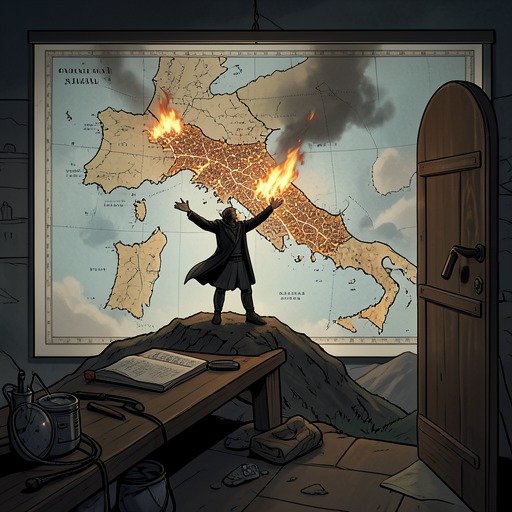
The Florios of SicilyThe Sicilian Revolution of 1820 was a revolt against Bourbon rule and the loss of Sicily’s political autonomy, driven by demands to restore the 1812 constitution and re-establish the Kingdom of Sicily. It briefly brought back the Sicilian Parliament, but city rivalries and the Bourbons’ ability to exploit them left the movement vulnerable to suppression. The novel presents the conflict not only as a contest over constitutions and national independence, but also as a struggle over who governs the island’s customs, commerce, and resources—and who bears the cost when political authority changes hands.
Causes and Political Background
The revolt followed the 1816 abolition of the Kingdom of Sicily and repeal of the 1812 constitution, measures that consolidated the Kingdom of Naples and Sicily under Bourbon rule. By December 1816, Neapolitans administered state offices and customs and held military command. Palermo had lost its independence, while heavier taxes, trade restrictions, and new constraints on commerce compounded an already faltering economy. The novel describes Sicily as politically divided: Palermo, Messina, Trapani, and Catania pursued competing interests, even as hostility toward rule from beyond the Strait of Messina provided a shared grievance.
The events of 1820 unfolded amid a broader constitutional crisis. In Naples, rebellious army units and the discovery that many officers had joined the Carbonari helped bring Ferdinand I under pressure. He granted a constitutional charter recognizing aristocratic and popular rights and established a parliament. The Sicilian revolt was connected to this crisis, but its objective went further than constitutional reform within the united kingdom: its supporters sought to restore the separate Kingdom of Sicily.
The narrative gives the island’s aristocracy a central, complicated role in that demand. Sicilian nobles resented Bourbon rule for displacing their power, privileges, and customary positions, despite the Bourbons’ earlier refuge on the island. Their opposition was therefore both a defense of political independence and a struggle to recover their own authority over Sicily and its people. The revolution’s language of self-government arose from a society where inherited privilege remained deeply entrenched.
Outbreak and Revolutionary Government
The revolt broke out in Palermo on July 14, 1820, during the Feast of Saint Rosalia, while the city was crowded with people. The uprising drew in nobles, intellectuals, and others who seized the opportunity created by the crisis in Naples to declare Sicilian independence. In the novel’s street scene, shouts demand the return of the constitution taken away in 1816 and proclaim the Kingdom of Sicily; the crowds, wagons, and horses fill Palermo’s streets and squares.
The rising forced Prince Francesco to take refuge in Naples and led to the creation of a Sicilian Parliament, which restored the constitution. The new government’s independence project, however, was not simply an assertion of constitutional rights: it aimed to restore the Kingdom of Sicily as a distinct political entity. That aim placed it in direct conflict with the Bourbons, while disagreements among the island’s cities impaired the unity needed to defend it.
The revolution also disrupted ordinary commercial operations. In a scene at Palermo’s Customs House, word reaches Ignazio that a provisional government is being formed and that outgoing ships have been blocked. Merchants and seamen crowd the customs courtyard as soldiers try to hold them back. The stoppage makes the political crisis immediate for the Florios: a shipment is caught in the confusion, and the customs apparatus on which trade depends has become uncertain and contested.
Suppression and Austrian Intervention
The Bourbons exploited divisions among Sicilian cities, especially those between Palermo, Messina, and Catania, and suppressed the revolt by force. The monarchy was restored in November 1820, returning Sicily to the control of the Neapolitan government. The revolution’s institutional gains—the parliament and restored constitution—therefore proved temporary, while the political autonomy it sought remained unrealized.
The defeat was consolidated on the mainland the following year. Ferdinand I appealed to the powers of the Holy Alliance—Prussia, Russia, and Austria—for assistance against the insurgents. On March 24, 1821, Austrian forces entered Naples and restored the king to the throne. They remained there until 1827, when Francesco I, who had succeeded his father in 1825, finally managed to remove them. The sequence places the Sicilian revolt within a wider contest over constitutional rule, while showing how foreign military intervention reinforced the Bourbon restoration.
Commerce, Status, and the Revolution’s Afterlife
For the Florios, political change is also a material threat. The loss of autonomy after 1816 brings customs administration under Neapolitan control and tightens the burdens on trade; the 1820 revolt then halts outgoing shipping and unsettles the handling of goods. In a later revolutionary crisis, Vincenzo describes buying rifles in England on behalf of a revolutionary committee, while ships are requisitioned and the family is effectively pressed into providing a loan. These later events are not part of the 1820 revolt, but they echo its central tension: political movements depend on commercial resources, and merchants can be drawn into financing or transporting a cause whose outcomes they cannot control.
The novel also places the revolution’s claims of independence beside the Florios’ struggle for recognition in Palermo’s status hierarchy. Vincenzo’s courtship of Isabella Pillitteri exposes the divide between commercial wealth and inherited rank: although her family is indebted, she considers herself above a shopkeeper’s son, and her mother tells him that money cannot overcome the importance attached to blood. In later scenes, Giulia’s marriage does not erase the contempt of aristocratic society, and Vincenzo’s daughters are judged by the circumstances of their birth even when his money makes him a desirable business connection. These episodes are not consequences of the 1820 revolt, but they sharpen the novel’s account of the social order whose privileges the revolution’s aristocratic leaders sought to reclaim.
The revolution’s significance thus lies in the distance between its constitutional and national ambitions and the forces that defeat or contain them: local rivalries, Bourbon restoration, and foreign intervention. Its recurring material counterpart is the precarious position of commerce. Customs, ships, credit, and money are not scenery around political history; they are means by which governments exercise authority and by which the Florios try to preserve their business through successive regimes. Later, Vincenzo denounces the transfer of the Bourbon treasury to Piedmont to pay for annexation, interpreting unification as another seizure of Sicilian resources. The 1820 revolt belongs to an unfinished conflict over who may rule Sicily—and who may claim what the island produces.