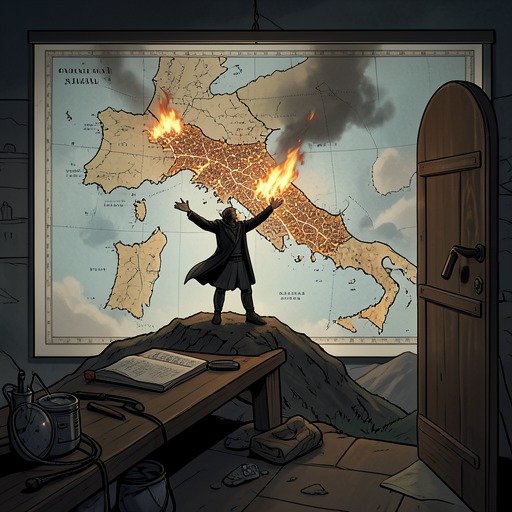
Sicilian Revolution of 1848–1849
The Florios of SicilyThe Sicilian Revolution of 1848–1849 is the island’s uprising against Bourbon authority, a movement that briefly establishes a revolutionary government before collapsing under military reconquest. Its significance in the novel lies in the collision between political ideals and material power: the revolution needs ships, weapons, and money, while the Florios’ commercial assets become both indispensable to its cause and vulnerable to every regime that claims them.
Causes and political background
The revolt grows from a longer history of political upheaval and contested sovereignty. Revolution had been spreading through Italy since 1796, while the Bourbon monarchy’s position in Naples was repeatedly shaken by French military power. In 1799, the Neapolitan Jacobins established a republic and forced Ferdinand IV and Maria Carolina to take refuge in Palermo. The republic soon ended in repression, but the episode established a pattern in which Sicily became a refuge and strategic foothold amid wider struggles over rule.
Napoleon’s later conquest of Naples again drove Ferdinand to Palermo under British protection. Although he continued to rule Sicily, the island’s political status and its relationship to the mainland remained unsettled. In 1812, a revolt over Ferdinand’s income tax led the Sicilian government to promulgate a constitution modeled on the Westminster system. It curtailed the king’s power, abolished fiefdoms, and proposed reforms to government, with modernization and closer ties to Britain among its aims.
That constitutional settlement was overturned when Ferdinand united the kingdoms of Naples and Sicily in 1816 as the Kingdom of the Two Sicilies. The Sicilian constitution was annulled, and the island was treated as a colony under heavy taxation. Neapolitans took over state offices, customs administration, and military command; Palermo lost its political independence, while heavier taxes and restrictions on trade compounded economic hardship. These institutional changes matter to the later revolt: the conflict concerns not only who governs, but who controls the island’s revenues, commerce, and public authority.
A new political opening arrived in 1830, when Ferdinand II became king and pursued economic and social revival. Infrastructure and technical development advanced, including railways, military ships with metal hulls, and electrical street lighting. Yet these changes did not resolve the island’s constitutional grievance. When revolution broke out in 1848, Sicilians again sought political autonomy and the restoration of constitutional government; the movement also faced disagreement about what kind of state could replace Bourbon rule.
Uprising and revolutionary government
The revolutionary crisis reaches into the Florios’ business through customs and shipping. When a provisional government is being formed, outgoing ships are blocked and the customs administration falls into confusion. Ignazio Florio learns of the stoppage from Ben Ingham and hurries to the Customs House, where merchants and seamen crowd the entrance. Soldiers hold the crowd back with rifles, threatening to shoot, but the gathering does not disperse. The scene gives the political upheaval a concrete commercial cost: ships cannot leave, goods are at risk of requisition, and a change of government immediately disrupts the movement of trade.
Vincenzo Florio is drawn further into the revolution when he buys a large consignment of rifles in England on behalf of the revolutionary committee. He sees the purchase as a decision that may bring regret, not as a straightforward endorsement of a stable political program. The revolutionaries proclaim a Kingdom of Sicily but cannot find a king willing to accept its crown. The British, meanwhile, oppose Sicily’s separation from the Bourbons. The parliamentary elections of the previous March have selected nobles and wealthy men to attempt to apply the 1812 constitution, but, as Vincenzo observes, the new order lacks a sovereign who will anchor it. The weapons purchase therefore places the merchant inside a movement whose political destination remains uncertain.
Vincenzo’s involvement is also financial and logistical. Revolutionary authorities requisition ships and effectively compel him to lend them money. Trading falls by half after the revolt begins, affecting the merchant bank, the foundry, and the fleet. The Sicilian Steamship Company’s vessel Palermo, previously working at full capacity, is taken by Ruggero Settimo’s revolutionary regime to transport troops. The same commercial resources that make the Florios powerful make them available for public use—and expose their livelihood to the needs and decisions of competing authorities.
The revolutionary leadership itself is divided over the political future. Vincenzo regards Settimo, president of the Sicilian government, as a committed but reasonable figure who understands that the nobility would never accept a republican government and therefore seeks a compromise. He contrasts Settimo with Pasquale Calvi, whom he considers more uncompromising. This disagreement underscores the gap between the shared opposition to Bourbon rule and agreement on what should follow it. The revolution must seek arms and practical support while attempting to define a government capable of holding together different political interests.
Defeat and the fall of Palermo
By 1849, the revolutionary cause is failing. The novel renders the defeat in the landscape of Palermo: the sea-facing walls have been shelled and broken, alleys are obstructed by the remnants of barricades, and barracks, including the one at the Noviziato, have been devastated. At Porta Felice, a huge canvas blocks the view of the sea from the Cassaro, preventing signals from passing between the Royal Palace and Bourbon ships offshore. The city’s defenses and its communication with the harbor have become part of the same struggle.
A delegation of prominent citizens meets the Bourbon commander Carlo Filangeri, Prince of Satriano, at Caltanissetta and surrenders the city. But surrender by the city’s representatives is not consent from its people. The inhabitants rise, build barricades against the city guard, and reject concessions to the Bourbons. Hunger does not overcome their hostility toward Neapolitan rule. This contrast between official capitulation and popular resistance marks the revolution’s political fracture: the decision to yield is made by a delegation, while the population continues to resist.
The resistance is left without the leaders who might sustain it. Government heads, including Ruggero Settimo and Giuseppe La Masa, flee. Aristocrats withdraw to country villas and courtyards, leaving Palermo to face the fighting alone. The city is described as disordered, starving, exhausted, destroyed, and burning. The loss is therefore both military and civic: the revolution’s leaders depart, the upper classes retreat, and the ordinary population bears the consequences of a struggle it has not agreed to abandon.
The family’s flight makes the defeat intimate. Ten-year-old Ignazio Florio watches the deserted village of Arenella through a sailor’s telescope and understands that the previous year has stripped away the security he took for granted. His family first left their house on Via dei Materassai and then Villa dei Quattro Pizzi. They now shelter aboard L’Indépendant, the steamship Vincenzo bought for his separate shipping venture, registered under the French flag. The ship is treated as a refuge because neither the rebels nor the Neapolitans are expected to risk provoking France by attacking it.
Ignazio cannot fully understand the political collapse. He knows that the Bourbons were driven out in 1848 and that his father and acquaintances became involved in the new government. He has heard that Taormina, Catania, Siracusa, and Noto surrendered in early April 1849, and that Palermo is now in danger, but no one explains the events to him. His mother’s aged, frightened face makes the cost legible even when the political facts are not. From the ship, he reassures her that his father will return soon; Vincenzo has gone to Palermo hoping that the king will grant a general amnesty, as Filangeri promised.
Vincenzo’s own role shifts as the revolutionary order disintegrates. At fifty, he has tried to avoid becoming too deeply involved, but after the leaders flee and Palermo falls into disarray, he takes a position with the National Guard, believing the circumstances leave him no choice. He distances himself from the revolutionary government’s actions as soon as he can and maintains that he has not mismanaged his business. The revolution thus leaves him negotiating not simply between political sympathies, but between the immediate demands of authority and the protection of the commercial world he has built.
Bourbon restoration and the revolution’s legacy
After the reconquest, Ferdinand II seeks to restore unity in the Kingdom of the Two Sicilies. He imposes a substantial national debt and suspends the constitution promulgated by the Sicilian Parliament in March 1848. Weary from prolonged instability, the people and local administrations accept the taxes; the aristocracy also distances itself from renewed rebellion. Later uprisings are isolated, chiefly rural, and fail to acquire a significant presence in the cities. The restoration therefore consolidates power not only through military victory but through exhaustion, fiscal demands, and the withdrawal of influential groups from resistance.
Pressure from the British government to reduce taxes and repression does not substantially alter the political atmosphere. Bourbon rule becomes associated with reaction and unease at home and abroad. When Francesco II succeeds his father in 1859, he inherits an often reactionary aristocracy protective of its privileges and continues policies that impede the south’s economic and social progress. The revolution’s defeat has not settled the island’s political question; it has restored a regime whose structures preserve the conditions that provoked opposition.
The revolution also survives in the work and interventions of its exiles. Giuseppe La Masa and Ruggero Settimo remain among those carrying forward the patriotic cause, alongside Francesco Crispi, a young lawyer from Ribera near Agrigento. Their continued activity contrasts with the immediate collapse of the 1848–1849 government: military defeat disperses the movement rather than erasing its political aspiration.
For the Florios, the revolution establishes a recurring pattern in which state power reaches directly into commerce. During the later crisis of Garibaldi’s arrival, Vincenzo, acting as a trade governor, orders all cash and bank drafts moved into the Royal Bank’s safe, anticipating that the money may need to be released or converted after the crisis. He cannot protect the substantial gold ingots in the treasury from requisition. The episode echoes the earlier revolution’s use of ships, customs, and credit as political resources: a merchant’s prudence can shelter liquid funds, but it cannot place his business outside the claims of a changing state.
That pattern continues after unification. Vincenzo complains that the Bourbons kept three of his five steamers to transport troops, sank another, and later demanded a fine because mail services had been interrupted. He objects that the disruption was not his fault and that the new authorities are charging him for losses caused by the previous regime. In a later argument with Giulia Portalupi, he denounces the Piedmontese as turning Sicily into a colony and accuses Naples and Turin of staging annexation while the Bourbon treasury is carried north to pay for it. His anger shows how the revolution’s promise of autonomy remains unresolved in his eyes: one authority has replaced another, while control over ships, public money, and the island’s economic future remains contested.
The 1848–1849 revolution is consequently a turning point in both public and family history. Its constitutional experiment is brief, its defeat devastating, and its leaders driven away; yet its practical demands expose how political sovereignty depends on controlling taxation, customs, transport, arms, and credit. The Florios’ experience gives that contest a merchant’s measure: blocked departures, requisitioned steamers, a troop-carrying vessel, a forced loan, and a family seeking safety aboard a French-registered ship. The uprising falls, but its conflict over who may command Sicily—and who must pay for that command—continues beyond the restoration.