Sicilian Revolutionary Government of 1848
The Florios of SicilyThe Sicilian Revolutionary Government of 1848 was a provisional authority formed after the revolt against Bourbon rule, pursuing renewed constitutional government and an independent Kingdom of Sicily while struggling to make either project viable. In the novel, its fortunes are measured not only through political declarations and military defeat but through the consequences for Palermo’s merchants, fleet, finances, and households: the revolution takes ships and money, while the government’s collapse leaves the city exposed to hunger and reconquest.
Background and Constitutional Aims
The government’s political inheritance reaches back to the 1812 revolt. In response to an income tax imposed by Ferdinand IV, Sicily’s government promulgated a constitution drafted on the Westminster model. It was designed to strip the Bourbon king of much of his power, abolish fiefdoms, and reform the machinery of government. Its proponents aimed both to modernize Sicilian society and to strengthen the island’s relationship with Britain, which had an interest in keeping Sicily independent. The constitution was annulled after Ferdinand I’s 1816 coup united the kingdoms of Naples and Sicily. Thereafter, Neapolitans administered state offices and customs, and heavier taxes and trade restrictions further weakened Palermo’s political autonomy and economy.
That history gives the revolutionary government’s constitutional project a practical as well as symbolic force: it sought to reverse a settlement that had transferred authority and administration away from the island. Yet constitutional restoration did not mean that the revolution had a secure design for the state it intended to create. Vincenzo Florio recalls that elections had selected four noblemen and wealthy men to apply the 1812 constitution, but the revived framework lacked a settled political center. The Kingdom of Sicily was being proclaimed without a king willing to accept its crown. Neither the son of Carlo Alberto, Duke of Genoa, nor another candidate would take it, and British opposition to Sicily’s separation from the Bourbons narrowed the government’s prospects.
Rule, Resources, and the Merchant City
The revolution’s authority reached into commerce through requisitions and disrupted administration. During the uprising, outgoing ships were blocked amid the formation of a provisional government and confusion at customs. Merchants and seamen crowded the Customs House; soldiers guarded the entrance with rifles and threatened to fire, while the crowd pressed around them. This scene makes the government’s emergence tangible as a struggle over who could move goods and ships, not merely as a change in political language.
Vincenzo bought a large consignment of rifles in England on behalf of the revolutionary committee. The purchase placed his commercial resources directly in the service of the new government, but he feared that he would regret it. At the same time, his ships were requisitioned and he was practically forced to provide a loan. He resented the use of his accumulated wealth to wage a war whose outcome and political direction were uncertain.
The government also made demands on transport. The Palermo, a vessel of the Sicilian Steamship Company that had been working at full capacity, was taken by Ruggero Settimo’s revolutionary regime to carry troops. Vincenzo said trade had fallen by half since the revolt began, affecting his merchant bank, foundry, and ships. His account connects revolutionary policy to a wider commercial contraction: the same fleet that sustained business became a resource claimed for military purposes.
Political independence did not resolve the government’s fiscal weakness or the social question. Vincenzo argued that the authorities, short of money, turned to wealthy intermediaries such as himself and Gabriele Chiaramonte Bordonaro, even drawing him into the Civil Guard. He recognized that members of rich families in government might have education, travel, and high ideals, but insisted that poor people could not eat ideals. The dispute exposes a central tension in the revolutionary project: a government seeking national liberty depended on private fortunes and faced a population whose immediate needs could not be answered by constitutional aspiration alone.
Internal Limits and the Fall of Palermo
The government was not a unified political force. Vincenzo regarded Ruggero Settimo, its president, as committed to the cause but willing to reason. Settimo understood, in Vincenzo’s assessment, that Sicily was not ready for a republican government and that the nobility would not accept one, so he tried to mediate and find a solution. Vincenzo contrasted this pragmatism with Pasquale Calvi, whom he considered more stubborn than a republican. The disagreement reflects an unresolved choice about the shape of the new order, even as the government confronted the immediate pressures of war and administration.
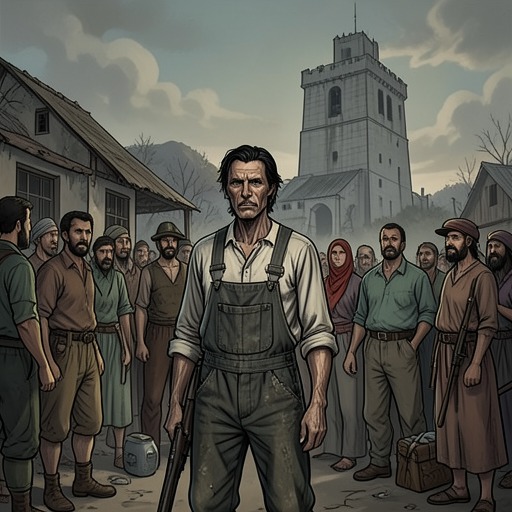
Nor did popular resistance guarantee the survival of the revolutionary regime. With its prospects already compromised, a delegation of prominent Palermo citizens met Carlo Filangeri, commander of the Bourbon army, at Caltanissetta and surrendered the city. Palermo’s people rejected that decision. They rose against the city guard and erected barricades, refusing concessions to the Bourbons despite hunger. But the uprising in the streets was left without effective leadership: government leaders, including Settimo and Giuseppe La Masa, fled, while aristocrats withdrew to their country villas and courtyards. Palermo was left disordered, starving, exhausted, destroyed, and burning.
The surrender and popular resistance thus belong to opposing accounts of political authority. The delegation could hand over the city, but it could not make the people accept the return of Bourbon rule; the people could resist, but were abandoned as leaders and elites withdrew. The revolution’s defeat was not simply the loss of a military contest. It exposed the distance between a government’s claims, the divided interests of Palermo’s social groups, and the population’s determination not to submit.
Consequences and Political Meaning
The retreat of the revolutionary government had consequences for both the Florio family and Vincenzo’s public position. As Palermo collapsed, his ten-year-old son Ignazio saw the family take refuge aboard L’Indépendant, a steamship Vincenzo had bought for his new shipping company with Ignazio. The vessel was registered as French, a protection Vincenzo believed would deter both rebels and Neapolitans from attacking it for fear of provoking France. The family’s flight turns the political crisis into a domestic fact: the revolution and its approaching defeat dislodged them first from their home in Via dei Materassai and then from Villa dei Quattro Pizzi.
After the revolutionary leaders fled and the city fell into disarray, Vincenzo took a position in the National Guard. He had not wanted the role, but felt he had no choice; he distanced himself from the revolutionary government’s actions as soon as he could and believed he had not made a wrong move in managing his business. His trajectory reveals the constrained position of a merchant whose money and infrastructure made him useful to competing authorities, while political involvement threatened the commercial world he had built.
The same pattern of state claims continued after the regime changed. The Bourbons retained three of the five Casa Florio steamers to transport troops and sank another. A year later, they challenged the interruption of the postal distribution service and sought to fine Vincenzo, although he argued that the missed service was not his fault. Later, he condemned Piedmontese annexation as a new form of subordination, arguing that Sicily was being made a colony and that the Bourbon Crown treasury had been taken north to finance the annexation campaign. These later disputes do not make the revolutionary government responsible for every subsequent grievance; they show the continuing stakes of the political failure it had tried to prevent. Across successive regimes, control of ships, customs, money, and communications remained a means by which external authorities exercised power over Sicily.
The novel therefore presents the Sicilian Revolutionary Government of 1848 as an ambitious but materially vulnerable experiment. Its effort to restore the 1812 constitutional order and establish an independent kingdom faced divisions over the future form of government, dependence on private resources, the need to supply the poor, and the superior force of Bourbon reconquest. Its defeat left no simple resolution: the city’s resistance outlasted its leaders’ commitment, while the commercial families drawn into the revolution continued to bear the costs of rulers claiming Sicily’s resources.