Sicilian Sulfur
The Florios of SicilySicilian Sulfur is both a resource extracted from Sicily’s land and a turning point in Casa Florio’s commercial expansion. Called “the devil’s gold,” it carries a double meaning: it enriches merchants and supplies European industry, yet its extraction deforms workers’ lives and leaves Sicily with little of the prosperity created from its mineral wealth. The commodity’s importance becomes concrete when Vincenzo Florio turns an insolvent debtor’s stranded stock into a profitable export and, eventually, a durable line of business.
The mineral and its costs
The book introduces sulfur as a treasure discovered beneath land that had long been cursed for it. Its presence made the soil barren and unsuitable even for pasture, while the fumes burdened the landscape. Once demand made extraction profitable, underground corridors were dug. Children and men carried baskets of yellow stone to the surface, their backs deformed by the work; the clods were weighed and packed into sacks for sale. Sulfur’s value therefore begins in a stark contrast: the mineral raises commercial fortunes, but its production rests on exhausting labor and damaged land.
The routes out of Sicily widened the gap between extraction and the benefits of industrial use. Sulfur was shipped across Europe, with France and especially Britain taking substantial supplies, alongside destinations in northern Italy. In factories, it was burned in lead chambers and transformed through heat and steam into oil of vitriol, or sulfuric acid. This product served dye manufacturing and chemical processes in the factories spreading across Europe. The source material and labor were Sicilian; the processing and expanding industrial uses belonged to a wider market. The book’s judgment is compressed in the phrase “The devil’s gold makes you rich. It creates well-being and jobs. Everywhere. Except in Sicily.”
Vincenzo’s entry into the sulfur trade
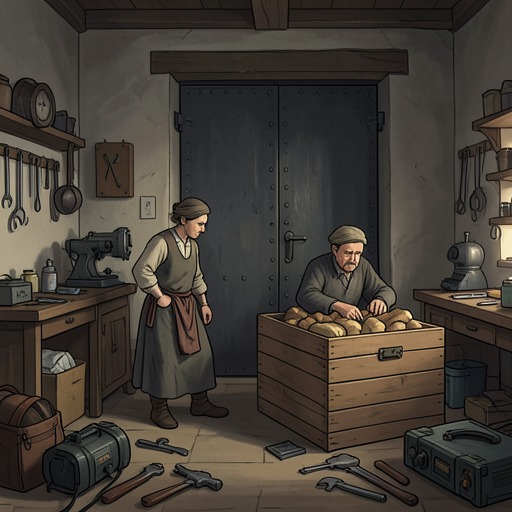
Sulfur enters Vincenzo’s business through a debt rather than a planned investment. In a memory set against his later consideration of a quarry, he recalls a debtor who had come from Agrigento because he could not honor his promissory note. The man had sulfur he could not sell: he lacked a way to transport it to the sea and could find no carrier willing to take it without payment. The creditor’s claim and the sulfur’s market value were thus separated by a practical obstacle—getting the mineral to a port.
Vincenzo and his uncle Ignazio recognized that the stock might have value beyond the unpaid note, and thought of their French associates. Vincenzo offered to inspect the sulfur and take it if it proved good, promising to tear up the promissory note in return. He did so. The exchange settled the debtor’s immediate obligation while giving the Florios control of a commodity that could be moved into an export network. The episode presents credit not simply as a written claim but as an opening to acquire goods, arrange transport, and connect a local producer to distant buyers.
The sulfur proved commercially valuable. The Florios placed the load in Marseille for three times the value of the promissory note. After Ignazio’s death, Vincenzo bought the land from which it came. What began as an answer to one debtor’s inability to transport and sell his stock therefore developed into ownership of the source itself. From that point, sulfur became an important entry in the Casa Florio balance sheet. The sequence—debt, inspection, transport, sale, purchase of land—shows how Vincenzo converted a blocked transaction into a continuing business interest.
A quarry, a contract, and the question of transport
Vincenzo’s later dealings show sulfur’s place among his expanding commercial concerns. In conversation with Giovanni Portalupi, he explains that he has taken over one of Baron Morillo’s mines. Portalupi has heard of the quarry and praises the sulfur as the most competitively priced he has found for its value. The discussion takes place around a contract, making the commodity’s quality and price part of an active business negotiation rather than merely a recollection of earlier success.
For Vincenzo, a mine’s value depended on how its product could reach ships and buyers. While considering the sulfur quarry, he studies a map of the Marsala coast with his cousin Raffaele Barbaro. Their discussion concerns a proposed wine cellar, not a sulfur shipment, but the map makes transport a concrete business constraint: the roads are little more than sheep tracks, large wagons cannot pass, and he does not want to spend money on carts. He favors a location with direct sea access so goods can move from production to a ship’s hold. Read alongside his sulfur transaction, this planning underscores a recurring commercial principle in his ventures: a commodity’s potential depends not only on what the land produces, but on the route that connects it to the market.
Wealth, status, and the book’s larger pattern
Sulfur’s story belongs to a broader world of commodities whose value depends on long chains of labor, transport, and trade. Elsewhere, the book describes spices passing through many hands, traveling by caravan and sea, and becoming more expensive at every stage; British and French colonial supplies reshape the market reaching Palermo. Sulfur follows a different route, from Sicilian mines toward European buyers and factories, but likewise reveals that commerce is made through connections extending well beyond the place of extraction. The Florios’ ability to take over a stranded load and sell it through Marseille turns their access to those connections into an advantage.
The commodity also sharpens the divide between money and inherited status. Vincenzo’s success in trade does not erase the contempt directed at him as a storekeeper’s son; an aristocratic rejection insists that wealth cannot replace blood. Sulfur offers a material counterpoint to that prejudice: commercial wealth can be accumulated through judgment, credit, and enterprise, even when social recognition remains contested. Its place in the firm’s accounts records a real change in the Florios’ economic position, while the export economy and the book’s contrast between Europe’s prosperity and Sicily’s deprivation prevent that ascent from appearing uncomplicated. Sulfur is at once resource, industrial input, debt settlement, and instrument of family advancement—a source of wealth whose benefits remain unequally shared.