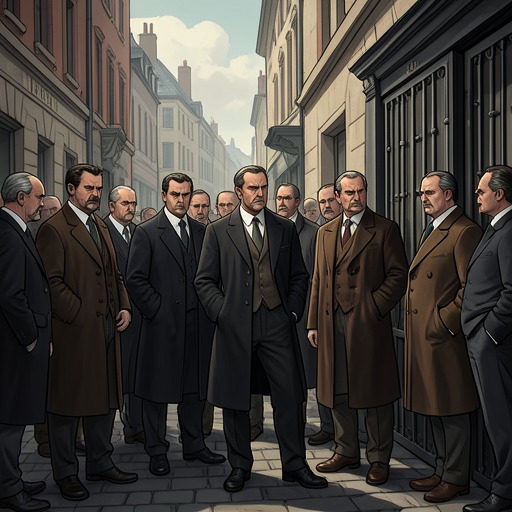
Venanzio Canzoneri
The Florios of SicilyVenanzio Canzoneri is a merchant and a senior figure in Palermo’s Canzoneri family, whose commercial influence places him among the Florios’ most consequential rivals. He is introduced through disputes over partnership and business authority, then reappears as a leader of opposition to the Florios’ medicinal trade. Yet his power is not fixed: the family’s debts and his father’s incapacity weaken the position from which he challenges them. His story shows how commercial standing in Palermo depends not only on goods and money, but on kinship, credit, guild authority, and reputation.
Identity and Commercial Setting
At the beginning of the nineteenth century, the spice trade is changing. Goods that have passed through long supply chains arrive in European ports aboard British and French ships, carrying products from overseas colonies as well as medicines and foodstuffs. With prices falling, markets diversifying, and harbors opening, more merchants can enter the business. In Palermo, the aromatari have organized a guild and even possess their own church. The Canzoneris belong to this increasingly competitive commercial world, with a standing that the Florios initially cannot match.
The Florios’ trade illustrates the system in which Venanzio operates. They obtain spices from India through British suppliers and goods from French colonies that reach them by way of Livorno and Italian sailors. Their warehouse behind the customs offices at Palazzo Steri lets them hold goods in transit and pay import tariffs only when stock actually enters Palermo. The arrangement is common among wholesalers, but the scale of the Florios’ business has grown enough that their original storeroom on Via dei Materassai no longer suffices. Their expansion brings them into more direct competition with established houses such as the Canzoneris.
Partnership and the Warehouse Dispute
The conflict becomes explicit when Paolo Barbaro learns that the Florios have rented a warehouse without consulting him. Barbaro is both Paolo Florio’s brother-in-law and a business partner who has supplied capital. He shoves Ignazio, then accuses him and the Florios of acting behind his back and signing the rental in their own names. Ignazio explains that a worker for Canzoneri told Barbaro about the arrangement, making Venanzio’s business network part of the dispute even though Barbaro is the one who confronts the brothers directly.
Barbaro’s grievance is not only about the warehouse. He insists that the Florios owe him notice because they are relatives and partners, and reminds them that his money gives him the power to take everything away. Paolo answers with the work the Florios themselves have done: they repaired and reopened the shop, and the premises Barbaro had described in Bagnara as satisfactory were damp and infested with silverfish. Now customers are coming and the business is making money. The quarrel exposes the tension between capital and labor, and between the authority claimed by an investor and the practical initiative of those running the shop. Venanzio is not shown leading this confrontation, but the report from one of his workers shows how quickly information and suspicion move between rival businesses.
Influence, Reputation, and the Apothecary Challenge
Venanzio’s family connections are also visible in the public deference shown to Carmelo Saguto. At a notary’s office, Saguto jumps the queue and is received with marked respect. Those waiting mutter but do not openly protest: Saguto is Canzoneri’s son-in-law, and people are reluctant to stand up to him. The episode gives the Canzoneris’ influence a social form. Their standing is not confined to stockrooms and transactions; family relations help secure attention and discourage opposition.
That influence meets a direct challenge when the Florios secure official permission to import and sell British bark powder. The authorization comes from the physician responsible for approving new drugs in Sicily, and Ignazio anticipates that Palermo’s apothecaries will protest. A delegation arrives at the Florio office with Venanzio at its head beside Saguto. The challenge is organized around the College of Aromatari: the Florios, their visitors argue, do not belong to the guild and have neither sought its permission nor followed its rules for selling medicinal herbs.
The dispute turns on competing claims to legitimate authority. Venanzio’s side invokes guild membership and established rules; Ignazio answers that the Florios have an official document authorizing the sale and will not break the law. Vincenzo remains standing and watchful, while Ignazio tries to keep the exchange inside the office rather than let it become a brawl. The contest is therefore at once commercial and institutional: the rival merchants seek to defend the guild’s control of medicinal trade, while the Florios rely on a government authorization that lets them bypass that control.
Ignazio shifts the confrontation from guild rules to commercial honor, asking whether debts, too, must be settled. Venanzio gives a deep sigh and agrees. The visitors leave; he keeps his head high and says nothing, while Saguto turns back at the doorway and bites his thumb at the Florios. The departure is not a reconciliation. Venanzio concedes the immediate point, but Saguto’s gesture signals that the affront will remain a source of hostility.
Debt and Declining Leverage
The balance of power changes as the wider market contracts. In 1817, a year described as lacking warmth, Ignazio warns Vincenzo that after seeking a loan the Florios may be fortunate merely to avoid a loss. Vincenzo notes that even Saguto has requested an extension of payments on behalf of his father-in-law. Since the older man’s apoplectic fit, his eldest son has been running the business. The exchange places the Canzoneris, once able to command deference, among merchants now strained by debt and disrupted authority within the family.
Vincenzo calls Saguto a dog who barks at corpses and licks wealthy men’s boots; Ignazio dismisses him as a lackey and pawn, kept content because his marriage brought money into the family. The insults are pointed, but the underlying fact is more consequential: the Canzoneris are in debt too, and the Florios’ rivals have stopped teasing them. Credit and reputation, which once made the Florios vulnerable, now constrain the established family as well. Venanzio’s authority is thus part of a commercial order in which advantage can reverse when payment falters.
Character and Narrative Role
Venanzio is portrayed less through private reflection than through the positions he occupies in public and commercial conflict: the senior Canzoneri at the head of a guild delegation, the relative of Saguto, and the representative of a powerful house whose influence is visible in a notary’s office. His restrained acceptance of Ignazio’s point contrasts with Saguto’s lasting resentment. The distinction matters: the encounter closes without a fight, but not without consequences for relations between the houses.
His appearances also place the Florios’ rise in a wider commodity economy. The Florios broker goods for other merchants, including wine, oil, tuna in brine, sumac, and sulfur, and claim they can obtain everything produced in Sicily. Their dealings span imported spices, medicinal bark, and products bound for processing elsewhere. Against this expansion, Venanzio represents the established merchant’s defense of customary controls and inherited standing. But the Canzoneris’ later debt shows that neither family nor guild prestige can insulate a business from a failing credit cycle. His narrative significance lies in that double movement: he has enough influence to make the Florios answer for their new trade, yet he belongs to a commercial house whose authority is itself vulnerable to changing fortunes.