Villa dell’Olivuzza
The Florios of SicilyVilla dell’Olivuzza is both a marker of the Florios’ ascent and the setting for a late reckoning with age, illness, and succession. First presented as part of Palermo’s expanding landscape of new wealth, it becomes the home where Giulia cares for Vincenzo after his stroke and where the family’s next generation is already taking shape.
From Palermo’s New Landscape to a Florio Residence
The villa appears in a forward-looking account of Palermo’s growth beyond Castellammare. The newly rich are building elegant houses among vegetable plots and olive groves, often on the foundations of older palaces, with gardens planted with exotic species brought from British and French colonies. In that changing cityscape, the narrator says that Ignazio Florio will create Palazzo Olivuzza, another name associated with the property. The passage places the Florios’ future residence among the visible signs of a city being remade by wealth, while emphasizing that this future is still to come.
The name Villa dell’Olivuzza becomes explicit in the epilogue, set in September 1868. It is described as a vast, green estate that will become the Reggia dei Florio. The movement from a future projection to an inhabited home gives the estate two scales of meaning: it belongs to the private life of the family, but also to a public landscape in which new commercial fortunes establish themselves through grand residences.
The House in September 1868
The epilogue situates the villa amid greenery and describes its Gothic lines, arched portal, and mullioned windows screened by white curtains. The room where much of the scene unfolds is on the second floor of the right-hand wing, in the quietest part of the house; its two windows overlook the garden. The lavish furnishings—velvet armchairs, Persian rugs, a mahogany dressing table, and a large bed with a carved headboard—make the household’s prosperity tangible.
Yet the scene does not isolate the family from domestic labor. From the servants’ quarters below, washerwomen can be heard beating laundry, and one is singing. That sound places the villa’s comfort within an occupied household rather than presenting it as an empty emblem of status. The room’s quiet and rich furnishings coexist with the work that sustains life in the house.
Giulia, Vincenzo, and the Turn in His Health
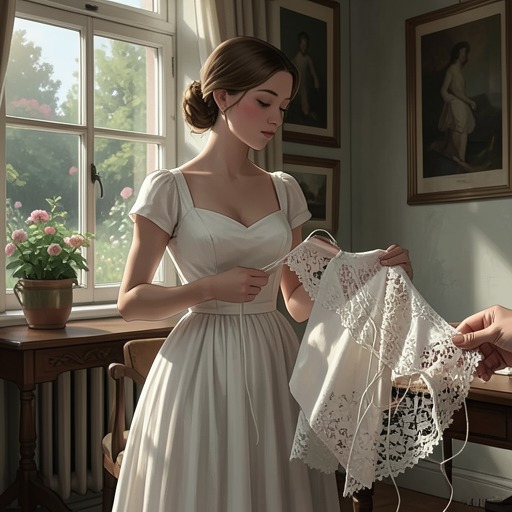
Giulia is shown in the villa embroidering a christening gown promised to her son and daughter-in-law. Their child is expected soon; she knows the baby will follow little Vincenzo, who is just over a year old, and takes comfort in the continuity implied by the names. Her son has already produced an heir for the business and named him after his father, sustaining her hope that Casa Florio will always have a Vincenzo and an Ignazio.
That confidence is shadowed by Vincenzo’s recent stroke. The narrative recalls that it occurred four months earlier, at the end of May, after the couple had moved into the villa, formerly belonging to the princess of Butera. They were in the same bedroom when Giulia heard him moving restlessly under the blankets and he told her he felt unwell. She turned on the electric light, a new installation Ignazio had arranged as soon as he bought the estate, and saw the effects of the stroke in Vincenzo’s face. The villa’s modern amenity illuminates the crisis without reversing it: from that point onward, something in her husband has changed.
Succession and the Meaning of the Estate
After the stroke, Vincenzo hands the entire business to Ignazio. He does not admit that his body can no longer be trusted, but the narrative makes the transfer a practical acknowledgment of his altered condition. A few days later, he summons the notary, Quattrocchi, and makes a will, explaining to Giulia that he does not want to leave anything unsettled in case he suffers another attack. The estate is therefore more than the setting for family comfort: within its rooms, the authority built through Vincenzo’s working life passes to the next generation.
Villa dell’Olivuzza gathers the book’s contrasting images of prosperity and vulnerability. Its gardens, imported plants, spacious rooms, and household furnishings speak to the Florios’ rise; the bedroom, the electric light, and the will record the sudden limits placed on the man who helped build that fortune. At the same time, the expected child and the repeated family names point beyond the immediate crisis. The villa stands at once for what the Florios have acquired and for the uncertain work of preserving it.