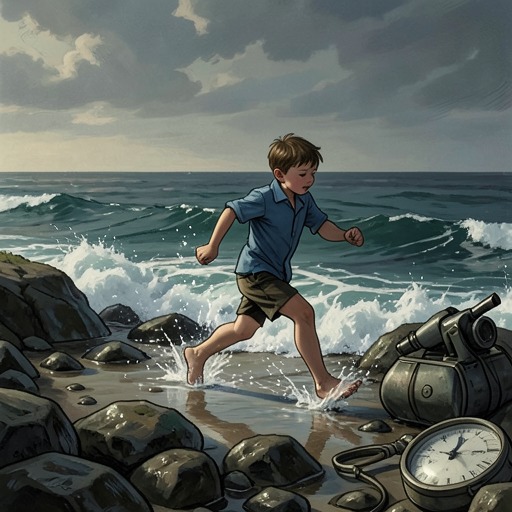
Vincenzo rescues Ignazio from the sea
The Florios of SicilyVincenzo rescues Ignazio from the sea in a turning point for both the child’s survival and his understanding of his father. After Ignazio disobeys a warning to stay away from the slippery cliffs at Arenella, he loses his footing and is pulled into the water. Vincenzo sees him from the house, runs to the shore, and dives in; afterward, he directs the effort to revive the child. The danger ends in rescue, but its emotional consequence continues into the night, when Ignazio sees a look of fear and affection in his father’s face that he has never seen before.
The child goes to the shore
Ignazio slips out of the house and heads for the sea at Arenella. For several days his parents have forbidden him to approach the cliffs beneath the tower or climb the nearby stack because the rocks are too slippery. He remembers spending the summer there without falling and swimming on a couple of occasions. He has not yet dared to dive from the Balata, the large stack beyond the point of the bay, although his father has promised to teach him the following summer. That promise is connected to the family’s sense of itself: the Florios, Vincenzo has told him, must know how to swim, because seawater and blood run together in their veins.
On this outing Ignazio moves along the rocks and reaches toward a crab. His leather sole slips on dry seagrass, and he falls into a puddle of stagnant water. When he tries to turn back, holding on to the cliff, he cannot lift his feet free. The wind throws him off balance and he falls into the sea. He struggles to reach the surface, but the water closes over him; he calls for his mother and loses consciousness. The accident is not a deliberate dive or a test of skill, but the consequence of a child’s movement across a shore his parents have told him to avoid.
Vincenzo sees him and dives
Vincenzo is still in his office, initially supposing that his son must be playing near the boats or on the beach. He has reason to think of his own childhood, when he used to run off toward La Cala and the harbor without anyone worrying over him. Yet he goes to the windows overlooking the cliffs. The narrative leaves uncertain whether instinct or chance prompts him to look; what he sees is unmistakable: a hand and then a leg amid the foam, a body in the water below the cliffs.
The sight changes the scene from ordinary parental concern to immediate danger. Vincenzo runs through the courtyard, taking off his jacket and plastron as he goes. At the front gates he kicks off his shoes and dives into the sea. Giulia follows him toward the cliffs, calling for her husband and son, while the people behind her gather in alarm. Her view of the rescue remains uncertain as Vincenzo surfaces and disappears again in the dark water, and the body in the waves is difficult to distinguish from the water’s movement.
The rescue and its immediate aftermath
Ignazio emerges first. He is pale and coughing, and Giulia recognizes that the cough means he is alive. Vincenzo surfaces just afterward, cold and scratched, but focused on the child. When Giulia tries to take Ignazio, Vincenzo pushes her away and insists that the boy be turned on his side so he can expel the water. He strikes Ignazio on the back; the child coughs and brings up seawater and remnants of food before briefly opening his eyes and calling for his mother.
Giulia wraps Ignazio in her shawl as he continues to cough and shiver. Vincenzo then lifts him and carries him toward the tower. The rescue thus moves through distinct hands and actions: Vincenzo locates and retrieves his son, takes charge of the first response, and carries him from the shore; Giulia stays beside the child and wraps him against the cold. In the days that follow, Ignazio remains in bed with a fever attributed to the shock and cold. Giulia calls what happened an accident, a name that keeps the episode present as a household event rather than something simply left behind at the water’s edge.
A new understanding between father and son
That night, after mother and child have fallen asleep together, Ignazio wakes and sees his father sitting in an armchair. Vincenzo’s face and posture show tension, relief, panic, exhaustion, and affection. Ignazio has never seen him look at him that way. He understands that his father was frightened for him and is unsettled by the thought that this fear may mean Vincenzo loves him.
The recognition is private and incomplete. Ignazio wants to reach out and invite his father closer, but tiredness overtakes him, and he falls asleep again without speaking. He does not see that Vincenzo’s eyes are filled with tears. The rescue therefore changes more than the immediate balance between life and death: it gives the child a new way to read his father’s fear, while leaving the father’s emotion largely unspoken. The sea that made Ignazio vulnerable also creates the moment in which he glimpses an affection he had not known how to recognize.