Vito Cordova
The Florios of SicilyVito Cordova, the overseer of the tuna fishery on the Aegadian Islands, is the local authority Vincenzo Florio must meet when he takes over the lease. Known by the title u’ rais, Cordova stands between the island’s established fishing community and Vincenzo’s plan to change how its catch is processed. His response to that plan—especially the question of whether island families will be allowed to work—makes him a measure of whether commercial innovation will alter only the product or the community’s share in production as well.
Identity and Setting
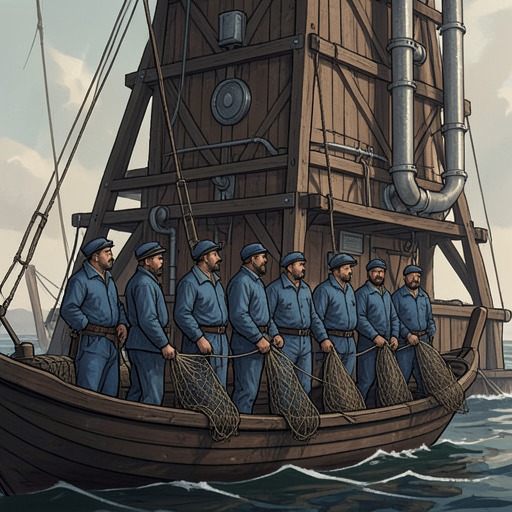
Cordova introduces himself as the overseer, or u’ rais, when he steps forward from a gathering of fishermen to greet the newly arrived steamship. He has a powerful build, curly hair, and a beard reaching halfway down his chest. He bows his head and gives the traditional greeting, Assabbinirìca, establishing his familiarity with the island’s customs before business begins.
The meeting occurs after Vincenzo’s party sails around the Gulf of Castellammare and past Cape San Vito, with the Aegadian Islands coming into view. A crowd gathers to see the metal-hulled steamer enter the harbor. The surrounding poverty is immediately visible: the island is bare, its houses are little more than hovels, and women and barefoot children stand near the fishermen. Cordova emerges from this community, not from the distant owners’ administration.
The New Lessee and the Old Arrangement
Cordova’s first exchange with Vincenzo carries the weight of a change in authority. He asks whether Vincenzo has come to inspect the marfaraggio or the boats, then learns that the visitor is from Palermo and has been leased the fishery for nine years by the Pallavicinis. The Genoese owners, Cordova explains, have always sent stewards rather than coming themselves. Vincenzo’s personal arrival is therefore unusual: for the first time, the man directing the operation is present on the island to see it himself.
Cordova’s cautious question about where Vincenzo comes from also marks the gap between the local workforce and outside ownership. Vincenzo identifies himself as a Palermitan lessee, while the old pattern Cordova describes is one in which Genoese proprietors remain absent and send representatives. The encounter does not erase that hierarchy, but it changes its immediate form: Cordova can speak directly to the person making decisions, and Vincenzo chooses to ask what the overseer thinks.
Judgment and the Proposed Change
During a review of the catch, Vincenzo says that the current mattanza has yielded three thousand tuna so far, with the season only beginning in May. When the bookkeeper starts to report on salt supplied by Vincenzo’s associate D’Alì, Vincenzo cuts him off. He turns instead to Cordova, who estimates that at least as many tuna may still be caught, along with many sardines. By seeking the overseer’s assessment, Vincenzo treats Cordova’s practical knowledge of the fishery as more relevant than the routine account of supplies.
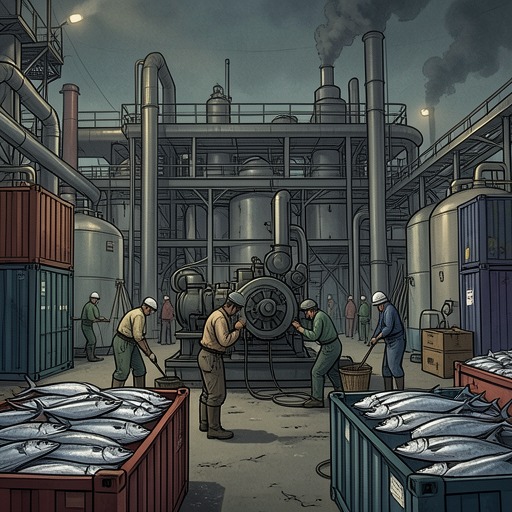
Vincenzo then announces that the operation will no longer produce only salted tuna. He argues that sailors and shipping companies distrust salted fish because it is said to cause scurvy, leaving much of it unsold. The alternative is to cut and boil the tuna, then preserve it in oil in airtight barrels. Cordova is present as Vincenzo explains this proposal, but the evidence does not give him a technical role in devising the method; the initiative belongs to Vincenzo and rests on trials already conducted with tuna from Arenella and San Nicolò l’Arena, with Carlo Giachery’s help.
Labor, Families, and Response
The change reaches beyond the preservation process. Vincenzo proposes altering the marfaraggio to include boilers for cooking the fish and accommodation for seasonal workers. Rather than employ fishermen alone, he intends to bring families into the operation. When the bookkeeper objects that people on the island cannot do what Vincenzo imagines, Cordova is there as the person whose knowledge of the workforce could confirm or challenge that judgment. Vincenzo answers that they will begin by themselves and the families will learn together.
Vincenzo adds that the enterprise will make use of the tuna’s by-products: fat will be rendered into lamp oil, and the dry bones used for soil. The plan thus treats the catch as more than a single saleable food, while its labor proposal treats the island’s families as more than a background to the fishery. Cordova’s brief question about whether the families are included draws attention to the human consequence of the new system. Vincenzo confirms that they can all work, and a hint of a smile appears on Cordova’s cracked lips.
Narrative Significance
Cordova’s role is concentrated in the encounter between inherited practice and a proposed industrial reorganization. His greeting, his account of the absentee Genoese owners, and his estimate of the catch establish him as the fishery’s local representative; his presence when Vincenzo lays out the new method gives the plan a witness from the community it will affect. The exchange also makes a distinction between changing production and changing participation. Preserving tuna in oil may answer a market problem, but Vincenzo’s promise to employ whole families is what draws Cordova’s visible response.
The scene does not establish what Cordova later thinks of the scheme or whether the promised employment succeeds. It ends instead on the possibility opened by Vincenzo’s assurance. The families who live around the fishery are no longer described only through poverty or as people supposedly incapable of new work; they are named as potential workers who can learn together. Cordova’s smile registers that possibility without turning it into a guaranteed outcome.