"Shengping" Writing Practice
The Glass Bead GameThe “Lives” are official exercises in which young Castalian students compose fictional autobiographies set in a chosen period of the past. More than stylistic assignments, they let students try on other historical worlds, examine the self as something changeable, and express creative impulses within an intellectual culture wary of independent literary work. Three exercises by Joseph Knecht survive, and the practice offers a revealing counterpoint to the Province’s ideal of anonymity: it asks the student to imagine a life, while loosening the claim that any single life exhausts the person.
Assignment and Form
The custom began in the earliest days of the Pedagogic Province. Students who had not yet entered the Order were asked from time to time to write a “Life”: a fictitious autobiography in which the writer placed himself in a past era and imagined a life suited to its culture and intellectual climate. The setting could range from imperial Rome and Periclean Athens to seventeenth-century France, fifteenth-century Italy, or Austria in Mozart’s time. Language specialists might write in the language and style of their chosen period, producing exercises modeled on forms as varied as monastic Latin, the Italian of the “Cento Novelle Antiche,” Montaigne’s French, or the baroque German of Martin Opitz.
For students still exploring their subjects, the assignment belonged to a permissive educational order. They could spend semesters or years using libraries and attending lectures without committing to a single field; they reported their reading, lectures, and research annually, and composed a “Life” each year. Unlike Knecht’s unofficial poems at Waldzell, his three surviving Lives were therefore legitimate, ordinary work required of students during their years of free study.
Historical Imagination and Self-Knowledge
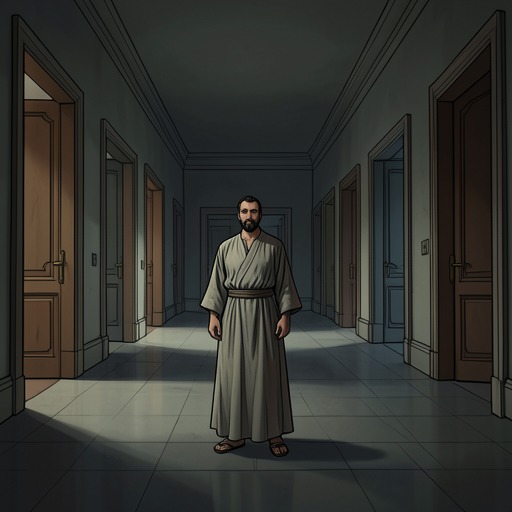
The exercises preserved a playful remnant of the Asian doctrine of reincarnation and the transmigration of souls. Castalians were not required to believe literally that they had lived before. Instead, students used the possibility as an imaginative game: they moved themselves into different bodies, times, and conditions, and practiced cautiously entering past cultures through historical and stylistic study. In that process, the person could be regarded as a mask, a temporary garment of an entelechy, rather than as a fixed identity.
The practice could also expose the desires concealed within its historical costumes. Some students came to believe in the truth of their invented previous lives; their compositions became idealized self-portraits, casting them as people they longed to be. Often elaborated into small novels, the Lives provided a permitted channel for youthful creative energy in a culture where serious literary creation had long been discouraged and partly displaced by scholarship and the Glass Bead Game. Writing them could mark an initial step toward self-knowledge as well as a release for artistic impulse.
The same freedom made the exercises useful to teachers. Students sometimes used their invented pasts to deliver critical or revolutionary judgments on contemporary life and Castalia. Teachers generally received such sallies with benevolent understanding, and the compositions could offer unusually clear evidence of an author’s intellectual and moral condition at a time when students were not closely supervised. The Life was thus at once imaginative play, historical practice, self-portrait, and an indirect statement about the present.
Knecht’s Surviving Exercises
Three of Knecht’s Lives, written during his free-study years, have been preserved. After he submitted his third, the “Indian” Life, the Secretariat of the Board of Educators suggested that any further exercise should be set in a better-documented, historically more recent period and pay closer attention to historical detail. Knecht began preliminary research for an eighteenth-century Life, imagining himself as a Swabian pastor who left Church service for music. The proposed figure was connected to Johann Albrecht Bengel, Oetinger, and Zinzendorf’s Moravian Brethren.
Knecht investigated church organization, Pietism, Zinzendorf, and the period’s liturgy and church music. He was fascinated by Oetinger and developed genuine love and reverence for Bengel, even arranging for a photograph of Bengel’s portrait to stand on his desk. Zinzendorf both intrigued and repelled him. Knecht eventually abandoned the project, satisfied with what he had learned, and concluded that his extensive study had left him unable to make a Life from the material. The episode shows how the exercise could become more than a literary construction: historical immersion might itself fulfill the student’s purpose, even when no finished fictional biography followed.
A Practice Against Fixed Identity
The Lives’ invitation to adopt another historical self stands in productive tension with Castalia’s institutional ideal of anonymity and the integration of individuals into the hierarchy. The Province’s biographical record of Knecht is itself fragmentary, and its chronicler presents the effort to recover his life as a service to truth and scholarship rather than a cult of personality. The fictional autobiography offers a different kind of access: not a transparent record of a person, but a disciplined imagining of what that person might be under other conditions.
That tension helps explain the exercise’s lasting value within Castalian education. A student could test an ideal, criticize the present, or approach the self from a historical distance without claiming literal reincarnation or unrestricted artistic freedom. The Lives made invention serve study, while allowing study to disclose desire. In Knecht’s case, their preserved variety and the abandoned eighteenth-century project register an enduring movement between imaginative identification and the limits of historical knowledge.