Age of Wars
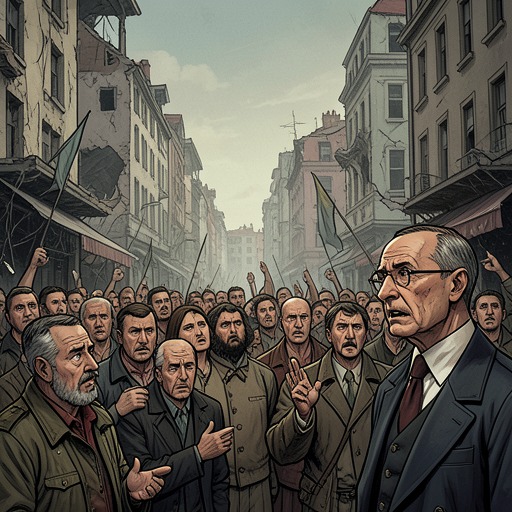
The Glass Bead GameThe Age of Wars names the prolonged conflict whose end made Castalia possible: out of a world exhausted by violence came a demand for order, moderation, and spiritual stability. The era is not merely a backdrop to the novel’s institutions; its aftermath explains their purpose, their dependence on society beyond their borders, and the political fragility that Castalians usually prefer not to see.
The War’s Aftermath and Castalia’s Origins
Castalia arose at the end of the Age of Wars from two converging forces. One was the ascetic labor of scholars, artists, and thinkers who had come to their senses; the other was the deep craving of peoples left exhausted, bled, and betrayed for normality, reason, lawfulness, and moderation. The resulting cultural order was meant not to govern or compete for power, but to safeguard the spiritual foundations of a more stable world.
That origin is easy for Castalians to treat as settled history, and harder to grasp as a continuing political condition. The province and its institutions can seem eternal to those who live within them, but their existence presupposes a workable harmony between the wider world and its guardians of culture. The Age of Wars therefore marks both a beginning and a warning: the conditions that permitted a protected life of the mind were made by historical crisis, and history does not guarantee their permanence.
A Measure of Peace and Its Limits
The costly memory of war makes Castalia’s modest material requirements politically intelligible. In a discussion of the province’s annual expense, Joseph Knecht remarks that its budget amounted to about one tenth of what the country had once spent each year on armaments during the Century of Wars. The comparison casts Castalia as a relatively small investment beside the machinery of militarization, while also reminding readers that its peaceful institutions rest on resources supplied by the society around them.
That dependence is one of the problems the war’s aftermath leaves unresolved. Most Castalians know that their order emerged from historical suffering and understand its intended service to stability. Yet few recognize that world history as a whole does not steadily advance what is rational or beautiful; at best, it sometimes tolerates such things as exceptions. A handful of political thinkers, including Dubois, attend to the legal and economic conditions of Castalia’s survival. For most of its inhabitants, those foundations remain obscure.
Rome and the Shared Inheritance of War
The Roman Church also survived the last great epoch of wars, enduring severe losses and emerging renewed and purified. By contrast, secular centers of art and science were swept away in the general decline of culture; the Order and the Castalian ideal arose from their ruins. This unequal historical inheritance helped shape the proposed rapprochement between Castalia and Rome: the Church was older, had endured more storms, and was to be granted precedence even as the two institutions recognized their mutual need.
The effort to bridge their distance follows from a common fear of future dangers and a shared claim to preserve the things of the spirit and the cause of peace. It also exposes a tension inherited from the postwar settlement: Castalia seeks cooperation with a religious institution while grounding its own order in no church or theology. Father Jacobus’s eventual contribution to a more cooperative relationship between Rome and Castalia shows how historical understanding, rather than simple agreement, could narrow that divide.
From Ruin to Cultural and Ritual Order
The Glass Bead Game gives one form to the intellectual life that grew out of the ruins of secular culture. It came to unite arts and sciences in a universal symbolic practice, partly taking over the roles of art and speculative philosophy. Its Christian theological vocabulary could be incorporated alongside mathematical axioms and musical themes, and for genuine players the Game approached worship without developing a theology of its own.
The annual solemn Game likewise joined people across Castalia’s differing disciplines in a symbolic act of harmony. Its ritual recalled a unity capable of embracing variety, and for believers it possessed the force of consecration; for others, it could serve as a substitute for religion. These institutions transform the search for stability into intellectual and ceremonial forms. Their very need for protection, however, keeps the Age of Wars present beneath their apparent serenity: the culture born from catastrophe remains dependent on a world whose history may again turn against it.