Board of Educators
The Glass Bead GameThe Board of Educators is the governing body that oversees education and intellectual organizations in Castalia, linking the selection of gifted children to the staffing of schools, universities, the Order, and the Glass Bead Game. Its authority is exercised through a hierarchy of offices and formal procedures, but its practical purpose is not merely administrative: it preserves the system that forms Castalian scholars and assigns them to lives of service. Knecht’s career reveals both sides of that system, from the Board’s guidance during his induction as Magister Ludi to the demands that leave him little freedom to determine his own work.
Structure and Educational Authority
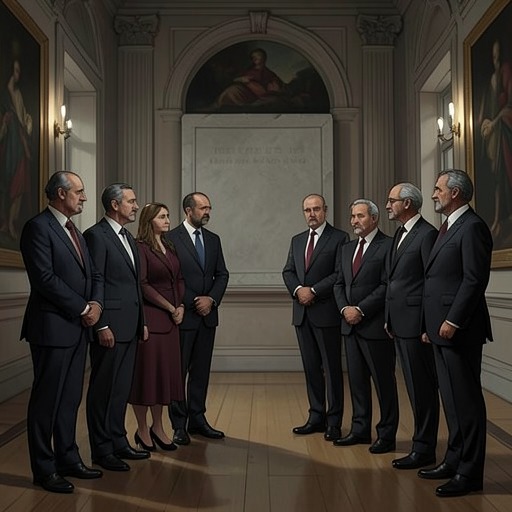
The Board is formed by the directors and highest-level teachers of the elite schools, rather than by the faculties of the universities. Its membership is drawn from the Council of Studies, a body of twenty councilors divided equally between representatives of the Board and the Order. This arrangement places the educational system in a shared administrative framework, with the Board representing one half of the council that selects candidates and helps direct Castalia’s intellectual life.
The country’s ordinary schools prepare the great majority of students for professions and university study. The elite schools form a separate track for pupils judged to possess exceptional gifts and character. Admission does not depend on an examination: a teacher recommends a child, usually around eleven or twelve, and the child is given time to consider whether the opportunity answers to a sense of vocation. Entry then requires the unqualified consent of both parents, and the pupil begins on probation. The Board’s role therefore begins before formal membership in Castalia’s scholarly hierarchy: it has charge of the institutions that identify, receive, and educate the future elite.
After admission, an elite pupil is not trained for a private livelihood. Subject to remaining in good standing, pupils are prepared for positions in the Order and the academic hierarchy, from school teaching to the highest offices, including the twelve Masters and the director of the Glass Bead Game. Specialization develops during the school years, as pupils with aptitudes for languages, philosophy, mathematics, or other disciplines move into the studies best suited to them. Many become teachers in public schools and universities, while remaining members of the Order for life and subject to its rules of poverty and bachelorhood. The Board thus administers a system that offers its pupils extensive scholarly resources and public responsibilities, but also places lasting limits on their professional and personal choices.
Governance of Intellectual Life
The Board’s remit extends beyond the schools. It has charge of education and intellectual organizations throughout the country, and its work intersects with Castalia’s institutions for study and research. The Glass Bead Game, for example, is not simply an independent art: its symbolic language draws on numerous fields, and additions to its fixed body of content are subject to strict control by the Game’s directorate. The larger institutional environment that sustains such practices depends on education authorities as well as on the Order.
That involvement does not make the Board the sole source of Castalian authority. Knecht’s descriptions of his duties distinguish the Supreme Council of Education, the Council of Masters, and the directorate of the Order as bodies with which a Magister must work. The Speaker of the Order chairs Board sessions and enforces their traditional rules of procedure, although he ranks below the Masters. These overlapping offices make governance both collective and hierarchical: the Magister Ludi represents the interests of the Glass Bead Game community, while the Board and other authorities establish the wider framework in which that community operates.
The institutional order also has a ceremonial dimension. When a new Magister is invested, the Board of Educators and the directorate of the Order attend alongside senior pupils, candidates, and officials of the receiving faculty. The ceremony is private rather than a public celebration. The new Master takes an oath, receives keys and seals, and is vested in an official robe. The presence of the two highest authorities makes the occasion consequential: the community of Game players receives its leader, who will preside over it and speak for its interests within the Board. Office is thereby made visible through ritual insignia while remaining subject to the administrative structures in which the officeholder must act.
Knecht’s Appointment and Trial
Knecht’s dealings with the Board become especially important after he is appointed Magister Ludi. He already knows many of the practical functions of the post, having assisted with Game courses for schoolboys, beginners, visitors, and elite pupils, as well as with practice sessions, lectures, and seminars. What is new is the broader work of office: serving on the Supreme Council of Education, working with the Council of Masters and the directorate of the Order, and representing the Game community in dealings with other authorities.
At first Knecht would rather have taken time to study the constitution, past Board proceedings, and the formalities of his position. He cannot arrange his start around that preference. Instead, he is directed toward duties he expects to be more familiar, especially winning the confidence of the elite pupils at Waldzell. A timekeeper and coach appointed through the Board supervises his schedule, while Alexander, delegated by the Order’s directorate, ensures that Knecht maintains the prescribed brief meditations three times each day. Administrative oversight and spiritual discipline thus accompany the practical work of assuming office.
Knecht’s first plenary session of the Board receives little of the attention he had expected to give it. He travels to the meeting by the fastest express and returns the same way, but his energies are consumed by the more immediate task of establishing himself among the Game candidates. Even during the session, his thoughts turn to a small seminar in dialectics in Waldzell’s blue Archives room, with only five participants; he finds that each hour of this work demands more of him than the wider official business. The contrast shows the difference between the visible reach of his new responsibilities and the personal, demanding labor through which he earns authority among those he is to lead.
After Knecht succeeds in winning the elite’s recognition, he asks them collectively to choose his deputy, or Shadow, rather than exercising his own right to select one. The choice is a gesture of trust toward a group whose resistance he has only just overcome, and it gives the tutors a direct part in the arrangement that will help sustain his office. The custom of the Shadow also exposes the costs built into Castalian hierarchy. A Magister’s deputy may be entrusted with significant functions and may represent the Master, yet cannot advance to the Master’s office; the Master, in turn, bears responsibility for the deputy’s official actions. The appointment therefore offers high status while placing the deputy in a constrained and unusually dependent position.
Authority, Service, and Limits
The Board’s authority rests on a conception of office as service rather than personal advancement. During Knecht’s admission to the Order, the former Music Master gives him a passage for meditation stating that every step upward in the hierarchy brings greater bondage and stricter service. The teaching frames the same institutional logic visible in the Board’s work: elevated rank means greater responsibility, not release from obligations. Knecht’s induction is marked by an oath and by advice to identify himself with the Order’s rules, while his subsequent appointment adds administrative duties and scrutiny to that commitment.
The system’s procedures can also permit action beyond what custom has recently allowed. When Knecht later prepares to resign and leave Castalia, Alexander considers whether the plan violates the rules. He concludes that the written provisions allow any member of the Order to resign, provided that the member relinquishes the accompanying privileges and separates from the Castalian community. The step is unprecedented in living memory and conflicts with unwritten bonds, but it is not formally prohibited. This distinction between written rules and customary expectations defines a limit on institutional authority: the Board and the Order govern a member’s position, yet their rules do not erase the possibility of departure.
Religious and Cultural Context
The Board’s work belongs to a culture in which intellectual life carries much of the weight of religious practice, even though Castalia does not rest on a church or a theology. The Glass Bead Game can incorporate Christian formulas alongside mathematical axioms and music, and for committed players it approaches worship without developing a theology of its own. The annual solemn Game likewise brings together divergent tendencies within Castalia in a symbolic act of unity. For believers it has the force of consecration; for others it can serve as a substitute for religion.
This arrangement has practical consequences for Castalia’s relations with the Roman Church. Father Jacobus initially regards the Castalian Order as an imitation of Christian models without the religious basis that gives those models meaning. Knecht responds by explaining Castalia and the Glass Bead Game; their exchange turns his teaching into a reciprocal education, as Jacobus’s historical scholarship helps Knecht see the roots and limitations of his own system. Jacobus’s eventual advocacy contributes to a benevolent neutrality between Rome and Castalia, followed by scholarly exchange, cooperation, and concord. The Board’s institutions are therefore not sealed from outside judgment: their educational and intellectual structures enter into contact with religious traditions, and that contact can alter the political and cultural conditions in which Castalia survives.