Contemplation in the Glass Bead Game
The Glass Bead GameContemplation in the Glass Bead Game is the disciplined inward attention that transforms the Game from an exhibition of intellectual virtuosity into a spiritual practice. Its players do not merely recognize connections among mathematics, music, and other fields: they pause over each symbol, attending to its content, origin, and meaning. The change checks mere speed and memory, gives the Game a religious dimension, and preserves the signs as bearers of understood meaning rather than an impressive but hollow code.
From virtuosity to contemplation
In its earlier form, the Glass Bead Game arranged, grouped, and set against one another concentrated ideas drawn from many fields of thought and aesthetics. It offered a rapid recollection of enduring values and forms, a virtuoso passage through the realms of the mind. Yet that formal brilliance could be imitated by people whose extraordinary memories were unsupported by other intellectual or spiritual qualities. Such mnemonists could overwhelm their fellow players by summoning countless ideas in dazzling succession. Their performances exposed a weakness in a Game that prized the abundance and speed of its associations without requiring a deeper response to what those associations meant.
The response was not to abandon the Game’s technical complexity, but to change the quality of attention it demanded. Displays of memory and virtuosity increasingly came under strict prohibition, while contemplation became an essential component and, for audiences, ultimately the principal one. This shift redirected the activity from rapid tracking of sequences and the intellectual mosaic toward a more inward engagement. The Game’s achievement would no longer be measured simply by how many ideas a player could call up or how swiftly they could be connected; players and listeners were asked to receive and consider what each connection brought into view.
The practice and its discipline
After the director introduced a symbol, each player was required to undertake silent, formal meditation on it. The exercise called for attention to the symbol’s content, origin, and meaning, and for an intensive, organic recollection of its full significance. Contemplation thus gave the Game a deliberate pause: the symbol was not merely a cue for the next move in a chain of associations, but an object of thought in its own right. Its meaning had to be inwardly attended to before the play could proceed.
This practice rested on training cultivated in the elite schools. Members of the Castalian Order and of the Game associations brought their methods of contemplation and meditation from institutions that nurtured those arts with exceptional care. The rule therefore joined a specific demand within the Game to a broader discipline of formation: players were expected not only to know its learned language, but to possess the trained attention needed to engage it. Contemplation was not an optional mood added to an otherwise complete performance. It was a learned practice that shaped how the Game’s symbols could be understood.
Its function was also protective. The Game’s signs drew their force from a highly developed language that connected knowledge across disciplines; without attentive understanding, those signs could be reduced to mere display. Contemplation kept its hieroglyphs from degenerating into empty signs. The distinction is consequential: a symbol may be recognized, repeated, and fitted into a pattern while its significance remains untouched. The required meditation was intended to prevent that separation between formal fluency and genuine comprehension.
From private exercise to public ceremony
The contemplative turn accompanied a change in the social life of the Game. For a long time it remained a private exercise, played alone, in pairs, or in larger groups. Especially brilliant and well-composed Games might be written down and circulated between cities and countries for admiration or criticism, but the practice had not yet become a public ceremonial institution. The new emphasis on contemplation helped alter that character: in time, public ceremonial Games became the form with which people most commonly associated the Glass Bead Game, even though private play remained open to everyone and particularly appealed to young people.
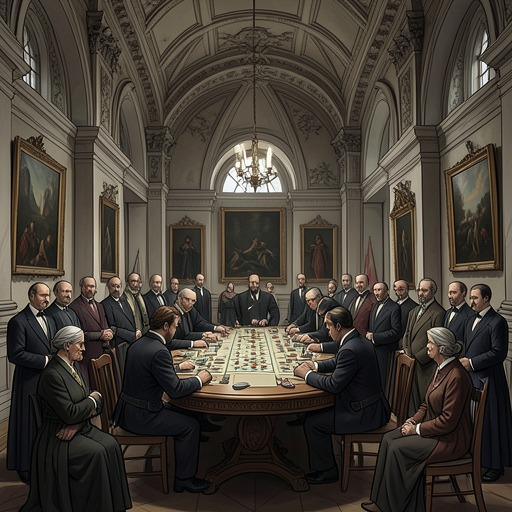
Public Games took place under a few superior Masters, subordinate to the country’s Ludi Magister, before invited guests and a wider audience following events across the world. Some lasted days or weeks. During such a Game, players and guests alike lived an ascetic, selfless life of complete absorption, observing rules that even regulated how long they were permitted to sleep. The account compares this discipline to the strictly ordered penitence of the exercises of St. Ignatius Loyola. Contemplation was therefore more than an inward technique for individual players: it helped organize a shared event, binding the participants and audience into an extended practice of attention.
The change in audience mattered as much as the change in performance. Earlier listeners were expected to follow the sequences of ideas with rapid attentiveness, a practiced memory, and full understanding. The later demand for a deeper, more spiritual approach made the audience’s participation contemplative as well: spectators were not simply witnesses to intellectual speed, but were drawn into the ritual gravity of the Game. Ceremony gave public form to a principle that began as a corrective to individual virtuosity.
Symbols, music, and the limits of abstraction
The Glass Bead Game’s symbols belonged to a language whose rules and grammar drew particularly on mathematics and music and could establish relationships among the contents and conclusions of many scholarly disciplines. A game might begin with an astronomical configuration, a theme from a Bach fugue, or a sentence from Leibniz or the Upanishads. Players could develop the starting motif or enrich it with allusions to kindred concepts; experts and Masters could weave it into extensive combinations. In this setting, contemplation made the connection between formal combination and considered meaning central to the practice. The symbol was not meant to function only as a unit in an elegant construction; its significance was to be apprehended.
Music offered both a model for the Game’s unfolding and a warning against confusing abstraction with experience. A Game could state, vary, and develop themes in a manner resembling a fugue or a concerto movement. Yet Joseph Knecht later insisted that music could not be understood through the intellectual patterns extracted from it alone: its historical character also depended on its sensuous qualities, including breath, rhythm, timbre, and the friction and stimulus created by blended voices and instruments. His distinction illuminates the need for contemplation within the Game. A pattern may be formally legible while the experience that gives it weight is missed; disciplined attention seeks more than the abstract outline.
Knecht’s account of a private association makes a related limit clear. He recalled how the fragrance of a young elder, encountered on a spring walk, became inseparably linked for him with the opening chords of Schubert’s “Die linden Lüfte sind erwacht.” Together, the scent and the music formed a personal sign of spring’s approach. He could communicate the association to others, he said, but could not transmit it so that it became their own reliable response. This private symbol contrasts with the Game’s public language. The Game depends on signs that trained participants can interpret within a shared system; an individual’s association, however meaningful, cannot simply be made universal by explaining it. Contemplation asks players to attend deeply to symbols, but does not erase the difference between a communicable structure and an experience that remains personal.
Religious purpose and cultural meaning
The contemplative rule marked what the history of the Game calls a necessary turn toward the religious spirit. It made the Game more than a rapid survey of intellectual achievements by requiring a silent inward act after each symbol. In the Game’s mature conception, symbols and formulas from the sciences and arts were brought into structural, musical, and philosophical relation within a universal language. Their play aspired toward perfection and pure being, and players described this movement as a passage from Becoming to Being. Contemplation supplied a practice suited to that aspiration: the player was to pause, recollect, and seek the meaning of a sign rather than treat it as a token in an endless display.
The contrast with empty virtuosity remains the principle’s defining tension. The Game depends on technical command, complex structures, and a vast cultural inheritance, but technique alone can produce only a dazzling succession of signs. Contemplation does not reject the intellectual instrument; it demands that its player attend to what the instrument articulates. By joining rigorous form to inward consideration, it sustains the Game’s claim to unite knowledge and spiritual purpose—and explains why the pause after each symbol is not an interruption of play, but part of what the play means.