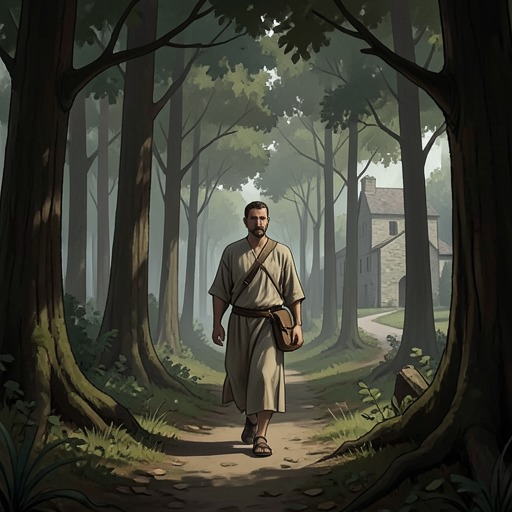
Dion Pugil’s death and Josephus’s succession
The Glass Bead GameDion Pugil’s death and Josephus’s succession are shaped not by a sudden crisis but by a gradual, shared preparation for the end. As Dion becomes less able to stand and serve visitors, he repeatedly identifies Josephus Famulus as his successor. He then chooses the place of his own burial, has Josephus help dig the grave, and asks him to plant a palm there. When Dion dies, Josephus buries him and carries out that request, living long enough to see the tree bear fruit. The ending makes succession a bond of spiritual kinship and practical care, embodied in a grave and a living tree.
Declining Strength and the Naming of a Successor
Several years pass after the earlier events in their life together. Dion is increasingly subject to spells of weakness: on some mornings Josephus must help him stand, including after prayer, and on some days Dion spends the hours staring into space. His capacity to hear confessions also becomes intermittent. The change is measured through repeated acts of assistance rather than a single declaration: Josephus helps Dion rise, serves as his substitute when needed, and remains beside him as his teacher’s physical powers diminish.
During these periods Dion sometimes asks Josephus to tell visitors that he is his successor. Josephus demurs, but Dion answers his reluctance with a penetrating look. The succession is therefore announced before it is made official by any final ceremony. Dion’s insistence gives Josephus a future responsibility while the older man is still present, and tests whether he can accept a role that the narrative has already begun to place upon him.
Preparing the Grave
One day, when Dion can stand without assistance and appears stronger, he leads Josephus to a place at the edge of their small garden and tells him that this is where he will be buried. He asks Josephus to bring a spade so they can dig the grave together, adding that there is still a little time. The choice of site and the invitation to work on the grave make the prospect of death part of their ordinary life together rather than a subject kept at a distance.
After that, Josephus digs a little in the early morning each day. When Dion feels able, he too manages a few spadefuls, with difficulty but in a persistently cheerful mood. The work becomes a recurring act of companionship: Dion’s awareness of his approaching death does not interrupt their daily routine so much as give it a shared purpose. From the time the digging begins, his good humor continues through the day.
Dion connects the burial place to what will live after him. He asks Josephus to plant a palm on his grave and imagines that Josephus, or someone who comes after him, may eat its fruit. He reflects that too few trees have been planted in his life, and tells Josephus that he is leaving both a tree and a son. The comparison gives their relationship its final form: Josephus is not Dion’s biological child, but Dion names him as a son and joins that kinship to the tree’s future growth.
Death and Burial
Dion’s manner in these final days contrasts with his earlier weakness. He is calmer and more cheerful than Josephus has known him, and he speaks of death as release from the body and from a burden borne for a long time. He says that since they began digging the grave he has been happier and more content than he had been in many years. This is not presented as a denial of death: Dion has chosen its place and prepared Josephus for it. Rather, his serenity grows alongside that practical preparation.
The following day Dion does not come to morning prayer or call for Josephus. When Josephus, alarmed, looks into his hut, he finds that Dion has died in his sleep. His face bears a radiant, childlike smile. The quietness of the death answers the earlier work of preparation: the grave has already been dug, the successor named, and the task that remains is one Josephus can perform.
Josephus buries Dion and plants the palm on the grave as requested. He lives to see the tree bear its first fruit. That detail completes the promise Dion had placed in their work: a future generation may receive nourishment from what is planted beside the grave. Josephus’s succession is thus shown through both his continuing religious responsibility and his faithful completion of a personal charge.
A Legacy of Care and Continuity
The episode joins authority to service rather than treating succession as a title alone. Dion’s repeated naming of Josephus establishes who is to follow him, but the grave and palm give the transfer its intimate substance. Josephus has to assist Dion in his weakness, share the labor of preparing the grave, bury him, and preserve the future he imagined. The successor inherits an obligation enacted in care as much as an office.
The palm also makes the ending’s account of continuity concrete. Dion will not remain alive in the ordinary sense, but the tree he asks Josephus to plant survives him and eventually bears fruit. That outcome does not erase death; it places death within a chain of responsibility extending beyond the person who dies. Josephus’s survival to see the first fruit marks the completion of Dion’s request while leaving the tree’s later future open to others.
The transition also recalls Josephus’s earlier spiritual despair and flight from his former life. He had come seeking Dion after being overwhelmed by thoughts of self-destruction; Dion’s guidance helped him return himself to God’s care. At the end of their relationship, Josephus is no longer the distressed visitor asking for direction but the named successor entrusted with Dion’s burial and future work. The parallel gives the succession its emotional weight: the man who once needed Dion’s help becomes the person who carries Dion’s instruction forward.