Glass Bead Game Commissions
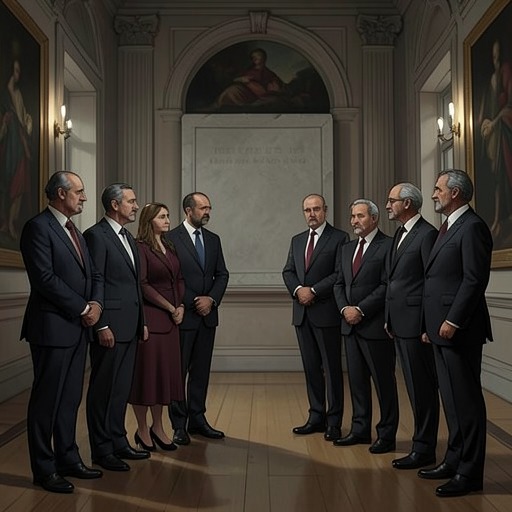
The Glass Bead GameThe Glass Bead Game Commissions are the national governing bodies that turn a learned symbolic practice into a regulated cultural institution. Under their Ludi Magisters, they supervise public Games, players, and schools; collectively, through the World Commission of the Magisters, they control changes to the Game’s rules and vocabulary. Their archives preserve accepted symbols and interpretations, making the Commissions both custodians of a shared intellectual language and authorities over its future development.
Institutional Formation and Structure
The Glass Bead Game began as a private exercise, played alone, in pairs, or among groups. Before its institutionalization, especially brilliant and well-composed Games might be written down and circulated between cities and countries for admiration or criticism. With the establishment of public matches and a national head of the Game, the practice acquired an official structure: France and England organized it first, and other countries followed. Each formed a Game Commission and appointed a supreme head, the Ludi Magister.
The Commissions operate under their national Magisters, who personally direct official matches and supervise the players and schools of the Game. The heads, like other high cultural functionaries, remain anonymous to the public; only a few intimates know their names. Official communications media, including radio, are made available for the great matches presided over by the Ludi Magister, so the institution’s public authority is displayed through carefully governed ceremonial occasions rather than ordinary personal publicity.
Above the national bodies stands the World Commission of the Magisters of all countries. It alone decides whether new symbols and formulas may enter the established stock, whether the rules should be modified, and whether new fields of knowledge should be brought within the Game’s scope. The national Commissions together form an academy responsible for the vocabulary, development, and purity of what is described as a world language for thoughtful people.
Regulation and the Game’s Symbolic Language
The Commissions govern a language whose rules and grammar draw especially on mathematics and music, while enabling players to express relations among nearly all scholarly disciplines. Its symbols do not merely label isolated subjects: they permit ideas, formulas, and cultural works to be placed in structured relation. A player may begin with an astronomical configuration, a theme from a Bach fugue, or a sentence from Leibniz or the Upanishads, then develop it through parallels and allusions to related concepts. The Game’s capacity lies in the possible combinations within its established framework, and two games using similar themes may still take entirely different courses according to the players’ minds, characters, moods, and skill.
That flexibility is balanced by strict institutional control. The manuals, pedals, and stops of the Game’s vast organ-like system are treated as fixed; attempts to alter their number or order are no longer practically feasible, and any addition of new content is subject to stringent oversight. In the current era described, additions or modifications are rare. The World Commission’s authority therefore protects a common symbolic grammar while limiting unilateral expansion: individual players may elaborate freely within the system, but they cannot redefine its shared language on their own.
Each national Commission maintains an Archive of the Game, a register of symbols and decipherments that have been examined and accepted. By the time of the account, the archive holdings far exceed the number of ancient Chinese ideographs. The archive is not simply a record of play; it embodies institutional recognition, distinguishing material admitted into the common canon from private or unapproved invention. The Commissions thus regulate not only how the Game is played, but also which new meanings can become publicly legible within it.
Public Matches, Training, and Cultural Authority
Official matches elevate the Game into cultural festivals. Some last for days or weeks, with invited listeners and a wider international audience following closely. During these ceremonies, players and guests submit to disciplined conditions, including rules governing how long they may sleep. The public spectacle rests on intensive preparation and self-restraint, giving the matches an ascetic character rather than the quality of a merely aesthetic display.
A passing final examination at an academy, especially an elite school, is generally considered sufficient qualification to play, though outstanding ability in a major scholarly field or in music is also tacitly expected. Ambition to join a Commission or become Ludi Magister is common among fifteen-year-old elite pupils, but only a small minority still seriously pursue such service by the time they reach doctoral study. Devoted players continue to study the Game’s lore and practice meditation; at the great matches they form the reverent inner circle that sustains the ceremonies’ seriousness. For them, the Ludi Magister appears almost as a prince or high priest.
The Commissions’ place within Castalian education links game governance to a larger system of intellectual service. The Order and academic hierarchy recruit from the elite pupils, and the Ludi Magister directs the Glass Bead Game within that structure. The Commissions’ supervision of schools and players therefore reaches beyond the administration of tournaments: it shapes the training and institutional continuity through which qualified practitioners enter the Game’s community.
Meaning and Limits of Institutional Stewardship
At the height of its prestige, the Game is understood as a disciplined pursuit of synthesis and perfection. Players develop themes in forms compared to a Bach fugue or concerto movement, and some schools seek to set opposed ideas—such as law and freedom, or individual and community—on equal terms before working toward a synthesis. Discordant, negative, or skeptical conclusions are generally unpopular and sometimes forbidden. The Commissions’ preservation of rules and approved symbols supports a practice whose ideal is not simply clever combination, but the movement from multiplicity toward unity and from Becoming toward Being.
The institutional reach of the Commissions also marks a boundary between collective communication and private experience. In a remembered account, Joseph Knecht describes how the scent of an elder twig and the opening chords of Schubert’s spring song became inseparably joined for him. He could explain the association, but could not make it a universally valid symbol for another person. The Game, by contrast, depends on conventions and training that allow symbols to be recognized and used across a community. The contrast clarifies what the Commissions preserve: not every personally meaningful association, but a shared language whose signs can be interpreted through common rules.
Their achievement is consequently double-edged. They enable the Game to communicate across disciplines and countries, and they guard its accumulated vocabulary against arbitrary alteration. Yet the same authority that secures continuity also determines what may be added to the canon and how the system may change. The Commissions stand at the point where intellectual freedom within a game meets institutional limits on the language of the game itself.