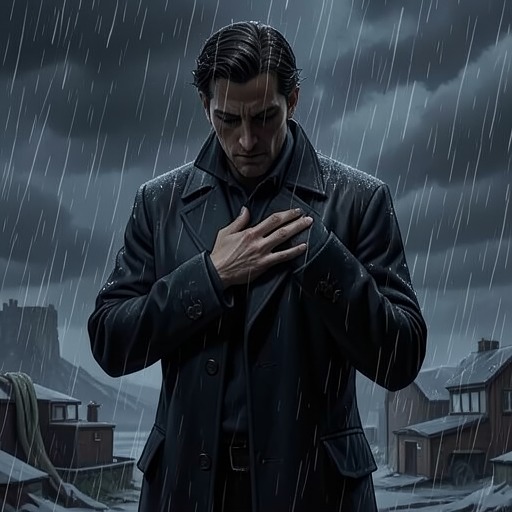
Govinda’s invasion and the death of Prince Ravana
The Glass Bead GameGovinda’s invasion and the death of Prince Ravana bring Dasa’s imagined life as a ruler and father to a violent end. The attack turns a failing effort to preserve peace into the loss of his capital, his family, and his freedom; its aftermath then reveals that the life Dasa has been living was a vision, and returns him to the forest and the question of Maya.
Causes and Background
Dasa’s conflict with Govinda has been worsening despite his attempts to prevent war. Govinda’s incursions and challenges grow more frequent, while Dasa’s efforts to secure an alliance with the powerful Rajah of Gaipali come to nothing. The Rajah is favorably disposed toward Dasa but, as Govinda’s kinsman, politely refuses to join him. Dasa sees no remaining path to a peaceful settlement and begins to long for the inevitable calamity to arrive quickly rather than prolong uncertainty.
He nevertheless makes another visit to the Rajah of Gaipali and continues to urge moderation and patience in his council. His words no longer carry hope. The council debates whether the next enemy raid should prompt an invasion of Govinda’s territory or whether Dasa should wait for a larger attack, allowing the people and neutral observers to see who had violated the peace. As the argument continues, Dasa improves his armaments. The invasion will make that deliberation moot.
The Invasion and the Fall of the Capital
Govinda’s forces first stage a major raid that draws Dasa, the cavalry captain, and his best troops toward the frontier. While Dasa is away, Govinda sends his main force into the country. The attackers storm the gates of Dasa’s capital and besiege the palace, where Pravati and their son Ravana are trapped amid the fighting in the city streets.
When Dasa learns what has happened, he turns back at once. His concern is no longer the cautious calculation that had shaped his efforts to preserve peace: he rushes home, driven by fear for his wife and son. He finds the battle moving through the streets, fights his way to the palace, and attacks the enemy there. By twilight he has collapsed, exhausted and wounded. The battle is lost, and the capital and palace have fallen into Govinda’s hands.
Ravana’s Death and Dasa’s Captivity
Dasa regains consciousness as a prisoner and is taken before Govinda. Govinda leads him into another room of the palace, the room with carved and gilded walls where Dasa had kept his scrolls. There Pravati sits under guard, staring down at Ravana’s dead body across her knees. Her stillness and altered appearance convey the shock of the loss; she does not turn toward Dasa, and he initially takes in the scene without speaking to her.
Dasa kneels beside his dead son and mourns both Ravana and Pravati, who remains mute. The moment joins defeat in war to the destruction of the family that had made Dasa’s life meaningful. His captors soon order him to stand and lead him away. Neither he nor Pravati has spoken to the other. Their separation is thus not resolved by a farewell or an explanation: the scene ends with Dasa removed from the palace while his wife remains beside their child.
Bound and carried by wagon to a dungeon in Govinda’s capital, Dasa is left alone with a shoulder wound and a jug of water on the stone floor. He wants death to end the anguish and believes that refusing water might hasten it, but he cannot bring himself to drink or to carry that intention through. Weakness overtakes him, and he falls asleep. The conquered ruler’s immediate aftermath is not a plan of escape but a collapse into exhaustion and grief.
Awakening and the Meaning of the Episode
When Dasa returns hazily to consciousness, he finds that he is no longer surrounded by dungeon walls. He is standing in a forest with a water-filled gourd in both hands. The sight of the forest and spring restores the earlier setting: beyond the ferns stands the hut of the yogi, who had sent him to fetch water and whom Dasa had asked to teach him about Maya.
The transition makes the palace disaster part of the lesson Dasa had sought. The loss of Pravati and Ravana, his defeat by Govinda, and his imprisonment have felt like an entire life, but his awakening returns him to the moment before the yogi’s teaching. The gourd links the two experiences: in the dungeon Dasa had reached for water and found himself in a reality that no longer held; in the forest he is again carrying the water he was sent to fetch. The invasion therefore functions both as a family tragedy within Dasa’s vision and as the turning point that brings him back to the question of illusion.