Hierarchical assignment principle
The Glass Bead GameThe Hierarchical assignment principle is Castalia’s method for turning exceptional pupils into servants of its intellectual institutions. Teachers identify and recommend candidates rather than selecting them through examinations; the Order and its hierarchy then direct members toward roles thought to fit their talents. The system contrasts Castalia’s freedom to pursue independent study with the restrictions of professional life outside the Province, while imposing its own lasting obligations. Its ideal is not freedom from assignment but freedom through service—and, at the highest levels, a growing burden of responsibility.
Selection and Education
Castalia’s elite schools sit alongside the ordinary schools that prepare most students for professions and university study. Their purpose is different: to recruit generations for the Order and for important positions in secondary education and universities. A Council of Studies, with ten representatives from the Board of Educators and ten from the Order, oversees the wider system and draws candidates from across the country. The elite schools are thus a selective channel into Castalia’s governing and educational life, not simply advanced schools for high achievers.
Admission depends on judgment, recommendation, vocation, and consent, not an entrance examination. A teacher may approach an eleven- or twelve-year-old and ask whether he would like to enter a Castalian school. The boy is given time to decide, and admission on probation requires the unqualified consent of both parents. If an elite pupil fails a course, he returns to the ordinary schools. This process presents selection as a response to individual gifts rather than a contest in which pupils claim a place for themselves, though the authorities retain the power to assess and direct those gifts.
Elite pupils do not train for a livelihood of their own choosing. As they advance, those with particular aptitudes for languages, philosophy, mathematics, or other subjects are transferred to courses suited to their abilities. Most eventually become teachers in public schools or universities; others enter the Order’s offices, including its senior posts and the direction of the Glass Bead Game. The system distributes people across educational and intellectual work, treating personal capacity and institutional need as complementary grounds for placement.
The distinction between Castalian and non-Castalian life persists after schooling. Graduates generally complete their last courses between twenty-two and twenty-five and are then admitted to the Order. They gain access to its libraries, archives, laboratories, teachers, and facilities for the Glass Bead Game. Some become subject teachers outside Castalia but remain members of the Order for life. Unless they resign, they cannot become professionals such as doctors, lawyers, or engineers, and they remain bound by the Order’s rules of poverty and bachelorhood. The public calls these scholars, with a mixture of respect and mockery, mandarins.
A small number of the most gifted pupils are allowed to pursue free study for as long as they wish. Some research, collect, advise libraries or archives, or devote themselves to scholarship without a practical application. That latitude has limits: a person may continue such work so long as his conduct does not degenerate. Castalia’s freedom is therefore substantial as a mode of study but conditional on continued membership in its disciplined community.
Assignment as Freedom and Obligation
When Joseph Knecht asks why people outside Castalia call certain careers “free professions,” the Music Master explains that the label is ironic from the Castalian point of view. Outside the Province, a student may appear to choose a profession, though family influence may already constrain that choice. University study then follows a rigid curriculum and examinations; licensed professionals may pursue their careers, but their prospects depend on money, ambition, reputation, public approval, and competition among social groups. The apparent freedom of career brings dependence on forces that Castalia believes can enslave the individual.
An elite pupil, by contrast, does not claim to be a better judge of his own abilities than his teachers. He accepts the place his superiors choose—or is directed by the qualities, gifts, and faults that make one role more fitting than another. This submission is presented not as the end of freedom but as its precondition: once independent study begins, the pupil may pursue even obscure or seemingly foolish subjects without the narrow professional curriculum imposed on university students. Castalian freedom lies in the work one can undertake after giving up the right to select a career for oneself.
The principle’s account of vocation joins aptitude to service. The natural teacher becomes a teacher, the natural educator an educator, and the natural translator a translator; each is said to find the place where he can serve and, in serving, be free. Membership also releases the individual from the pursuit of income, fame, rank, political allegiance, and professional success. The ideal dissolves the distinction between private person and public office, but it does so by making the member’s life answer to a hierarchy rather than to personal choice.
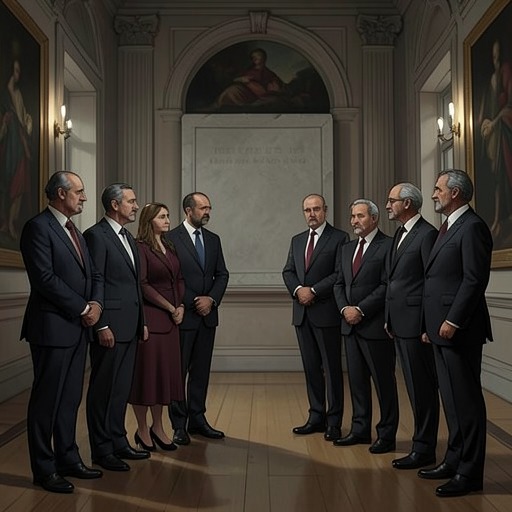
This bargain is explicit in the Music Master’s advice to Knecht. Castalia is not merely an elite but a hierarchy, he says, in which each “brick derives its meaning only from its place in the whole.” No path leads outside that whole, and climbing higher does not bring increased freedom: it brings greater responsibilities. The image makes the system’s cost visible. A member acquires meaning through participation in the collective structure, but cannot treat advancement as personal emancipation from it.
Knecht’s Place in the Hierarchy
Knecht encounters this principle as a personal question when his schooldays at Eschholz end and he is to be transferred to a higher school. At the graduation ceremony, after the principal has described the path toward admission to the Order, he asks the Music Master about professional freedom and Castalia’s exclusion from ordinary careers. The Master’s answer gives Knecht an early account of the social order he is entering: Castalian life relinquishes the freedom to choose one’s livelihood in exchange for a different freedom, grounded in study and assigned work.
The Master’s lesson is both institutional explanation and warning about Knecht’s future. His name seems to make the word “free” especially alluring, but the advice does not promise him independence from authority. Instead, it asks him to understand that a member’s gifts may determine his placement as much as a superior’s decision does, and that the result must be received as service. The distinction between personal inclination and institutional assignment remains present even when the system describes the two as naturally aligned.
Knecht later teaches Castalia’s history and the Glass Bead Game to Father Jacobus while receiving lessons from him in historical scholarship. The exchange unsettles the neat assurance that Castalian education can explain itself from within. Preparing his account, Knecht consults histories and official materials that he had not studied as a pupil and discovers that his own understanding of the origins of the Order is pale and schematic. Jacobus helps him place Castalia in the wider history of nations. The encounter shows that specialized formation within the hierarchy can leave gaps in historical understanding, and that intellectual service sometimes requires learning beyond the inherited account of one’s own institution.
The assignment principle is also tested by family privilege. During Knecht’s visits to the Designori household, Tito’s mother explains that her son was gifted but difficult to handle and that she would not have wanted to impose her own ideas on him. She and her husband had not claimed the old Designori family privilege of seeking a Castalian education for him, having broken with Plinio’s father and the family tradition. Her eventual confession that she could not bear to part with her child sharpens the difference between formal selection and a family’s capacity to consent to a child’s departure. The procedure formally requires parental agreement; the cost of that decision is intimate, not merely administrative.
Authority, Service, and Institutional Limits
The system’s promised freedom is inseparable from permanent discipline. Graduates who remain in the Order accept poverty and bachelorhood and cannot simply turn their education into a private professional career. Even those placed outside Castalia as teachers remain subject to the Order’s rules. The arrangement secures a body of trained scholars for public education and the Province’s institutions, but it also separates them from the ordinary social and economic paths available to other people.
Knecht’s argument to the Board of Educators exposes another limit: Castalia’s intellectual vocation depends on institutions and resources beyond its own hierarchy. In his memorandum, he identifies the Glass Bead Game as the Province’s distinctive creation, the most precious and also the most fragile part of its intellectual life. If the country faced a crisis, he warns, the schools could be contracted, libraries and collections deprived of support, and material provisions cut; other disciplines would still be valued for their practical uses, while the Game could be dismissed as dispensable. His analysis places the principle of assignment within a broader dependence: service may organize Castalia internally, but it cannot guarantee that the outside world will continue to support its work.
The Hierarchical assignment principle consequently offers neither ordinary career choice nor unqualified liberty. It promises that people may find fitting work without competing for wealth and status, and that intellectual study can flourish outside a narrow vocational curriculum. In return, it requires obedience to placement, lifelong institutional affiliation, and acceptance of duties that increase with rank. Its ideal is a community in which each member serves according to his gifts; its unresolved question is whether that service remains free when the institution, rather than the individual, defines where those gifts belong.