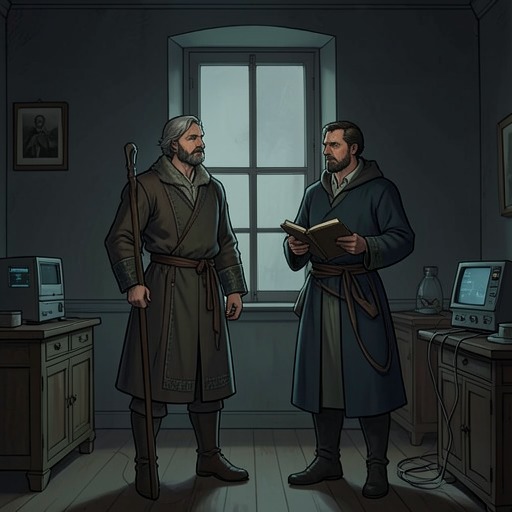
Joseph Knecht and the Music Master
The Glass Bead GameJoseph Knecht and the Music Master share a formative relationship in which musical instruction becomes spiritual guidance and personal trust becomes preparation for service. The Master first reveals to Knecht how music can make order and freedom audible; later, when the young man is unsettled by Plinio Designori’s challenge to Castalia, he offers frank counsel rather than easy reassurance. Their bond culminates in Knecht’s admission to the Order, conducted by a mentor who is himself about to leave office. The succession is intimate as well as institutional: the student enters the hierarchy just as the teacher lays down its responsibilities.
First encounter through music
The relationship begins in a practice room, where the boy Knecht is so awed by the old Master that he cannot answer when asked to play something from memory. The Master does not press him. Instead, he sounds the first notes of a melody, and Knecht nods and joins in with an old school song. After hearing it once more, the Master adds a second voice, letting a familiar tune become a small act of shared musical understanding.
The lesson deepens when the Master proposes making a fugue from the song. He extracts a short phrase as its theme, presents successive entries at changing intervals, and carries the development through contrasting modulations before bringing it to a close. Knecht watches the player’s white fingers and concentrated expression as much as he listens. In the music, he senses a world in which law and freedom, service and rule, can coexist. His response is not merely admiration for a skillful teacher: he feels love and reverence, and vows inwardly to serve the world of Mind that the performance has disclosed to him. The scene establishes the relationship’s governing pattern: instruction is precise and practical, but its consequence is a change in how Knecht apprehends his own life.
Mentorship under pressure
As Knecht advances at Waldzell, his devotion to music becomes concrete work. By his second or third year he can read and play notation, clefs, abbreviations, and figured bass from many centuries and styles with reasonable fluency. He learns music through its physical and technical particulars, not only through the abstractions that the Glass Bead Game extracts from it. That attention to sound helps explain why he postpones the Game’s introductory course: for him, musical knowledge must include the sensory qualities through which styles become intelligible.
The Master’s guidance is not simply indulgent encouragement. When Knecht writes in distress about Plinio Designori’s attacks on Castalia, he admits that the criticism troubles him because part of it answers to a voice within himself. Plinio challenges the Castalians’ separation from ordinary material necessity, their dependence on the work of people outside their privileged intellectual world, and their reluctance to create new music or poetry. Knecht cannot dismiss these claims, yet fears that accepting Plinio’s position would amount to disloyalty to the only home he knows. He turns to the Music Master because he cannot bring the problem candidly to Headmaster Zbinden after their earlier clash.
The Master responds in person, examining both Knecht’s grades and his private studies. He judges the latter too one-sided and agrees that Zbinden had been right to object. He directs Knecht to speak with the headmaster and to engage Plinio openly, without teacherly supervision, while defending Castalia and raising the disagreement to its highest level. The result is a clearer, more relaxed relationship between Knecht and Zbinden, as well as the famous disputations between the two boys. The Master’s support therefore does not shield Knecht from conflict: it gives him a demanding form in which to meet it.
Confession and restored balance
During a later visit, the Master recognizes that Knecht is exhausted and struggling to keep his balance. A few probing questions meet with moroseness, so he changes his approach. Under the pretext of explaining a musicological discovery, he takes Knecht to a practice room, has him bring in and tune a clavichord, and draws him into a long lesson on the origin of sonata form. Once Knecht has relaxed enough to listen, the Master plays a Gabrieli sonata and tells him of a crisis from his own years of free study.
The Master had once become so absorbed in ambitious musical and historical research that he began to doubt the value of intellectual work and to envy people living more immediate lives. He then recounts how a Yogi identified the neglected cause of his exhaustion: he had stopped meditating and had failed to recognize the consequences of that omission. Returning to meditation required him to begin again with elementary exercises and patiently relearn how to compose himself. The confession makes the mentor fallible without diminishing his authority. Knecht sees that even a Master can go astray, neglect a rule, and recover; the example helps him understand the risk he himself is running and return to meditation with renewed seriousness.
The episode also clarifies the Master’s teaching about discipline. The harder a task presses on a person, he explains, the more necessary meditation becomes as a renewing source of energy and inner concord; intense work can make that very source easy to neglect. His authority rests not on an image of unbroken perfection but on having experienced the failure he warns against. For Knecht, the disclosure is an act of confidence: he is grateful that the revered teacher has entrusted him with a piece of his private past, and the friendship grows more human without losing its spiritual gravity.
Music, form, and the Game
Their relationship takes shape within a culture that treats music as both an art of the senses and a model for intellectual order. The Glass Bead Game draws on music and mathematics to establish relations among fields of knowledge, and its themes may be developed through variation and combination like those of a fugue or concerto movement. Yet the Game’s capacity to abstract relationships does not, in the Master’s teaching, make it a substitute for music itself. Knecht’s own insistence that musicians must know sound through hands, fingers, mouths, and lungs gives practical weight to that distinction: intellectual pattern and embodied musical experience are related, but they are not interchangeable.
This understanding also gives the Master’s teaching a wider ethical register. Knecht describes classical music as a gesture of courage, serene piety, and affirmation in the face of human tragedy; the same note, he says, should be present in the Glass Bead Games and in people’s lives and sufferings. The Master’s influence appears in the way Knecht learns to hold formal order together with lived experience: the student is trained not merely to analyze a structure but to hear what its sounds and discipline make possible. The relationship thus joins musical craft, meditation, and the responsibility to serve without reducing one to another.
Admission and departure
The bond reaches a decisive institutional threshold after Knecht’s examination. The Magister Ludi recommends that he seek admission to the Order, and Knecht discovers that he has already been placed on the list of nominees. He asks for the Music Master to perform the ceremony, obtains leave, and travels to Monteport. The Master is ailing, but welcomes him gladly; he tells Knecht that he has arrived just in time, since the Master is about to resign and will soon lose the authority to admit a younger brother.
The initiation takes place in the Master’s music cell, the same room in which Knecht first encountered meditation. The Master has assigned him a passage from the Order’s rules to contemplate: advancement in office means tighter bondage and stricter service, not greater personal freedom. Before the witnesses, Knecht plays a Bach chorale prelude; one brother reads the abbreviated rules, and the Master asks the ritual questions and receives his oath. Afterwards they sit together in the garden, where the teacher advises him on identifying himself with the rules and living by them.
At their parting, the Master tells Knecht that it is fitting for him to step into the breach as the Master departs, as if he had a son who would stand in his place. He urges Knecht not to be downcast: he is tired, looks forward to leisure, and hopes they will meet often. He also asks Knecht to use the familiar form of address from then on, something he could not offer while he held office. The gesture marks a change in their relationship without dissolving its hierarchy: affection can now be spoken more plainly because the Master is laying down his formal authority.
Knecht returns to Waldzell with only three days’ leave. The Magister Ludi congratulates him on admission to the Order and observes that only an assignment within its organization remains before they are complete colleagues. Knecht is taken aback by the prospect that his freedom as a student is ending. The scene closes the first phase of his life under the Music Master’s guidance: he leaves their private bond carrying the Master’s lesson that higher office means heavier service, just as the teacher relinquishes the post that gave him the power to receive his pupil into the Order.